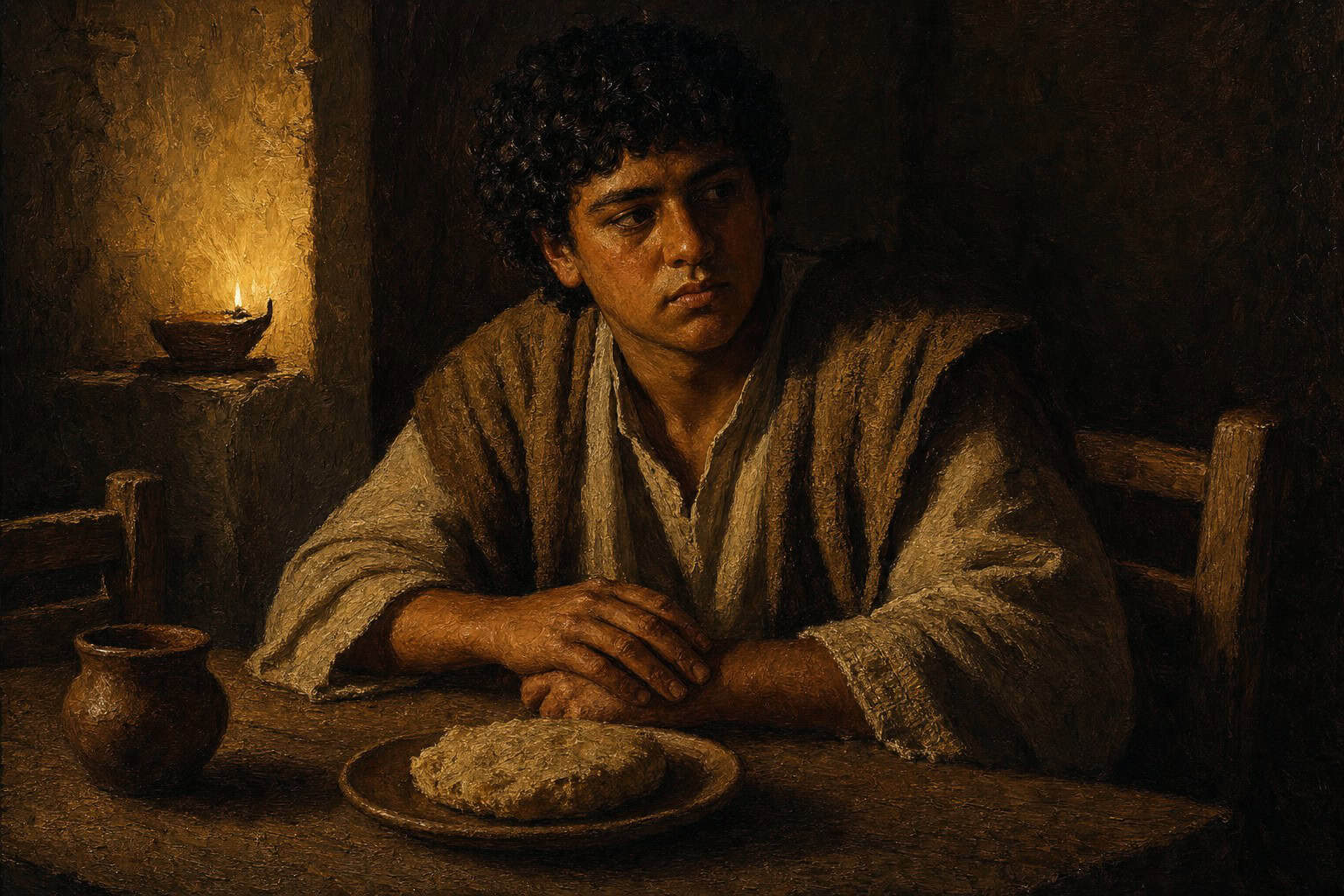
The pain I hide comes out sideways—shown, not felt. A reflection on wounds we display to control instead of confess, from Fractions of the Soul.
The Breadcrumbs Dropped on the Table Between Us
I have spent my life mistaking exposure for honesty. In the fifth chapter of Fractions of the Soul, a man sits across from a woman and begins the slow trade of secrets—childhood stories, the shape of an old loss, the day he learned he did not fit anywhere. It looks like intimacy. It sounds like the thing two people do when they finally stop hiding from each other. But I know that room too well, because I built rooms exactly like it, over and over, for years. I know how a story about a hurt can be laid on the table like bread, not to be shared, but to be counted. The narrator watches her the way a man watches weather—reading what she gives, weighing what he holds back. He names her breadcrumbs of affection, her small tests, her guarded ways of saying yes without ever being caught saying it out loud. He calls it plausible deniability, this careful withholding, this feeding of one who wants closeness and starving of one who does not. And all the while he is doing the very same thing, only he calls his own version reason and logic, and hers instinct and feeling. That is the first lie the scene taught me about myself. The pain I hid never stayed hidden. It came out anyway, dressed up, angled, offered at the precise moment it would do the most work. I did not confess my wounds. I deployed them. There is a wide difference between a man who bleeds in front of you and a man who shows you a scar he has already polished to a shine. The polished one asks for nothing and controls everything. He tells you the worst thing that ever happened to him and watches your face soften, and in that softening he finds the opening he was hunting for the whole time. I called this closeness for years. I called it being open, being brave, being unafraid of the dark parts. But openness that keeps score is not openness at all; it is a longer, quieter, more patient form of hiding. The body knows the difference even when the mind refuses to. My hands were steady when I told those stories. My voice did not break. A man who is truly bleeding cannot keep his voice from breaking; the wound speaks through the throat whether he wills it or not. And so the very steadiness that felt to me like strength was the proof of the fraud all along. I was showing the wound so that I would never have to feel it in front of someone who might have loved me enough to hold it. I misread that steadiness as maturity. It was only distance from myself.
Laying the Mind Naked Without Ever Undressing the Heart
What the passage calls vulnerability, I have to name more carefully now, with older and warier eyes. The woman in it learns to lay her mind bare, unembarrassed, trusting the respect and adoration she believes she can see in the man across from her. She hands over the raw parts—the loss, the loneliness, the parent who was not there, the years of not fitting anywhere. And the narrator receives all of it, ponders it alone and with her, turns it over in his hands and calls it adoration, and perhaps in some hour it truly was. I want to defend him, because I am him, and part of me still believes the tenderness was real and not only a technique. That is the thing I cannot settle, even now. A man can genuinely love the moment a woman trusts him and still be using that very trust to steer her. Both things live inside the same breath, and I cannot pull them apart cleanly. The scene lets me feel how much a person longs to be seen all the way down, how the body itself aches toward that kind of union—not the touch first, but the being known, which the touch was only ever meant to seal and confirm. Desire is not mainly a hunger for flesh. It is a hunger to be received without editing, without arranging, without the small betrayals of self-presentation. And that is exactly the hunger a hidden man learns to weaponize, because he understands it perfectly from the inside; he has felt it and he has starved it. He offers her the feeling of being received. He gives her room to be naked in her mind, accommodating her, welcoming her interpretations, never embarrassing her. And he never once undresses his own heart in return. He undresses his story, which is not the same thing at all. A story is something you have already survived and arranged into order. A heart is the thing still trembling that you cannot arrange, that shakes in your hands while you speak. I gave women my survived material and kept the trembling thing locked in another room entirely. I let them believe the exchange was equal because the sheer volume of my disclosure ran so high. Look how much I have told you. But quantity is a magician’s misdirection, a flash of the free hand while the other hand hides the coin. The one wound I would not name—the fear that I was hollow, that I could take love in endlessly and never give it back—that one I buried carefully beneath all the others I performed so well. And here is what unsettles me most: the women were not fooled the way I told myself they were. Some of them felt the withholding. They felt the polished surface where a raw place should have been, and their fingers found no purchase there. They stayed anyway, for a while, because even incomplete recognition is warm. And I let their staying tell me my fraud had worked.
The Steady Hand That Proves the Fraud
The turn came, when it finally came, not in any confrontation but in a silence. I remember sitting once after one of those long confessional nights, alone in the emptied room, and feeling nothing at all where the feeling should have risen. I had just told a woman the worst of my childhood, laid it out with practiced care. She had wept. And I had watched her weep with the calm, absorbed attention of a man reading a map by lamplight. When she gathered her things and left, I waited for the ache to catch up with me the way it does with people who feel their own words. It did not come. That absence was the whole revelation, and it arrived quietly, like a draft under a door. A man who has truly opened a wound cannot close it again on command, cannot walk his guest out and feel level and clean, cannot file the night away as progress made. The steadiness I had prized my entire life was the evidence standing against me. I had turned my pain into a tool so completely, worn the groove so deep, that I could no longer locate the pain beneath the tool. It had become a technique. And a technique feels nothing; it only performs. This is the thing the search leads to, the thing I most needed to hear and least wanted to.
A wound you display is a wound you have not yet dared to feel.
The pain you hide does not vanish when you display it. It vanishes from you. You lose access to your own wound by using it against loneliness. You grow fluent in the language of your grief and deaf to the grief itself, like a man who recites a prayer so often the words go smooth and empty in his mouth. I had wanted, more than anything, to be seen, and I had made certain no one ever could, because I only ever showed the arranged version, and the arranged version is not me. It is a portrait I painted of a man who once suffered. God was in that emptied room too, though I did not know it then and would not have believed it. Not to rescue me from the hollowness—He did not lift it, did not fill it, did not speak. He simply sat inside it with me, quiet, present in the very place where I had done my worst and most careful hiding. I felt no comfort, no warmth, no lifting of the numbness. I felt only that I was not, somehow, entirely alone in the deadness, that something patient shared the dark with me. That was the whole of the mercy that night: not the removal of the numbness, but a nearness within it that refused to leave. The scene in the book does not resolve, and neither did I. But something in me had been named. And a thing named can no longer fully pretend to be something else.
A wound you display is a wound you have not yet dared to feel.
What Broke in Me the Morning After the Weeping
After the naming came the harder living, which no one warns you about. Knowing that I had spent years showing wounds instead of feeling them did not teach me overnight how to feel them. The knowing and the doing sit in different rooms. That is the fallout: you catch yourself mid-performance and stop, and then you sit in the terrible plainness of having nothing arranged to offer, no polished stone to slide across the table. I had to learn to say a hard thing badly. To let my voice break instead of steadying it. To hand someone the trembling part and not watch their face for the effect it made. This is unbearably slow work, slower than any confession. The old habit is a groove worn deep by decades, and the body reaches for it the way a tongue reaches, again and again, for a missing tooth. I would begin to tell a real fear and feel the old machinery start up under me—the angling, the timing, the quiet calculation of how much to give and when to give it—and I would have to stop and begin again, clumsily, without the shine, my sentences coming out crooked and unfinished. It felt like weakness every time. Everything in me that had been trained to find security in my own strength, to measure a man by his action and his composure, recoiled from that crookedness. But I have come to think the recoil itself was the point, the place where the true work began. The thing I had called strength for so long was only fear wearing a well-cut coat. Real strength was the willingness to be worked upon, to submit to a sharpening I could not control or predict, to let another person’s honest presence grind against me until some edge in me actually changed. And I understand now why capability and depth so often isolate a man rather than draw people near. When you have made yourself impressive, unshakeable, fluent in the full history of your own suffering, you repel the very people who might have loved the trembling thing—because you never once let them near it. The women I most wanted were the ones who saw straight through the polish, and the polish was precisely what drove them away. I had built, brick by careful brick, the wall that made me lonely, and then I called the loneliness proof of my rare depth. The tenderness I still owe those women is only this: to stop reading them as tests to be passed and start hearing them as another whole consciousness, lived from the inside, longing exactly the way I was longing. She was not a puzzle to be solved. She was a person who laid her mind bare and received, in return, a performance dressed as a heart. I cannot give that back to her now. I can only refuse to do it again.
The Trembling Thing I Learned to Hand Over
Where all of this settles is not triumph. It is a plainer, smaller place than I once imagined I would arrive at. I no longer believe that showing my pain is the same as sharing it, and I no longer trust the ease with which I can tell my worst stories. When a confession comes out smooth and shapely, I have learned to distrust it, to suspect the technique working beneath the words. When it comes out broken, halting, when my hands will not hold still and my voice cracks in the middle of the sentence, I have learned to lean into that shaking rather than steady it, because the shaking is the truth arriving in real time and not the polished memory of truth performed after the fact. This is what the pain I hid finally taught me, and it is the plainest answer I can offer anyone who has typed that question into the dark: your hidden pain will out itself no matter what you do, but on your own terms it comes out as a weapon, and only on God’s terms does it come out as a prayer. The single difference is whether you can still feel it while you speak it. Feeling it costs you your control. That is the whole price, and it is not small. You cannot arrange the wound and inhabit it at the same time; the hand that arranges is not the hand that trembles. I spent decades choosing the arrangement, and it made me impressive and hollow, admired and unreachable. Now I am trying, badly and slowly, to choose the inhabiting instead, and it makes me smaller and more real, less a portrait and more a man. God has not taken the emptiness from me. He walks in it, at my side, in the low light. He was there in the room after the weeping, in the numbness that would not lift, in all the years of fraud, neither applauding my cleverness nor condemning my coldness, only near—which turned out to be the one thing I had never once permitted any living person to be to me. Fractions of the Soul hands you no method for stopping. It hands you a man who watches himself do this again and again and cannot fully stop, and it lets you feel the ache of a longing that keeps outsmarting the very thing it wants. That is where it leaves you—not cured, not tidy, but no longer able to mistake the polished wound for the real one. And that small unpretending, that refusal to keep painting the portrait, is the beginning of being able at last to be loved. My hands still steady themselves when they should break. But I know now which is the lie.