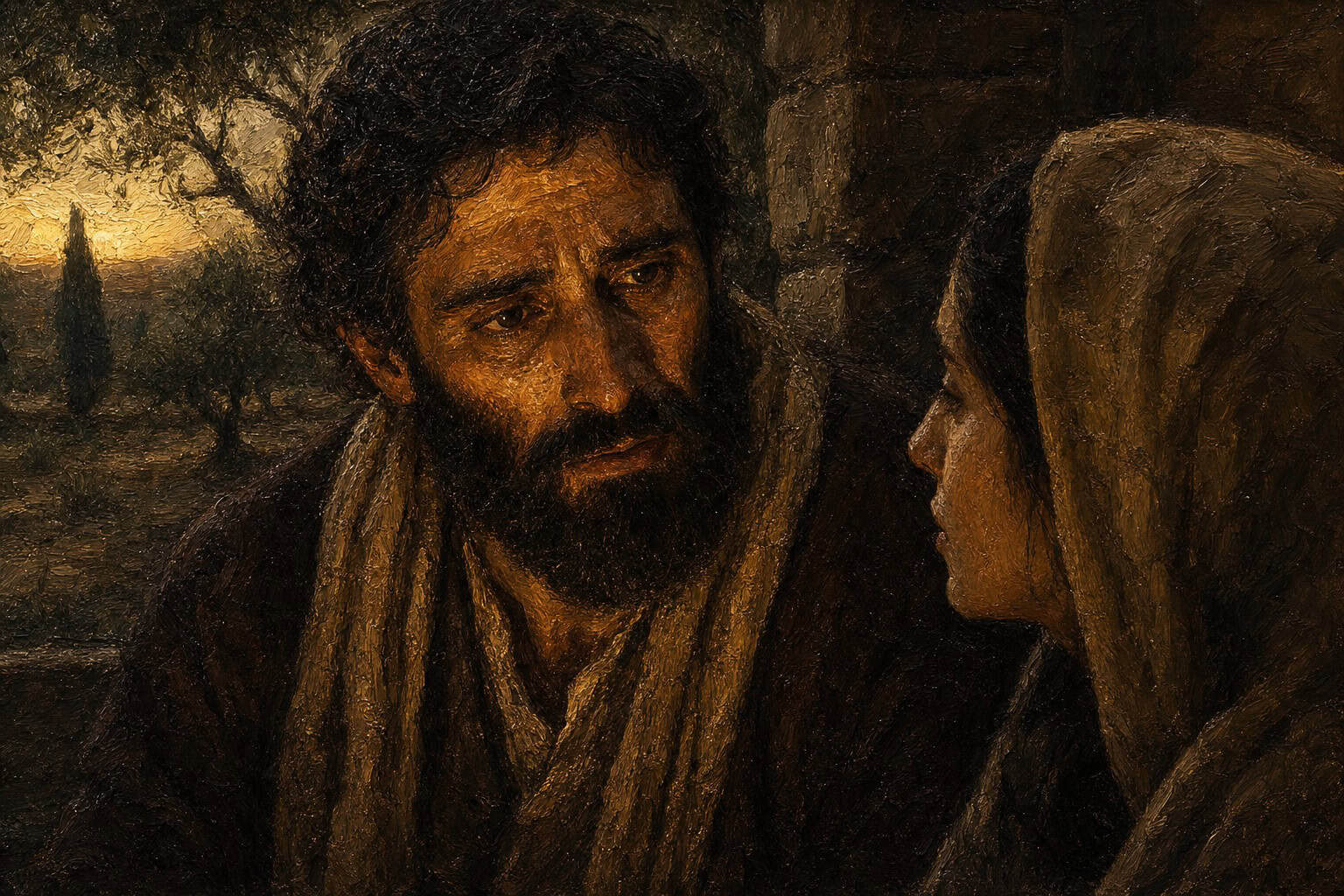
You feel younger than your years, or older. Which is true? Age counted not in the mirror but in how much of yourself you can still bear to see.
Two Strangers Waking in a Garden With No Clocks
There was a stretch of days, once, when the world had no history behind it. Two people woke into a garden and found that each of them was, at the same moment, a stranger and a mirror. I have gone back to that picture more times than I can count, because it names something I could not name in my own life for the longest time. The man looked at the woman and found parts of himself he had never met, rooms in his own house he did not know were there. She was learning her own shape slowly, the way you learn an unfamiliar room in the dark, palms against the walls, feet testing the floor. They talked. They took each other in, each in a private way, the same afternoon landing differently inside two separate skins. When I first sat with this, I was thinking about years — about how old I was against how old I felt — and I expected the question to be simple. It is not simple. The man and the woman were newly made. No birthdays behind them, no gray, no aching knees on cold mornings, no faces changing in the glass. And yet even there, before anything had gone wrong, one of them carried a loneliness the other did not. That single detail stopped my breath. Age, I began to suspect, was never really about the number of mornings a body has seen. It was about what the soul had been built to hold. The woman shared the man’s flesh but was shaped to her own spirit, so she loved in a different key than he loved, needed in a different measure than he needed. Two people in the same green place, drawing the same air, were already living at different depths. This is the thing I keep circling like a man circling a grave he is afraid to name. When we say we feel old, or young, we are not measuring time at all. We are measuring how much weight the inside is carrying, how much of the world around us we have taken in and cannot set down, how much of ourselves we can still stand to look at without turning the face away. The garden had no clocks on its walls. It still produced two different ages of the heart in one afternoon. That was my first clue that the feeling of age is not a lie the body tells. It is a truth the soul keeps, quietly, whether or not I want it kept.
The Borrowed Breath That Was Bent Before I Opened My Eyes
I used to believe my seeing was mine — fresh, clean, my own private window swung open on the world. That confidence took decades to crack, and it did not crack gently. The air moving through my lungs at this moment is not a new thing invented for me. It is the same breath first given to the first man, handed down a long line of borrowed inhalations, one chest to the next, until it reached mine. And with that breath comes an inheritance I never agreed to. I see through eyes that were already bent before I opened them. Every sensation reaching me has already passed through a stain I did not put there and cannot wipe clean. This is not a pretty figure of speech. It is closer to a plain fact I fought for most of my life. When I felt older than my years, I blamed the circumstances, the tiredness, the long list of disappointments. When I felt younger, I quietly congratulated myself on some freshness I imagined I had earned. Both moods missed the mark entirely. The point is that I have never once perceived cleanly. There is no unspoiled first morning waiting for me, no untouched first look at anything. The man and woman in the garden began in clarity and lost it. I began already inside the loss, reaching backward toward a clearness I have never held in my hands. So when someone asks whether we are as old as we feel, the honest answer folds back on itself and refuses to sit still. We feel through fallen eyes. Our sense of our own age is already colored, already smudged with fingerprints that are not ours alone. The young man who feels ancient may only be seeing his own corruption more plainly than the man beside him. The old man who feels boyish may simply be looking away from it, keeping his gaze on the middle distance. Neither of them is measuring time. Both are measuring how much of the ruin they can bear to notice at once. I think of the jealous watcher in that early scene, the one who studied the two people from a distance and read their weaknesses without ever entering their thoughts. He learned them by watching how they leaned toward each other, how they turned away, the small tells of the body. What unsettles me even now is that I do the very same thing to myself. I watch my own movements. I read my own weakness like a stranger cataloguing prey. And what I have called feeling old is often just the moment I catch my own pattern and cannot pretend I did not see it. The years do not press on the body first. They press on the watching.
An Ache Stitched Into the Man Before the Fall
Here is where the whole question turned over in my hands like a stone I had been carrying without looking at its underside. The man was made lonely on purpose. Before there was any sin, before anything went wrong, the maker wove an emptiness into him and then filled that hollow with the woman. She, drawn from his side, carried the structure of his loneliness but shaped now to her own spirit, so that she did not ache back toward him in the same way he ached toward her. I read that and felt the floor tilt under me. I had spent whole decades treating my hunger for another person as a defect, a wound needing to be closed, a childish weakness I should have outgrown by now and was ashamed I had not. And here was the claim that the ache came first — that it was built into the design, that the need for the other predated everything broken in me. My loneliness was not the proof that I had failed to become a man. It was older than any of my failures. It was as old as the first breath. That undid the age question completely. If the deepest thing in me is a longing stitched in before the fall, then I am not as old as I feel and not as young as I feel. I am as old as that first ache — which is to say, unspeakably old and never once finished. The number on any document is a rounding error set against it. And the severe part comes next; I will not soften it to make it easier to swallow. To need another the way the first man needed the woman is to risk being seen down to the floor and found wanting. That is the shame I fled all my life, the thing that made me cover my own face. I wanted to be known and I wanted to hide, in the same instant, in the same held breath. When I finally let someone see the raw middle of me, I braced for the retreat, and often the retreat came on schedule. I have watched people flinch from my honesty and choose the familiar sickness over the pain of a cure. I have done it to others just as coldly. I have chosen my known cancer over an unknown healing more times than I can bear to list.
The years you carry are not counted in the mirror but in how much of yourself you can still bear to see.
That is what feeling old truly measures. Not the skin. The seeing. And the garden holds a strange severe comfort folded inside its judgment: the ache was never my flaw. It was the maker’s own architecture, and even in the dark of it, I was not alone in the wanting.
The years you carry are not counted in the mirror but in how much of yourself you can still bear to see.
What Remained Standing When the Other One Stepped Back
After the honest word is finally spoken and the other person steps back, something is left standing in the space they emptied. I know that space too intimately. You open the center of yourself. You set down the true and undefended thing on the table between you. And instead of meeting you there, the other retreats into safety, quietly, almost politely. It is not cruelty exactly. It is fear wearing the good coat of self-protection, choosing the known illness over the sheer terror of being made well. I have stood on both sides of that stepping-back. I have been the one who fled and the one who was fled from, and neither role aged me kindly. Every retreat laid down years I could feel settling in the chest, a heaviness no night of sleep ever lifted off me. This is the part the age question never sees coming. We assume we grow old through the passing of time, one day stacked on the last. We actually grow old through love thrown away — ours discarded, or theirs, it hardly matters which. The one who pours himself into another’s becoming feels a particular helplessness when the whole investment is set out with the trash. You gave the seed. You knelt and watered it. And the ground simply refused it, closed over it, gave back nothing. The temptation after that is to withdraw, to wall yourself off, to decide that offering yourself was a young fool’s game you have at last grown too wise to play. I felt that pull often, and its voice was reasonable. Grow old. Grow guarded. Grow safe. But that kind of safety is not age at all. It is a slow burial with the eyes still open. And here is what I have come to see only late, only looking back over my shoulder: the maker never promised to lift the ache away, never promised to spare me the rejection. He wove the loneliness in and left it standing there in me, unremoved. What he offered instead was his own nearness inside it — not a rescue out of the emptied room but a companion who sat down in it. I did not always feel this. Most of the time the room stayed empty and the tears came with no comfort visible anywhere. But now and then, rarely, unmistakably, there was a presence walking with me in the very failure — not repairing it, not undoing it, just staying, the way a friend stays when there is nothing left to say. That presence did not make me younger. It did not take the weight off my chest. It did something stranger and harder to name. It made the weight bearable to look at directly. And when you can look at your own life without flinching from it, you stop lying to yourself about your age.
Reading the Only Clock That Does Not Lie
So I have stopped trusting the mirror to tell me how old I am. The mirror lies in both directions at once. It flatters me on a good morning and condemns me on a bad one, and neither report so much as brushes the real measure. The real measure is depth. How far down can I still go without turning my face away from myself. How much of my own pattern can I watch without pretending it belongs to some other man. How much of the ache set into me before the fall can I honor instead of shaming into silence. By that reckoning I am at once very old and strangely unfinished, because the longing that drives me is the oldest thing about me and the least complete. The first man carried it into a garden with no clocks on any wall. I carry it into rooms crowded with clocks that all lie to my face. What I could not see when I was young was that the feeling of age was never a verdict handed down on my body. It was a report on my seeing. When I felt ancient, I was looking straight at my own corruption. When I felt young, I was looking pointedly away from it. The task was never to feel younger, to fool the glass. The task was to keep looking — to let another person sound inside me without losing my own shape in the resonance, to reach out in trust while knowing full well the reach might come back empty and cold. That bind does not resolve, and I have stopped pretending it will. You hope and you grieve in one motion, the same hand doing both. You are as old as your grief and as young as your hope, and both are honest in the same breath. This is the ground I keep returning to in Fractions of the Soul, though I had no words for it while I lived it. I thought I was asking a question about time. I was really asking whether I could survive being seen and not vanish. The garden answered before I finished asking. It showed me two souls, one lonely by design, both taking in the world through their own separate depth, and it told me plainly that the ache was holy before it was ever a wound. So do not ask whether you are as old as you feel. Ask instead what you feel with. Ask how deep the feeling reaches and whether you can stand at the very bottom of it without covering your face with your hands. The years will keep their own tally, indifferent and exact. The soul keeps a different one. And in the dark where those two counts refuse to agree, there is sometimes, rarely, a presence that does not correct the number but only lowers itself to the floor and sits beside you in it. That, I have come to believe, is the one clock worth learning to read.