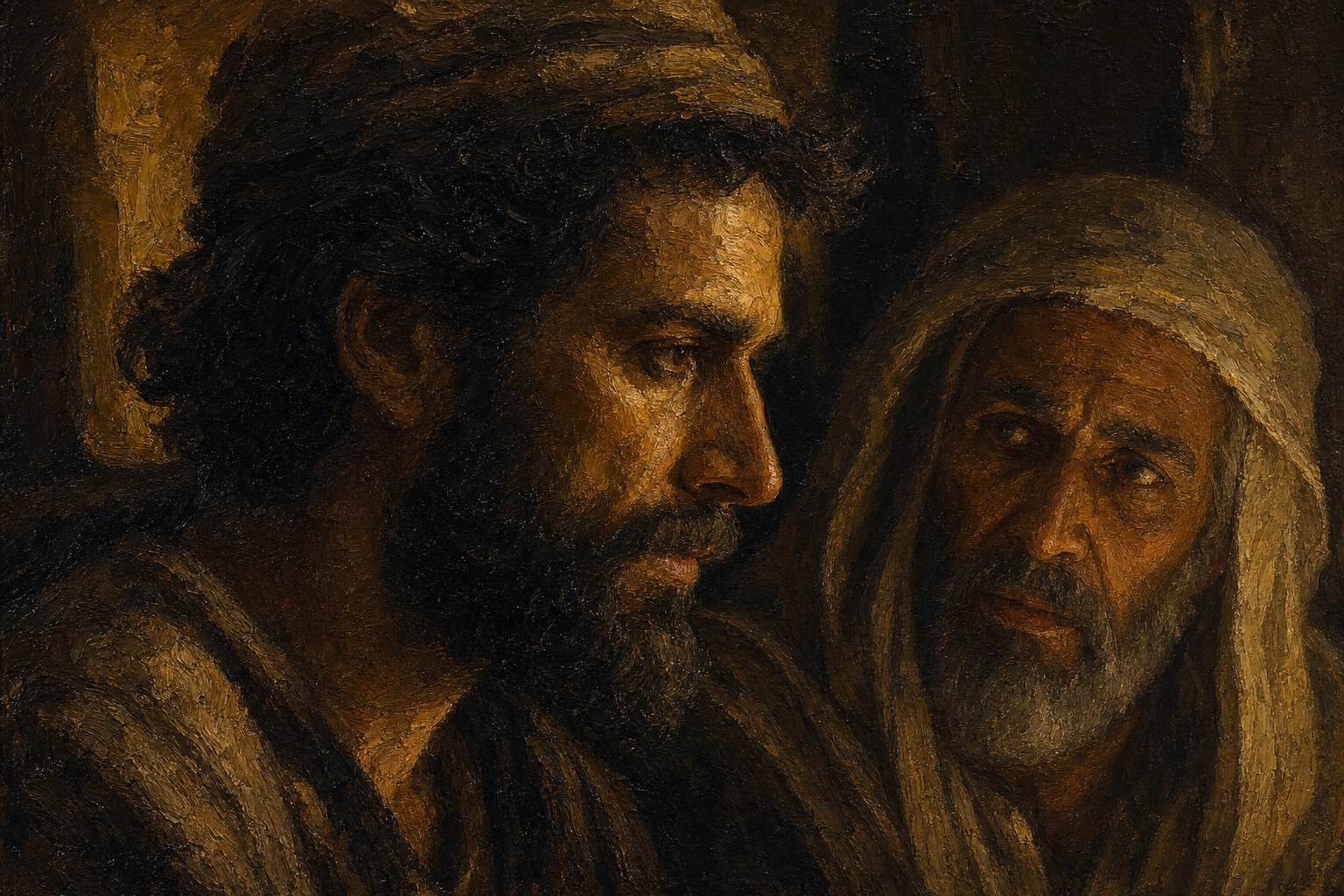
Warnings about taking communion, read through a memoir of desire and shame: what it means to come forward unworthy, and whether God waits there anyway.
A Girl Facing Forward Who Turned to Look
There was a young woman at that university, in the spring before Rome ever entered the picture, before the semester closed on a Thursday in May and his thoughts began drifting south toward Italy and its old stones. She was a friend, nothing scandalous, a keen mind and eyes that read the weather of a soul the way farmers read a bruised sky before rain. He remembers speaking to her once while facing forward, the side of his face offered to her, safe, angled away, his voice moving out into the room instead of toward her. She was watching him the whole time. He could feel it, that quiet pressure of another person’s attention against his cheek, and he kept talking anyway, kept his jaw set toward the middle distance. Out of nowhere she said he reminded her of a sad angel, and the words landed like a warm hand laid flat on the sternum, sudden, unasked. Frozen is the word he uses for what his body did next. Exposed. She saw him. That memory is where I want to begin, because the question people carry to the altar and the question he carried into that friendship are the same question wearing two coats. Who is allowed to come forward? Who has forfeited the right to be looked at kindly, to be received rather than refused? He tells us plainly that he chose not to pursue her, and he is honest enough to strip the choice of its costume. It was not humility. It was not that he thought her too good for him, though he lets that flattering reading hover for a breath before he kills it. He simply did not want the complications, the fallout, the mess of taking something he could not give back. He calls this a new level of dishonesty in himself, and the naming is what makes the passage worth reading twice. A man protecting a woman from his own corruption is not always noble. Sometimes he is only tidying the scene of a crime he has not committed yet, arranging the furniture so his restraint will photograph well. This is the ground beneath the communion question you searched for. The warnings — do not eat and drink unworthily, do not approach with unconfessed sin — assume you know your own heart well enough to sit as its judge. He did not. He mistook self-exile for love and called his withdrawal a gift. So the first thing this scene teaches about approaching any altar is that we are terrible witnesses to our own motives, and the flesh often knows what the mind will not sign.
The Cold Logic of Load-Bearing Walls
The classic warning against communion is not cruelty; it is protection, the way a rope drawn across a stairway holds a man back from a rotten step below it. Come forward with a soul at open war with itself, the old teaching says, and you eat judgment into your own body along with the bread. He would have understood that warning intimately, because he had built his whole life as a warning against himself, brick by careful brick. Look at how he handles this woman in his mind. He weighs her purity the way an architect weighs a load-bearing wall, calculating exactly what it can hold before something structural gives. He decides she cannot separate the body from the feeling, that in her the two are welded, that desire and love come as one piece with no seam to pry, and that to touch her would be to crack the whole frame. Maybe he was right. Maybe he was flattering his own restraint and hiding his fear of being truly known by someone with perceptive eyes. Both can be true inside the same hour, and he knows it. What strikes me is the vocabulary he reaches for — unfair, selfish, exploitative, taking advantage — the language of a man who has already decided he is contaminated and is now solving, coldly, for the least contaminating way to move through a room. That is exactly the posture the communion warnings can twist into if we let them harden. The rope across the stairway becomes a permanent address. We do not stay back for one honest season of repentance; we build a house in the last pew and hang a sign on it that reads reverence. He did this with her. He accepted her friendship, her quick mind, her spirit-attuned gaze, and he metered out precisely as much of himself as he judged would not stain her — no more, no ounce more. He gave her his profile and kept his eyes on the far wall. And the whole time his body was doing something his intellect had strictly forbidden. It leaned toward her warmth. It wanted to be seen by her. It reached even as the mind bolted every door and pretended not to hear the reaching. The tension gathers here precisely because his desire will not agree with his verdict on himself. He has read the warning and applied it not only to the altar but to every human being who might dare to love him. That is the danger the searcher may not see coming: a warning meant to make you reverent for a single night can quietly persuade you that you are permanently, structurally unfit to be touched by anything holy, or by anyone human, ever again.
Named a Sad Angel Before He Could Hide
Then she interrupts him. Sad angel. Two words, unbidden, and the wall he had raised so patiently comes down in a single sentence. Notice what actually happens in that moment, because it is the hinge the whole passage swings on. He had arranged himself precisely so as not to be seen — face forward, motives managed, the friendship kept at a temperature he could control. He was curating every variable, offering only the edges he trusted, presenting the profile and hiding the rest. And she looked straight past the arrangement and told him what she saw. Not the depravity he was so certain defined him down to the marrow. An angel. A sad one, wounded, fallen perhaps, but still angelic, still carrying the trace of something luminous he was convinced he had spent entirely. This is the thing the communion warnings never mention and that this scene quietly insists upon with its whole body. Sometimes the one who believes himself unworthy to approach is the only person in the room who cannot see what remains holy in him. She could. Her eyes, tuned to matters of the spirit the way an ear is tuned to a false note, found the residue of glory beneath the shame and said it out loud before he could smother it. He was frozen because being seen truly is itself a kind of communion, and he had not braced for it. It arrived unannounced, the way the deepest intimacies always arrive, piercing the careful darkness he maintained and touching the one place that had stayed bright. Here is where the theology turns honest instead of sweet. Grace did not lift him out of his sadness in that moment. It did not wipe the ledger clean or make the weight vanish. It walked straight into the middle of the sadness and called him by a truer name.
The warning is not that God will refuse you at the rail, but that you will refuse yourself before you ever arrive.
That is the revelation the scene lays before anyone who went searching for reasons to stay away from the bread and wine. God was not absent from the corruption he was so busy guarding others against. God was in the seeing, in her strange interrupting perception, present in the exact chamber he had sealed off as too dark for anything sacred to survive. He had the warning memorized and applied it with such thoroughness that he never once considered he might be welcome. She saw the angel. He saw only the fall, and kept his eyes there.
The warning is not that God will refuse you at the rail, but that you will refuse yourself before you ever arrive.
After the Wall Came Down He Stood Very Still
But do not mistake the moment for a cure. He was exposed, yes, seen, yes — and then the passage simply moves on. He does not drop to his knees. He does not turn and pursue her afterward. The recognition lands and life keeps walking; the semester ends, Italy calls with its churches and its ruins, and the sad angel stays sad and stays alone by his own careful arrangement. This is the honest fallout, and it is why the book earns your trust rather than begging for it. Being truly seen does not automatically undo a man’s long habits of hiding. He had spent years engineering distance, sanding down every point of contact, and one accurate sentence from a friend could not rebuild in an afternoon what he had spent so long taking apart. I keep circling the questions he would put to himself. Did he protect her, or did he protect his own image of himself as too ruined to be loved cleanly? Was his refusal to spoil her innocence a real mercy, or the last and cleverest form of the same self-absorption, making even his restraint a monument to the drama of his own darkness? He confesses it was dishonesty, and I believe him, but I also wonder if he was too hard on himself, if the wish to keep something luminous unstained was, in some smaller and realer chamber, a genuine tenderness he could not let himself claim or even name. Both readings press on the same bruise, and neither cancels the other. This is where the communion warnings return, changed. The teaching says examine yourself before you come forward. He examined himself endlessly — that was never his shortage. His trouble was that his examination always returned the identical verdict, unfit, unworthy, dangerous to the pure, and he treated that verdict as final revelation rather than as the very sickness in need of healing. A man can turn self-scrutiny into a locked room and throw away the key while congratulating himself on his rigor. He can use the vocabulary of reverence to dodge the sheer terror of being received. The floor never feels rotten from the inside; it feels responsible, careful, prudent. What he could not do with her, and perhaps could not yet do at any altar, was accept that the sadness she saw did not disqualify him. It was, maybe, the exact thing love had come looking for. The fallout of that frozen moment is not resolution. It is a man who was seen and did not yet know how to let himself be kept, carrying two words that told him the truth he was laboring so hard to disprove.
The Rail Is Not a Judgment Seat
So here is what I would say to the person who typed those words into the dark, hunting warnings about taking communion, half hoping to be told to stay away. The warnings are real and they are not to be waved off with a shrug. A soul at open war with what it knows to be right should not treat the altar like a snack line, reaching for the bread with an unrepentant hand. That much the old teaching gets right, and this book would never let you cheapen it into sentiment. But watch what happened to a man who took the logic of unworthiness and built his entire interior life out of its bricks. He did not merely stay back from the bread and the wine for a season. He stayed back from friendship, from a woman’s clear-eyed affection, from the plain possibility that someone might love the sad angel and not only the presentable profile he turned to the room. He confused the rope across the stairway with a life sentence and served it faithfully. The searcher may be doing the very same thing — using genuine reverence as cover for a much older fear, the fear that if you came forward and were truly seen, what looked back at you would be refusal. The scene answers that fear without pretending to erase it. She looked. She saw the sadness and the fallenness and the surviving light all tangled together in one face, and she did not recoil, did not flinch, did not lower her eyes. She named the good that had lasted. This is not permission to approach carelessly; it is a reminder that the altar is not a judgment seat crouched there waiting to catch you out. It is the one place in the world built for the unworthy who are willing to be seen. He could not receive that yet, and the book is faithful enough to leave him standing in it, frozen, exposed, unhealed, before Rome and everything Rome would ask of him. If you want to know what it costs to keep protecting the world from your own supposed corruption — and whether God waits inside that darkness rather than at the far end of it — the rest of Confessions to the Empty Chair is where that reckoning lives and breathes. It hands you no clean absolution. It walks beside a man who kept himself away, and it shows the God already sitting in the back pew with him, patient, unremoved by the sadness, calling him a name he could not yet bring himself to believe. Examine yourself before you come forward. Then come forward anyway. That is the harder warning, and the truer one.