How did Adam and Eve see God? A meditation on seeing and being seen, drawn from a starlit proposal in Confessions to the Empty Chair.
Dinner at Rosa’s, Then the Road Out of Town
The question you typed is older than any of us. How did Adam and Eve see God? In the beginning, before the shame, before the leaves stitched together into the first covering, they saw Him and did not flinch. That is the thing to hold onto. They were seen and did not run. To answer you honestly, I have to start small, at a booth in a diner called Rosa’s, on an ordinary evening after work, with the woman I would ask to marry me. In Confessions to the Empty Chair this scene comes late, near the end of a long book, and it is quiet in a way the earlier chapters never allowed. We order. We eat. The forks scrape the plates and nobody is performing. She tells the story again, the one we have worn smooth, about the first time she told her parents she wanted to move in with me. Her mother would not meet her eyes. Do not look at me, chickadee, her mother said, you are on your own with your dad on this one. Back then the words frightened her. Now she laughs telling them, and the laugh is not a cover; it is the real thing, low and easy across the table. That is what time does to certain fears. It does not erase them. It re-tells them until the sting drains out. What strikes me, looking back at that booth, is how much of love turns out to be a matter of being looked at, and by whom, and whether they hold your eyes or drop them. Her mother dropped them. Her mother sent her back down the hall to her father, alone, and would not choose. I sat across from her that night wanting the opposite gesture. I wanted to drive her somewhere and ask her to look up. The first pair in the garden saw God plainly, with clear sight, because nothing in them yet needed hiding, because there was not yet anywhere to hide. We do not begin there anymore. We begin at a diner table, greasy menu between us, deciding whether we will let ourselves be seen at all, or whether we will keep managing the angle of the light. I confess I am not certain, even now, whether I understood what I was about to ask of her, or only how badly I wanted the asking to be answered. When we walked out to the truck the night air was clean and cold. The road ran out past the city limits into open country, no streetlights, just the dark shoulder and the fence posts sliding by. She sat beside me, not yet knowing. In my pocket the ring pressed against my leg like a small live thing with its own pulse.
The Stars I Once Confessed My Sorrow To
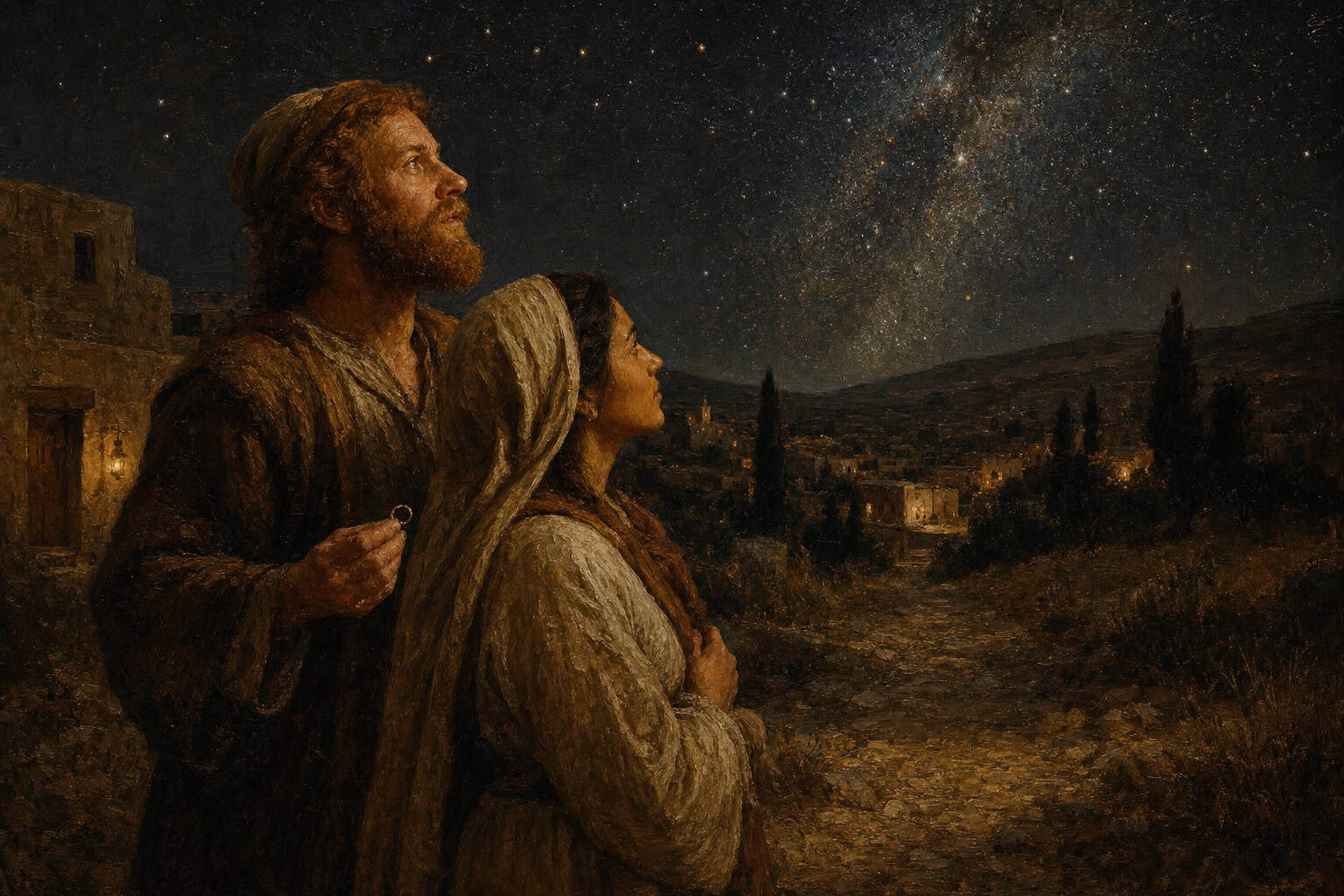
We pulled onto the gravel shoulder and I killed the engine. The quiet came in through the windows, that enormous rural quiet with nothing in it but wind and the tick of a cooling motor. I told her to get out and look at the stars. She tilted her head back and the whole sky was there at once, cold and vast and unbearably clear, more stars than a city ever lets you keep. Here is where the answer to your question deepens, because seeing God was never only a matter of the eyes. Adam and Eve saw Him with their whole bodies, unguarded, in a place that was made for them, and the place itself kept speaking of Him. I had my own place, though it was a poor and private one. These stars were not strangers to me. There was a season, years before, told elsewhere in the book, when I stood out under this same sky alone and confessed my sorrow to it because there was no one left to tell. I showed the stars my grief. I said things to them I could not say to a face. They took it and kept it and said nothing back, and their silence did not feel like rejection. So when I brought Leigh to this exact stretch of empty road, I was not only proposing. I was returning to a witness. I stepped around behind her while she was still looking up, and I slipped the ring out of my pocket. I want to be exact about one thing, because it bears directly on what you asked. I did not kneel. I told her plainly that I kneel to God alone. Some readers hear that and find it cold, a proud man refusing the humble posture. I think the first pair would have understood it. You bow all the way down only before the One in front of whom bowing is simply the truth of things. Every other gesture is a smaller one, and to spend the largest gesture on a lesser thing is a kind of lie. I told her I had brought her out here to meet my friends, the stars, the ones who had heard my sorrow, and that tonight I wanted them to hear something new from me. Standing there in the cold with the ring warming in my fist, I felt the strangeness of the whole thing land. The same sky that had swallowed my worst nights was now being asked to hold my best one. What had once been shown in grief was being presented again, in this new key, as triumph. That is close, I think, to how the garden worked, when to be seen was not to be exposed but to be held. But I was no Adam. I came to that field already carrying what he did not carry until after he fell. I came already ashamed. And I wonder, now, whether I chose the stars because they were the safe witnesses, the silent ones who had already seen the worst of me and stayed anyway, who would never talk back. Did I trust them more than I trusted her? That is a question I still sit inside, and it does not sit still.
When She Turned Around and Both Her Hands Rose
She turned around. Both her hands flew up and pressed against her mouth, and she went completely silent. That gesture is the whole scene. She had not seen it coming, and the sight of the ring stopped her breath in her chest. I asked her, plainly, no speech built for it, whether she would marry me. She said yes, one word, and the word fell into all that open dark. Now I have to tell you the thing I have kept back from nearly everyone for years, the thing that stands directly behind your question about the first man and the first woman looking at their God. There were two musics in me. I have written about them across the whole book. One is clamorous and dark, a demon’s noise, restless and hungry. The other is solemn and sorrowful and holy, a slower melody underneath everything. They had warred my entire life. They did not stop that night on the roadside. They have never stopped. But for the first time they did not war. Out under that field of light they found a harmony I had never believed was possible, a strange and unexpected fitting-together. The dark notes did not vanish. I do not think they ever will. What happened was stranger and far better than vanishing. The lower melody was taken up into the higher one, woven in, given an actual place inside a larger and more beautiful pattern than either could make alone. This is the answer I would offer you, if you asked me how a fallen man sees God after Eden. Not by scrubbing the darkness off himself first. By having the darkness gathered up into a song too large for it to ruin. Adam and Eve saw God with clean eyes, with nothing between the seeing and the One seen. We do not get clean eyes anymore. We get, if we are given mercy, a God who does not look away from the stain, who stands right in the presence of the mixed and muddied waters and does not recoil.
Redemption is not the erasing of your darkness; it is the moment God weaves even that into a music too great for it to spoil.
She saw in me what others had failed to see. She held close what others had abandoned. She heard, from my own mouth, what others could not bear to hear. And I stood there on the gravel, fully seen, the ring now on her hand, and for once in my life I did not go running for the leaves.
Redemption is not the erasing of your darkness; it is the moment God weaves even that into a music too great for it to spoil.
The Fear of Looking Back at What You Love
Then comes the cost, because there is always a cost, and this is where I have to turn the lens hard on myself. I had traveled a long way to be seen. Halfway across the world, to Rome, chasing a spiritual solace I never actually found there among its old stones. I had met dozens of women, in different cities, of different types, and I had performed and maneuvered and argued my way through room after room after room. I entered every one of them already decided, already managing exactly how much of myself would be allowed to show. The whole time the ache underneath was not really for a woman at all. It was an older homesickness, a deeper one. It was the longing to stand in front of Someone and say a single word without strategy behind it, the way the first pair spoke in the garden before there was anything left to conceal. And I confess that even my proposal carried the old reflex folded inside it. I chose silent witnesses. I did not kneel to her. Right up to the edge of the thing I kept the guarded habit of a man who has been left before and fully expects to be left again. Here is the fear I will now name, because it belongs to your question more than you would guess. The soul that finally loves something on this earth becomes afraid of heaven. Not from too little faith. From too much love. There is an old warning about the man who cannot stop looking back at what he cannot bear to release, and is undone for it, the beloved slipping away into the vast night while he stares. I had spent years dreading exactly that, dreading that I would love someone so much I could not let God have the last word, that my attachment would curdle into my ruin, that any real ascent would feel like a betrayal of the one face I could not stop looking at. That is a genuine danger and I will not soften it. What I did not yet understand, standing on that shoulder of road with her hand in mine, is whether the harmony I felt in my chest was healing or only a truce. Whether I had been given a wife or a well-lit hiding place. She did not condemn what I was and am. But had I finally let myself be truly known, all the way down, or had I only discovered a gentler, more merciful way to stay hidden inside another person? I still turn that over in the dark. The aftermath of every rescue is the suspicion that you never deserved it, and the graver suspicion, quieter and more corrosive, that you have quietly made the rescuer into an idol you cannot see past.
The Sword That Finally Found Its Sheath
Here is where it settles, though settled is too tidy a word for any of this. In the book I write that God’s sword found its sheath. I do not mean the long fight simply ended and the field went quiet. I mean the blade that had been swinging loose and open my whole life finally had somewhere to come to rest. With her, I felt no shame. That short sentence took me the better part of a lifetime to earn the right to write. For the first time I did not see the end at the beginning; I stopped reading every closeness as the first tick of a countdown toward loss. So let me carry you back to your question, the one you carried into a search box, about how Adam and Eve saw God. They saw Him near, in the cool of the day, in a place fashioned for them, and being seen did not wound them or send them for cover. We lost that. Every one of us was born east of that garden, already clothed, already flinching at the sound of footsteps. But the answer the whole memoir keeps reaching toward is that the nearness itself is not gone. It has only changed its form. God is not usually found by escaping the darkness, by climbing up out of it clean. He is found down inside it, walking beside you in the very thing you cannot forgive in yourself, present in the tears, quiet, entrusting you with the ongoing result of a song still being written. The clear-eyed sight of Eden becomes, for us who fell, something slower and stranger and harder to describe: to be seen by One who already knows the worst of you and stays anyway. That, I think, is the nearest we come now to how the first pair looked upon their God. Not innocence. Accompaniment. And I am still asking, honestly, whether I understood what I received on that dark road, or whether even here I am telling it a little too kindly to myself. The book does not hand you a clean bow at the end, and neither will I. What I can say is that the two musics still play in me, that the dark notes have never once gone silent, and that the older I get the more of the whole song I can hear, and the clearer its shape becomes. This memoir is the record of a man learning, late and clumsily, to be looked at without hiding. If your question was really about the first garden, stay for that. If it was secretly about your own longing to be seen and not condemned, stay for that too. The rest of the answer waits inside the pages, where the sheath is, and the unfinished song.