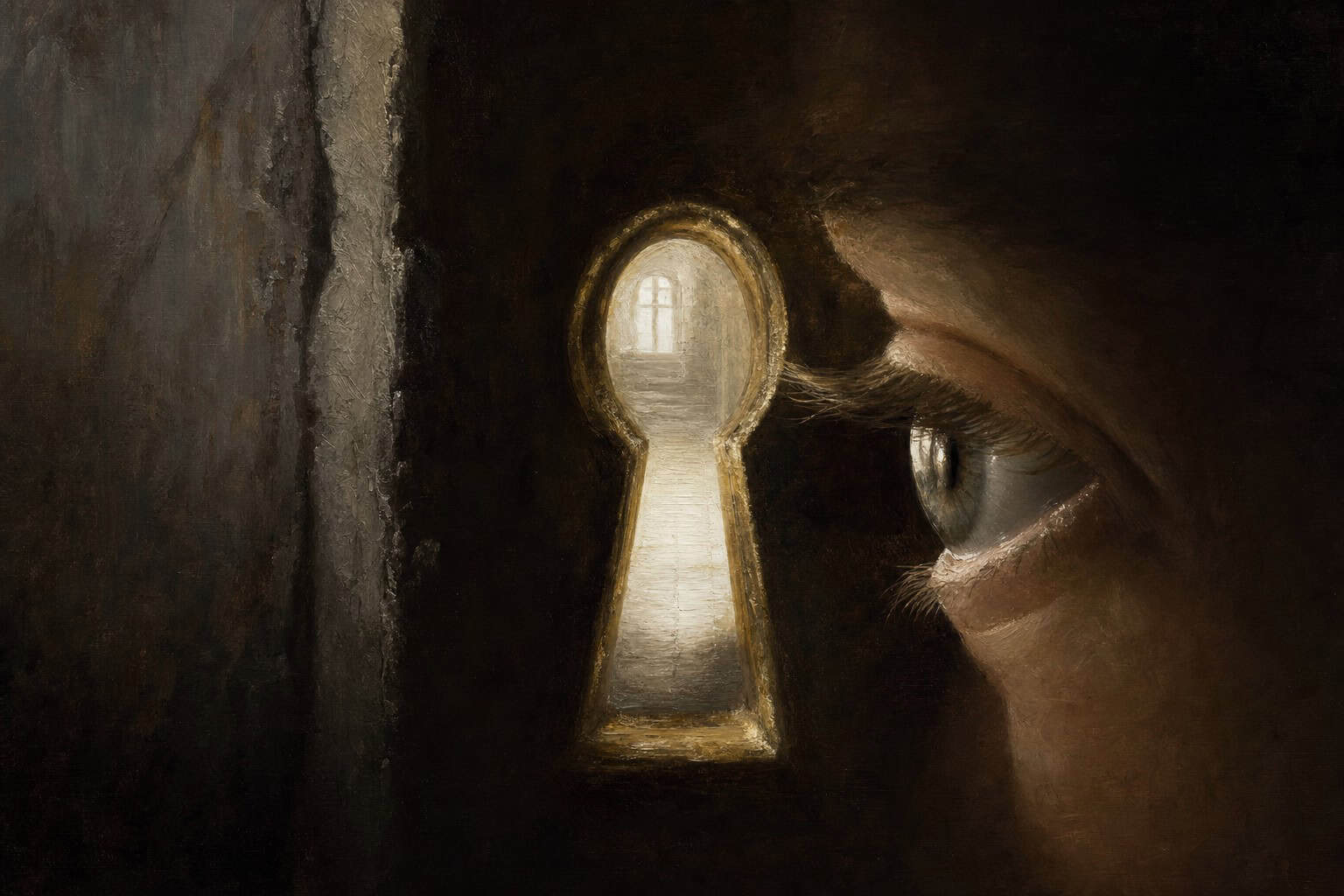
You have bent so long to this cold ring of metal that the chill of it feels like clarity, and the sliver you glimpse feels like the size of the world.
Eye Pressed Against Cold Metal
You are not floating in this passage; you are bent at the waist, cheek against a hard surface, eye pressed to a cold ring of metal. That chill on your skin is the shape of your life. You watch a thin strip of movement on the other side and call it reality, never noticing how cramped your own body has become in that posture. The keyhole does not shrink the room; it shrinks you, curls your spine, tightens your lungs, turns your whole nervous system into a narrow, twitching beam. Here the book names how most of us look this way through old injuries and call it insight. Every friendship, every prayer, every conflict passes through that cut in the door, so you see outlines and flashes but never the full weight of another person. The world feels small and hostile, but the metal against your bone tells a different story: the smallness is something you are actively holding in place.
Listening to the Eulogy Over Your Own Still Face
The passage drags your hunched body away from the keyhole and lays you flat. You are in the coffin now, skin waxy, hands folded, while voices rise above you. They speak in soft tones, but the text insists you hear what is buried beneath the praise. The words sound like kindness, yet their shape reveals a life that rarely resisted, rarely burned, rarely cost anyone anything. The stillness of your face becomes a verdict: all those years you called yourself gentle were often years of refusing to disturb the air. This imagined funeral is not a costume drama; it is a moral autopsy. Your choices, made in tiny, daily evasions, have congealed into a story that can be told in a few safe sentences. The reckoning here is brutal in its simplicity: whatever you actually lived is what will be spoken over your body, not what you meant to live, not what you planned to start next year.
When the Question Cuts Like a Second Spine
Into that chapel, into that cramped, keyhole-shaped life, steps the demon with his single, merciless question: would you do it all again, exactly as it has been? The passage does not stage this as fantasy; it lets the question land in the reader’s ribs like a second spine, rigid and unbending. You feel your own history press against it—every avoidance, every swallowed word, every night you chose numbness over honest pain. The thought of repetition chews at the edges of your throat. If your answer is revulsion, the text refuses to soothe you; that revulsion is treated as confession, proof that you already know something is crooked in your choosing. Yet nothing resolves here. The demon does not disappear. The funeral does not dissolve into light. You are left standing between coffin and question, back still aching from years of crouching, feeling how far your life has drifted from anything you would freely choose again.
Most of us mistake the narrow keyhole of our wound for the whole room, and architect our own smallness out of the very way we have chosen to see.
Dust on the Table, Weight in the Chest
Here the passage turns from scene to the quiet ache of an ordinary morning. You wake with that familiar heaviness in your chest, move past the same table where a thin film of dust has settled on unpaid bills, half-finished letters, small abandoned projects. None of it is dramatic, and that is the indictment. The text insists that these minor postponements are not neutral; they are the bricks of the world you are building, the script of the eulogy already being rehearsed in other people’s throats. Each time you choose not to speak a needed truth, not to ask the harder question in prayer, not to risk a real confrontation in love, you crawl back to the keyhole and tell yourself you are just being prudent. The stakes are described without sentimentality: keep living this way, and you will craft a life that your own soul would refuse if shown it whole. Fragment by fragment, you are teaching your heart to live smaller than it was made to be.
Hands Hovering Over an Unturned Handle
By the end of this passage, nothing outward has changed. You are still in the same hallway, still in the same body that knows the feel of cold metal against bone. Yet there is a new tension in your muscles, a tremor in your fingers that now hover inches from the unseen handle. The book names the central cruelty: the heart is not only fractured by what was done to it, but by the way it keeps choosing shards over wholeness, familiar crouch over unknown standing. Unity is not painted as a warm blur; it looks like the terrible clarity of owning your life as something you actively shape rather than endure. No answer is given here, no sudden surge of courage scripted on your behalf. The question remains lodged where your neck meets your shoulders: will you keep your eye at the keyhole, or will those hovering hands finally close around something solid and turn?