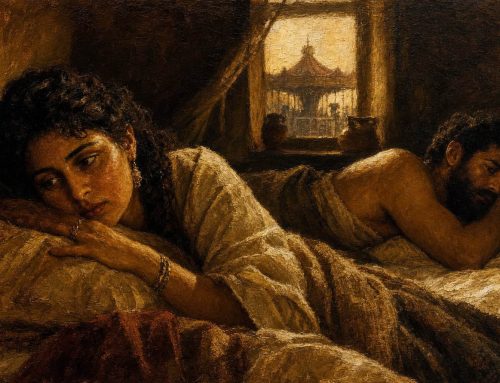
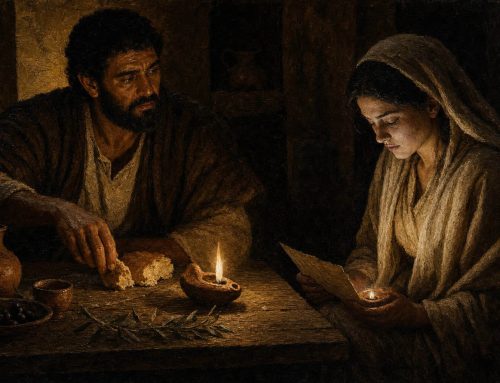
He stands in a field he broke from rock to pasture, hands still aching from the fence posts, and finds only droppings where he sowed — all he gave walked out the door in someone else.
Droppings in the Tended Field
A man stands in a field he has spent years turning from rock to pasture. His hands still carry the ache of fence posts driven in, of seed sown, of nights awake under a cold sky praying over a flock that could not hear his words. The sheep bend their heads and eat what his soul has ground into bread for them—his studies, his tears, his secret renunciations made for their good. They chew with dull rhythm, swallow, walk on. What leaves their bodies bears no trace of the labor that produced it; his offering reappears as piles of waste dotting the grass. The smell rises around his ankles as they drift toward some brighter patch beyond his fence line, bellies full, eyes already searching elsewhere. In that sharp, ugly odor, he feels what it means for obedience to be received without reverence, for grace to be processed like fodder and dropped behind them in steaming heaps.
Tools Laid Out for a Vanished Pair of Hands
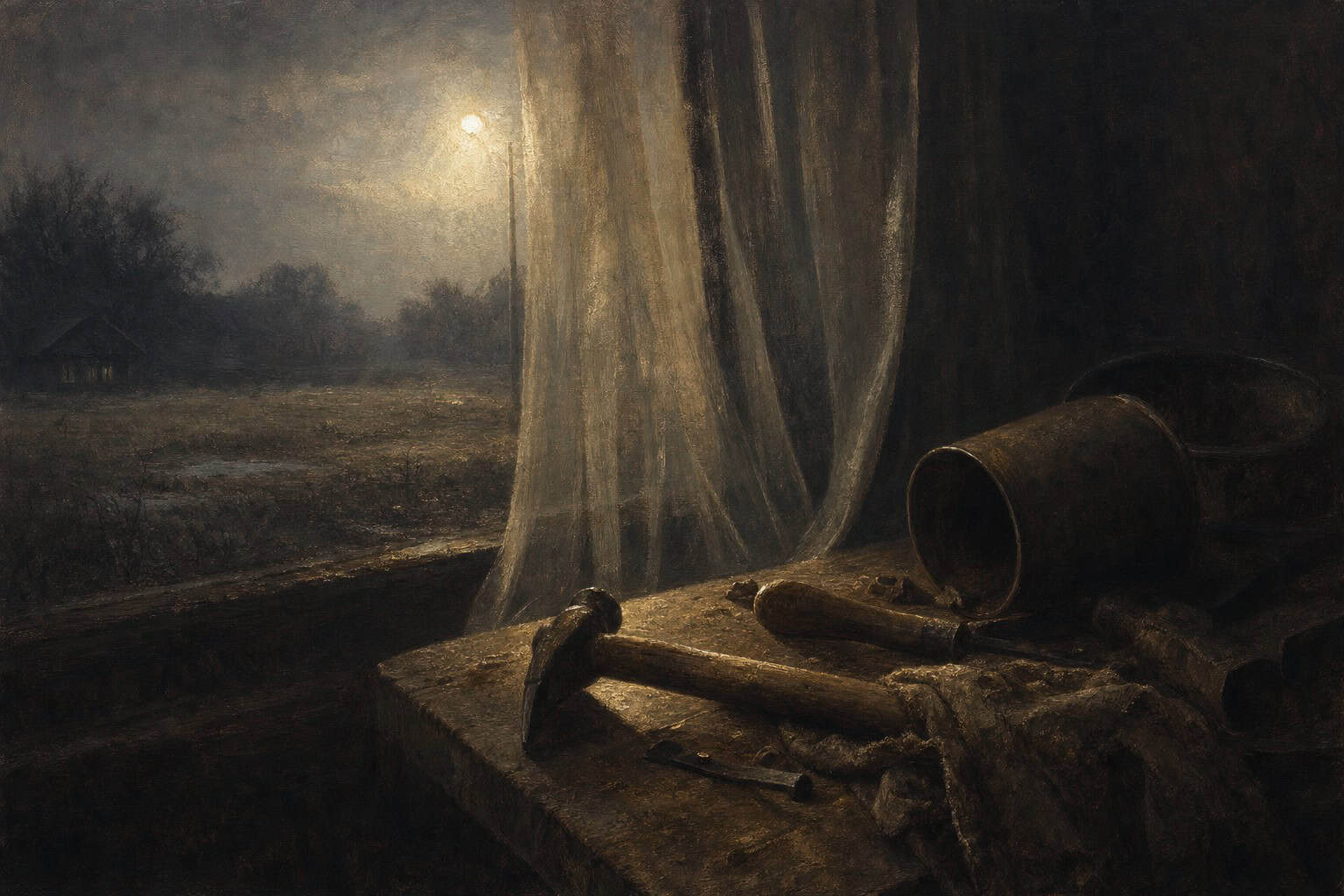
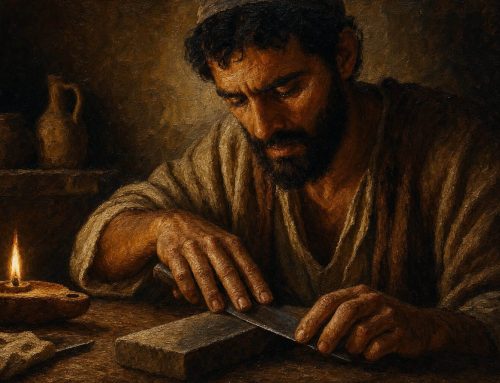
Not far from that field, another scene unfolds around an unoccupied workbench. A master has laid out tools in a careful line: chisel, plane, battered hammer, each one carrying the memory of mistakes survived and corrections learned. These were meant to pass into the apprentice’s grip, to leap from aged tendon to young muscle so that some part of the master would outlive his flesh. Instead, the bench sits waiting, the air above it empty. The student has walked off at some unremarkable hour, not with a dramatic renunciation but with the soft finality of simply not returning. The master sits with his hands resting uselessly on his knees, looking from tool to doorway, replaying old lessons for signs of where the thread snapped. The promise that wisdom could defeat the grave by crossing into another life tastes thin. Skill, once a source of pride, begins to feel like a weight that cannot be handed on.
The Same Dust at the Edge of the Field
Beyond the furthest fence post, beyond the last plank of the workshop floor, the ground evens into the same hard crust of earth. Here the field and the bench, the sheep and the apprentice, the servant and the master all face the single horizon that does not move. Death waits there, not as a melodramatic figure but as the slow certainty that every arm will someday drop its tool and every field will outlast its keeper. The servant’s poured-out years and the flock’s clueless wandering meet the same end. The master’s carefully honed craft and the apprentice’s half-learned tricks crumble into a dust that does not remember who loved truth and who fled it. Old photographs of their faces curl at the edges in some attic box; the pixels holding their smiles distort as formats change and machines fail. Those who survive hold the images at arm’s length, searching for a warmth that does not pass through paper or screen, feeling only the chill of matter that will not speak back.
There is no grief quite like wisdom poured out and finding no vessel to hold it, when everything you gave a student walks out the door with them.
When Your Labor Smells Like Waste
Anyone who has loved past their own comfort knows the sting of this field. You cook meals that end in scraped plates and no thanks, offer counsel that is met with a shrug, stay up through someone else’s night only to be edited out of their story once the crisis passes. Your work, your words, your body become fodder for other people’s journeys, and sometimes what you see in the aftermath looks less like fruit and more like droppings. You line up your own tools—degrees, skills, prayers learned the hard way—hoping to place them into a younger grip, and watch that hoped-for heir choose another path, or no path at all. In that gap, the heart begins to suspect that generosity is foolish, that to give is only to be emptied and left behind. The temptation grows to hold back your best, to feed yourself first, to keep your wisdom locked in your own bones where no one can trample it underfoot.
Dust on the Tools Waiting for Morning
Yet even as the sheep drift off and the apprentice’s stool stays vacant, the tools do not vanish. They sit where they were placed, catching a thin film of dust in the field’s waning light and the workshop’s quiet air. The servant stands with the sour smell of waste in his nostrils; the master runs a thumb along the edge of a plane gone slightly dull. Nothing resolves here. No grateful flock turns back, no contrite student knocks at the door with new resolve. What remains is the strange, suspended moment in which the giver has to decide whether the worth of his offering depends on the way it was received, or whether obedience can stand in a landscape littered with rejection. The night will come as it always does. The real question is whether, when morning returns and the dust has thickened, those same hands will reach again for seed and for steel.