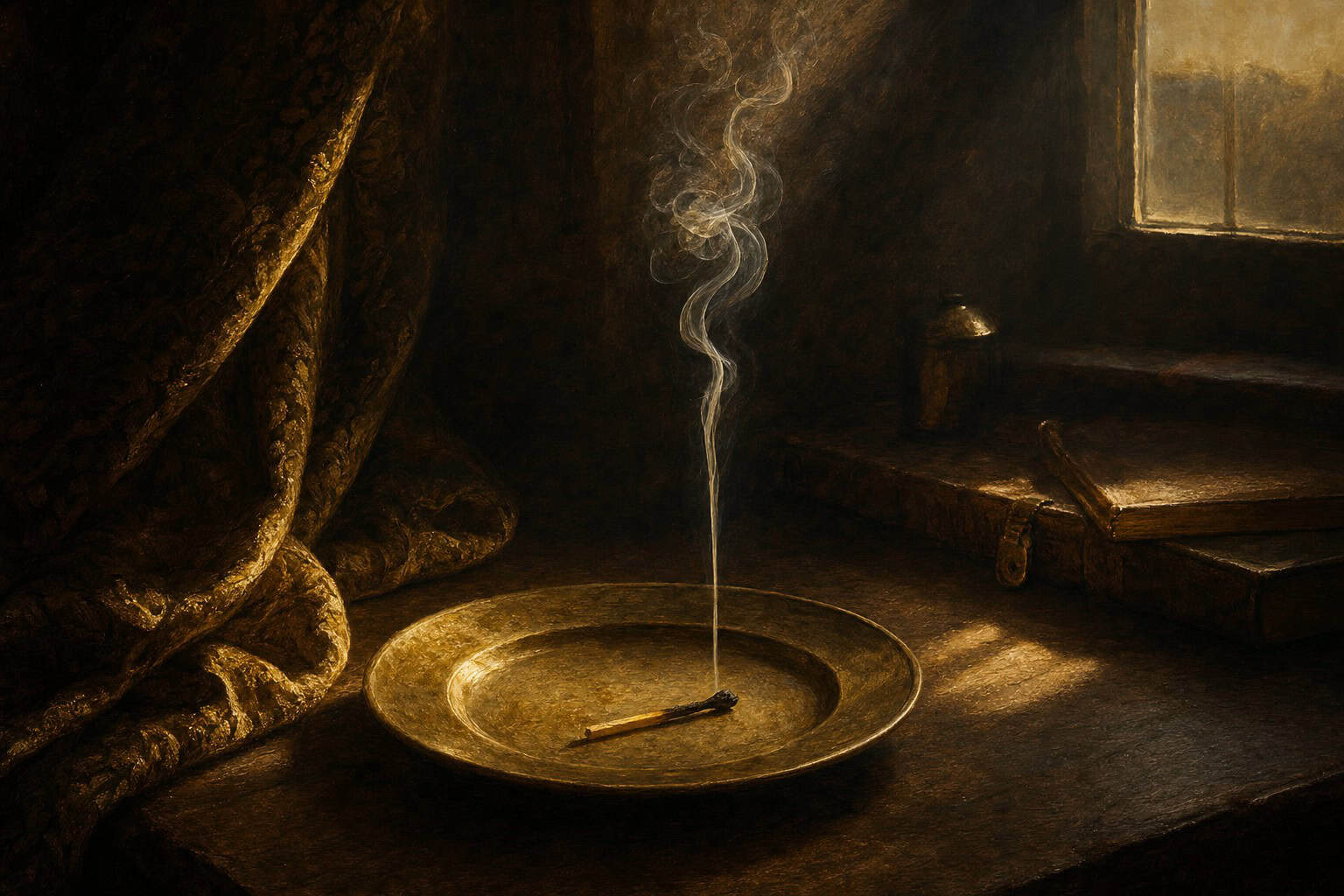
Everything from above must be translated down into what a body can bear, fire lowering itself to smoke at the threshold of the skin, because heaven offers more than flesh was built to hold.
When Fire Lowers Itself to Smoke
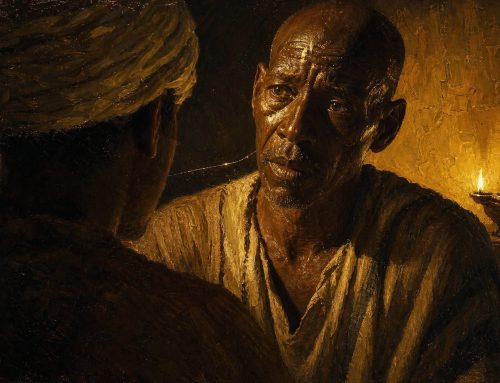
A single image carries this passage: fire dimming into smoke so we can survive its touch. The author lingers on how everything from above must be translated into what a body can bear. Flame becomes column, heat becomes warmth on skin, voice becomes breath moving through air. Not because God enjoys disguise, but because raw radiance would crush nerves and sight and mind. He stands inside this knowledge like someone too close to a bonfire, eyes watering, arm raised to shield his face, realizing even created light already asks too much. So heaven bends. Glory accepts the smallness of wind, water, bread, oil, and the fragile cords of human speech. The holy lets itself be handled like common matter so that creatures made of dust can meet it without burning. Smoke curls in the air of this chapter, soft and almost nothing, but it tells a harsher truth: if the flame did not hide, there would be no one left to see.
Smoke on the Skin of Temptation
Once fire has lowered itself to smoke, the author turns and notices something darker riding the same air. If God must wear elements to reach us, so does evil. Temptation does not arrive as theory. It comes as heat from another body, as a message on a glowing screen, as a hand lingering too long on an arm already hungry. Smoke clings to skin here: the way desire leaves a scent, the way a look across a room can feel like fingers. He recognizes that the worst injuries did not float in from nowhere; they carried the temperature of a familiar voice, a shared bed, a digital notification flashing his name. The demonic does not need horns when our own loneliness can lend it eyes and lips. This moment presses a hard reckoning: if all contact is mediated through flesh, then flesh is never neutral ground. Every touch can be altar or bait, and often both at once.
Reaching for Fruit Through a Haze
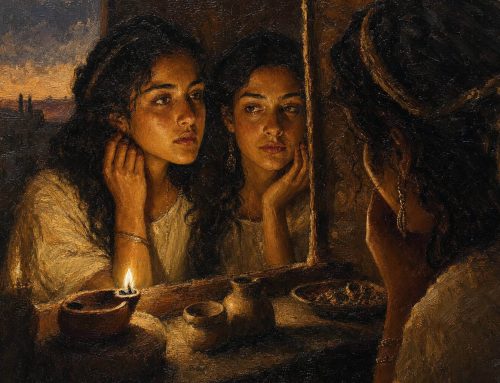
The smoke thickens when the scene moves between man and woman. There is a fruit hanging between them—promise of knowledge, promise of rest—but they reach for it through the same blurred senses that cannot hold God’s light. The author sits in that gap, remembering bodies that felt near while souls stayed unreadable, like shapes behind frosted glass. Skin meets skin, breath mixes, the air warms, yet the core of the other remains obscured. He feels the frustration in his own muscles, the ache afterward when pleasure has passed and the question still hums: who was that, really, beside me? Not accusation, but sorrow. The fruit of union looks clear from far away; up close, smoke swirls around it. This passage doesn’t resolve the tension. It simply names it: our tools for knowing are damaged, and we keep using them on what we most long to see. Hands close on sweetness; the pit stays hidden.
Such is the poverty of our senses that divine fire must dim to smoke before we can bear it; heaven always offers more than flesh can hold.
Sharing a Bed Inside a Cloud
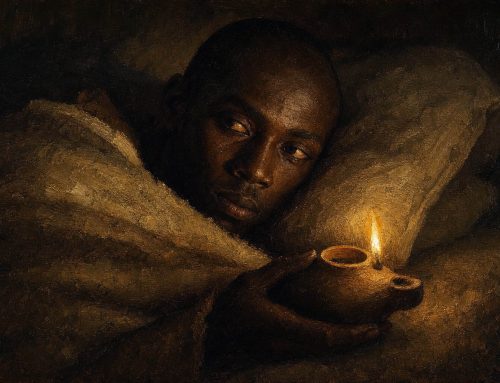
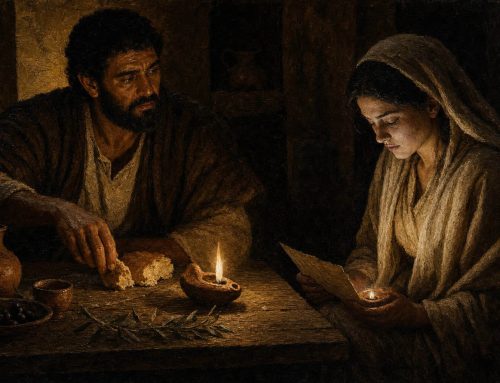
Here the image turns domestic without softening. Imagine two people in the same bed, shoulders almost touching, wrapped in the same warmed sheet, and yet each breathing their own private cloud. The author writes from that mattress, from that dim ceiling view, where even the sound of another’s heartbeat cannot grant full access. It is not loud drama, but the quiet weight of realizing that broken sight doesn’t improve just because the lights are off. Years of routine, shared meals, even children cannot clear the air entirely. He names this not as an excuse, but as a hard truth: we ask human intimacy to carry a hunger that was never sized for human shoulders. For an ordinary life, this lands close to the bone. You can do everything right—speak, listen, stay faithful—and still hit the edge where the other remains partly unreadable. In that edge, smoke hangs, stubborn and unresolved, between two sets of lungs.
Ash in the Lungs of Our Longing
The passage closes with the taste of smoke more than the sight of it. The author lets the image collapse inward: what we breathe, what fills our chest, is never pure flame but ash-laced air. Our attempts at communion—prayer that feels one-sided, touch that doesn’t quiet the ache, friendships that skim the surface—leave a faint grit on the tongue. He does not tidy this away. Instead he allows the body’s own protest to stand: stinging eyes, raw throat, the fatigue of always inhaling more haze than heat. Yet even that discomfort reveals something: we were built for a clearer burn than we now endure. The dissonance between what we taste and what we remember inarticulately keeps us restless. No technique in this scene fixes the distance, no sudden clarity parts the veil. The chapter simply walks us to this edge and leaves us there, chest rising and falling, aware of the thin ash lining every breath we take.