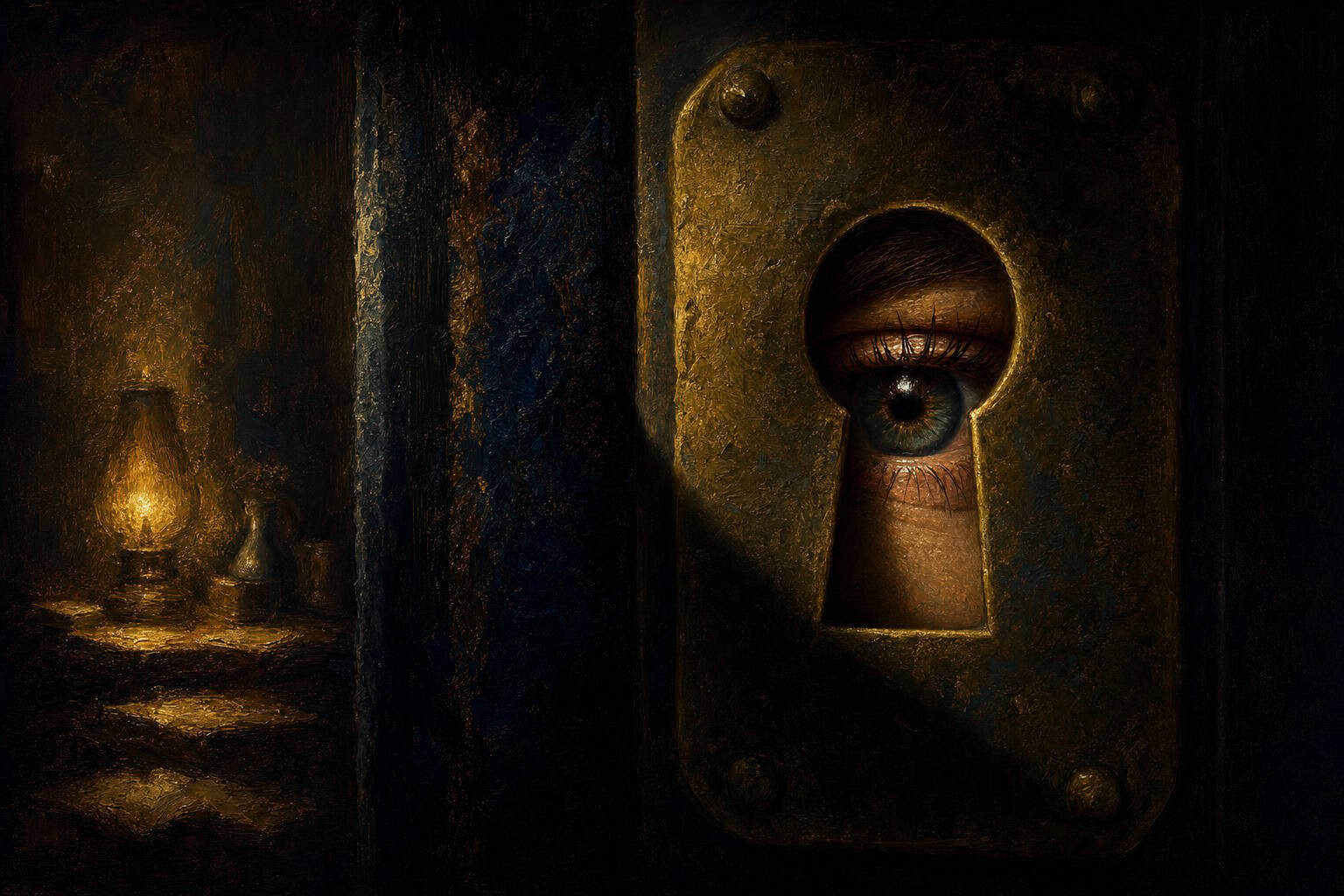
Cold metal rings the skin around his eye as he leans in, lashes almost scraping the rough edge, the whole moving world reduced to a flash of color and a turning shoulder — a life mistaking its narrow frame for everything there is.
Eye Against the Cold Keyhole
Metal chills the skin around his eye as he leans in, lashes almost scraping the keyhole’s rough edge. On the other side, life moves in broken pieces—a flash of color, a shoulder turning away, the brief arc of a hand. He cannot see the room, only this thin column of motion framed by brass. To follow one figure, he has to let another fall out of view; to focus on the left edge, he must abandon the right to darkness. This is not just his posture but his condition: his very seeing shaped like that small, unyielding opening. In this passage, the keyhole is not a symbol tucked into a scene; it is the scene, the way the self understands its own limits. He feels the ache of every path collapsing as he chooses one thing to watch. He is not simply looking through the keyhole. In a hard, humiliating way, he begins to grasp that he is the keyhole.
A One-Percent Knife at the Throat
As his eye strains against the metal ring, a different number presses into his mind: the thin genetic sliver between his body and the animal bodies he once saw at a zoo. One percent. All the music that ever made his chest tighten, all the paintings that drew crowds into hushed lines, hang from that measly difference. He imagines some cooler, slightly improved species glancing down at him the way he once watched monkeys fling themselves around a cage—mildly entertained, never impressed. The reckoning is not abstract; it stabs directly at his quiet pride, at the secret belief that his thinking, his capacity for “depth,” sets him apart in a noble way. If everything he reveres can be reduced to a rounding error in flesh, what happens to the weight of his choices, his guilt, his attempts at goodness? The keyhole cuts his field of vision; the one percent cuts his self-importance at the root.
Bodies as Makeshift Fires
He remembers nights when another body was his only heater, beds where sheets tangled around legs slick with sweat, the raw sound of breath in a dark room. Strip away the whispered names, the small promises of forever, and what remains is simple: two warm animals rubbing themselves into brief comfort. In this passage, the language will not allow him to hide behind tender phrases. He sees the pattern: how he and others have used skin like flint, striking it again and again, trying to force a flame strong enough to blind them to their own solitude. She, too, plays this game, but with a sharper discipline—splitting herself into separate selves for separate men, keeping each encounter sealed from the others. Her phone becomes part of her body, filtering who gets heat and who receives only a cold, delayed reply. The more he studies it, the clearer it becomes: every embrace here is a wager against the freezing air that fills the space after two people roll apart.
We each see the world through the keyhole of our own limits, mistaking that narrow view for the whole, and murdering every possibility beyond the frame.
The Keyhole in Your Own Chest
You know this scene without ever having pressed your eye to literal brass. It shows up when you catch yourself savoring your own intelligence, replaying a clever remark, or nursing the belief that your capacity for “deep” love separates you from the dull crowd. Then, like a bad taste rising from the stomach, comes the memory: that one-percent gap between you and the animal scratching its back on a tree. Every decision you have ever made—marriage, breakup, betrayal, fidelity—was chosen from a field you barely glimpsed. One job meant a thousand lives never lived. One “yes” at an altar meant a hundred faces you will never touch. You stand in a kitchen, or sit in traffic, or lie awake at 3 a.m., and you feel it: you are both the watcher and the frame that amputates almost everything from view. The fraction that flatters you also exposes you. You are not standing above the beasts; you are perched on a splinter.
Building Cathedrals Under a Narrow Beam
By the end of this passage, the keyhole has become less a quaint image and more a merciless light source, casting a thin beam onto the mess of human desire. Under that narrow stripe of illumination, two truths sit side by side: your vision will always be partial, and your longings will always try to outrun that fact. The numbers do not soften. One percent between you and an animal. One choice taken against countless buried. One body pressed against another to pretend, for a few minutes, that the keyhole has widened. The text refuses to rescue romance from its animal ground, or human dignity from its genetic smallness; it lets them stand there together, shivering. What you do with that is left untouched here. The scene closes not with comfort or despair, but with that same cold metal grazing skin, and a single eye refusing to look away from what little it can see.