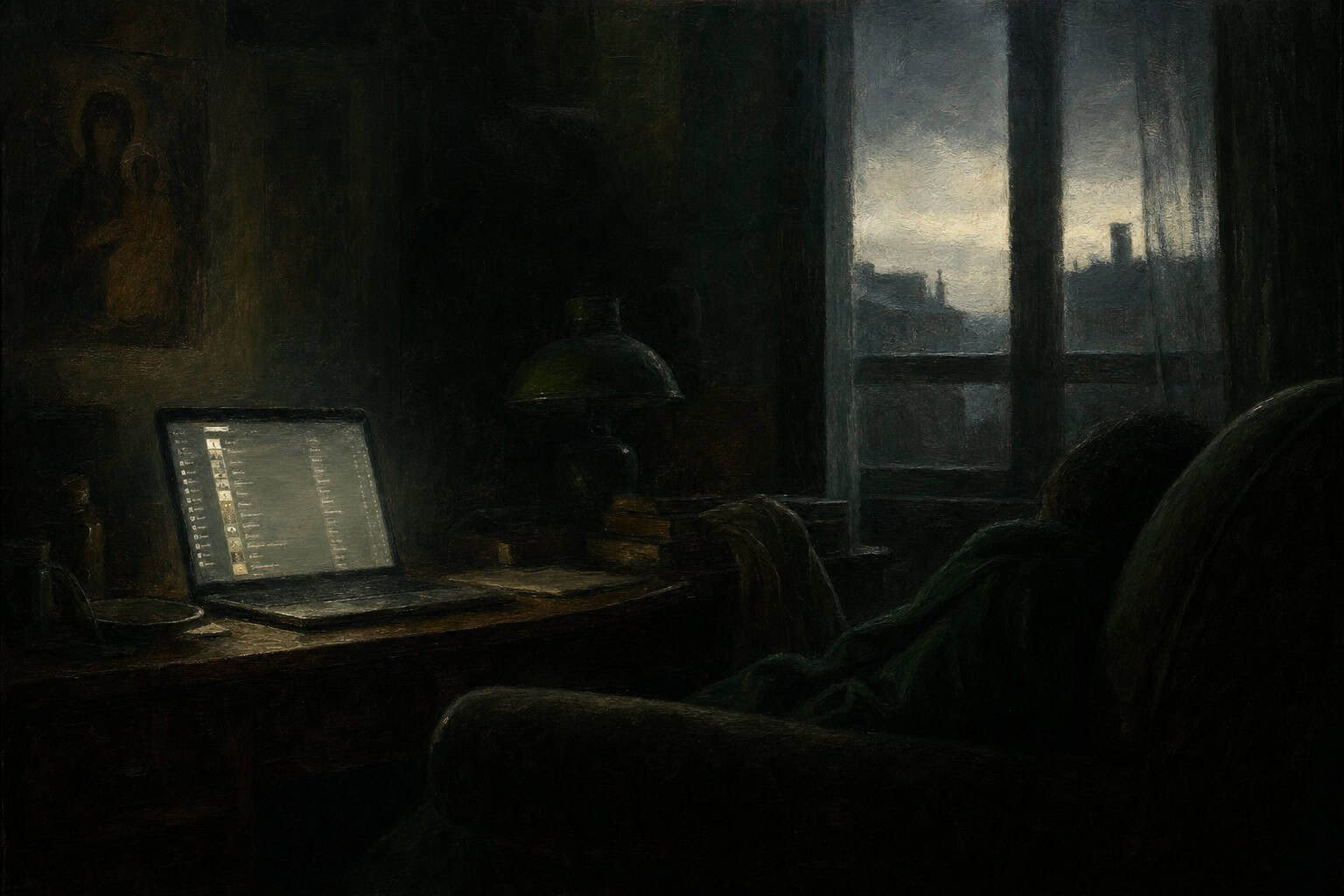
Blue light washes the room as ninety-seven track titles pile up like rosary beads — a fixed order for the hours, a liturgy he would never let himself call prayer.
The Screen Glowing With Ninety-Seven Names
Blue light washes the room as the cursor drags down an endless list: ninety-seven tracks, each line a small promise. The titles pile up like beads on a rosary, a fixed order for hours that would otherwise collapse into formless night. There is no crowd here, no sweat or smoke, only a man and his screen, scrolling through the names that have carried strangers through warehouses and fields until dawn. Bass and synth are still silent in the speakers, yet the body already remembers what these beats demand: motion, surrender, a loosening of the tight grip on waking pain. The catalog reads like a liturgy someone else wrote after giving up on church, a script for how to stay alive from midnight to morning. Fingers hover over the play button as if over a candle wick, knowing that once the first track starts, the whole sequence will want to run its course.
Beats Lined Up Like Hours Before Dawn
What looks like a playlist is really a schedule for surviving the dark. Each track length, each transition, carves the night into pieces that can be endured: four minutes of forgetfulness, six minutes of borrowed courage, eight minutes where nothing exists but the kick drum. The old Church hours once broke the day with psalms; here, the hours are broken with drops and builds, a different kind of call to rise. Yet underneath the structure runs the same ache: a soul trying not to be swallowed by the void between midnight and first light. The repetition is not laziness; it is armor. If the sequence holds, if the order of tracks does not fail, then maybe the mind will not slide into the familiar cliff-edge where nothing seems worth staying for. The playlist is less entertainment than scaffolding, thin metal holding up a heavy sky.
Basslines Pressed Against the Edge of the Abyss
Under the glossy names—ecstasy, ascension, forever—lurks a different truth: these songs are built to scream for you when your own throat has gone numb. The body, jittery even in stillness, knows why the volume must be high and the low end thick; quiet would expose the hollow under the ribs where dread lives. Each imagined drop on some distant dance floor becomes a shield against the picture of an empty future, a way to drown the thought that nothing holds. Yet the more the list scrolls, the clearer the tension becomes. This machinery of sound both reaches upward and leans toward collapse. It wants to lift the self out of its own weight, even as it flirts with the kind of dissociation that leaves a man staring at the ceiling, unsure how he got there. The pressure in this moment is simple and terrible: hit play and risk being carried too far, or sit in silence and face the unmasked dark.
The dance floor holds both the profane and the prayer, and the same rhythm that promises escape is often the one reaching for God.
Your Own Night, Your Own Headphones
Most will never stand in the exact apartment of this story, but almost everyone owns some version of this list—a set of sounds, shows, substances, or scrolling that keeps the night from closing in. There is no DJ booth or warehouse needed, only earbuds and a refusal to be alone with unfiltered thought. The passage exposes how fragile we are when our props for staying upright line up on a screen, ready to serve as both comfort and trap. To admit, as this narrator does, that certain scenes, parties, or freedoms would destroy him is not drama; it is sober inventory. Ordinary readers can recognize the same fault lines: the friend group that always ends in regret, the bottle that does not stop at one, the chat thread that erodes fidelity one joke at a time. This catalog of tracks asks a hard, practical question without ever stating it: which playlists in your life are helping you pray with your body, and which are quietly teaching you how to disappear?
A Cursor Hovering Over the First Track
In the quiet just before sound, the soul stands between two liturgies. One is the old one, with its stained glass and careful phrases that never seemed to touch the raw nerve of the body’s hunger. The other is this neon scripture, written in BPM and drug slang, yet whispering of water, fire, falling, rising—fragments of a faith that will not fully die. The man before the screen does not yet know how to let divine love reach into the same places that these beats have claimed, how to say yes to God without silencing the darker music that has kept him company. The finger has not pressed play; the speakers are still. What lies ahead is not a simple conversion from one soundtrack to another, but a long, unfinished work: learning which rhythms can be baptized, which must be buried, and whether he can ever dance without needing to vanish. For now, the night holds its breath with him, waiting to see which silence will break first.