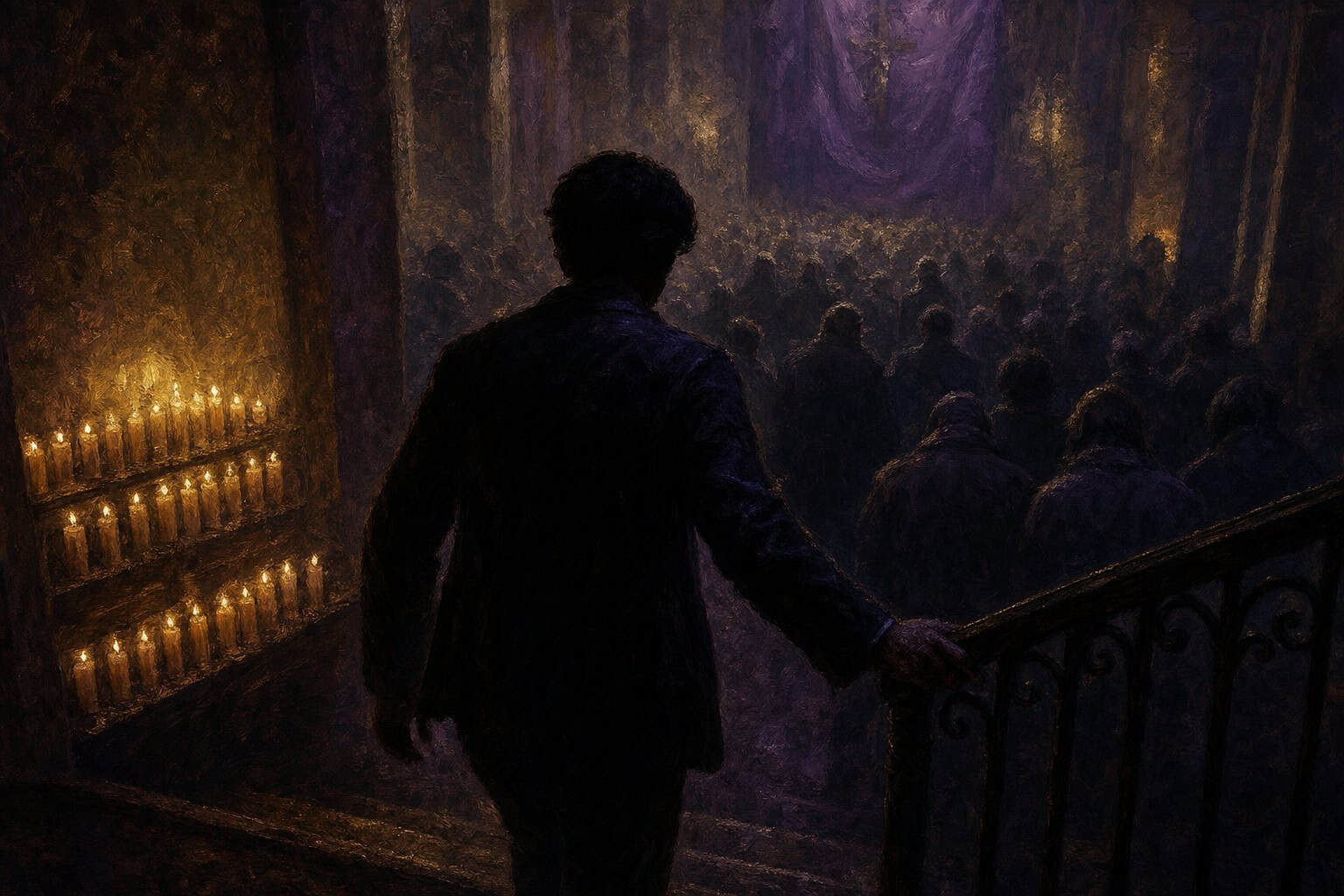
He keeps one hand on the cool metal rail, a small anchor above the bodies laughing below, not yet knowing how briefly the mind can hold its veto before the body drags him into the crowd.
The Hand on the Rail
He stands with one hand resting on the metal rail, a safe distance from the bodies moving and laughing below. The steel is cool under his palm, a small anchor for the mind that has learned to live several inches behind his skin. Up here, he can watch without being touched, can measure his smiles, time his jokes, decide exactly how much of himself to leak into the air. Then she catches his eye. No speech, no theology, only the brief tilt of her head toward the stairs that lead down into the crowd. His mind starts its usual calculations—risk, exposure, the threat of being known—but the hand on the rail betrays him first. Fingers loosen, muscles release, and before he has finished drafting his objections, his body has already turned. A nod answers her invitation. The rail that once felt like protection now hangs empty behind him.
When Hunger Grabs the Wheel
Desire doesn’t announce itself with romance here; it hits like low blood sugar. Knees a little weak, mouth slightly dry, chest aware of its own pulse. He has spent years training his intellect to veto anything that smells like risk, especially the erotic kind that once scorched his childhood. But this arousal is not an idea. It hums in his thighs, tightens his stomach, pulls his weight forward step by step. Every argument he mounts—about sin, about damage, about the danger of repeating old patterns—runs up against this blunt, embodied fact: he wants. The wanting is not polite. It refuses compromise, refuses delay, refuses to stay in the safe realm of fantasy. By the time his mind reaches its first “no,” his shoulders have already angled toward her, feet already taking the stairs. The hunger has seized the wheel, and his vaunted control is reduced to commentary hovering somewhere behind his eyes.
The Crowd as Moving Confessional
The press of strangers swallows him, warm and loud, smelling of sweat, perfume, cheap beer. For once, no one studies his expressions with the forensic care he has learned to fear. They are too busy dancing, shouting over the music, negotiating their own small dramas. This anonymity is its own kind of booth. He can slip into a joke without it being archived, can let his gaze linger without it being cross‑checked against a history. He feels her shoulder brush his arm, the barest contact, and a current jumps the gap his jokes could never cross. It is not tenderness, not yet; it is simply proof that his skin still conducts. Yet even here, his old architecture tries to rebuild itself: the practiced smile readies its mask, the script of deflection lines up on his tongue. The passage holds him in that friction—flesh leaning in, psyche bracing for retreat—as if the whole room were waiting to see which will win.
The mind can veto for only so long before the body overrules it, dragging us from our chosen purgatory into the mercy of the crowd.
What Our Own Railings Cost Us
Anyone who has ever gripped a metaphorical rail knows this trade. We call it prudence, discipline, even holiness: the careful management of expression, the rationing of need, the avoidance of situations where desire might speak louder than doctrine or fear. On the surface, it works. Fewer humiliations, fewer confessions, fewer nights replaying every word. But this passage lays bare the hidden bill. The same systems that mute danger also mute delight. The smile we fine‑tune to avoid misunderstanding slowly forgets how to curve for joy. The jokes we deploy like smoke grenades leave us standing alone after the laughter fades. When the young man’s body finally moves without permission, it exposes how costly his safety has been—how much genuine contact he has forfeited for the sake of control. The question that rises is not whether boundaries are good, but what happens when the rail holds us back long after the threat has passed.
Letting the Hand Fall Away
Some rescues arrive as softness; others come like a shove from behind. Here, salvation looks like a hand finally unclenching from cold metal, like legs obeying a throb of wanting instead of a spreadsheet of fears. Many of us live as he does, narrating our lives from somewhere behind the eyes, convinced that mastery means never being ambushed by our own flesh. This moment suggests another grammar: that sometimes grace rides in on the very impulses we least trust, not to excuse them, but to drag us back into a world where other people are more than threats. There is no promise in the scene that following desire will be clean or painless. There is only the stark alternative: return to the rail, resume the watch, recommit to being untouched. He stands one step deeper in the crowd now, heartbeat louder than the music, his abandoned hand tingling with the ghost of the bar it used to clutch.