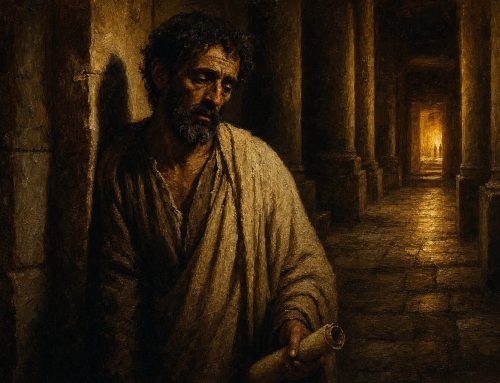
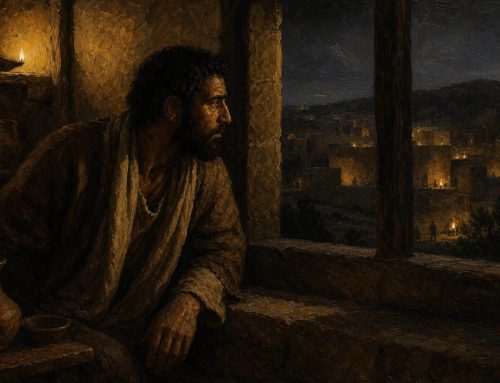
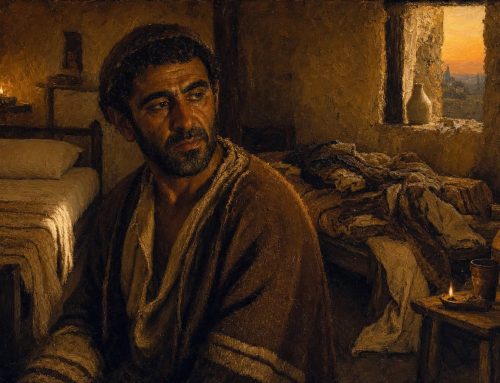
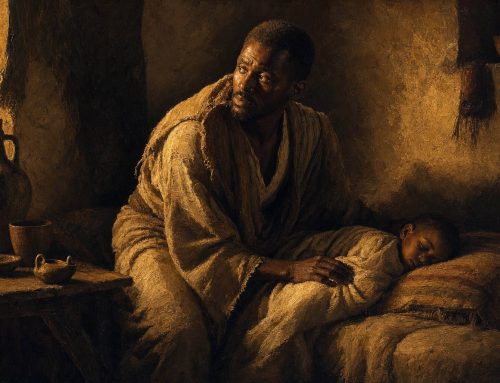
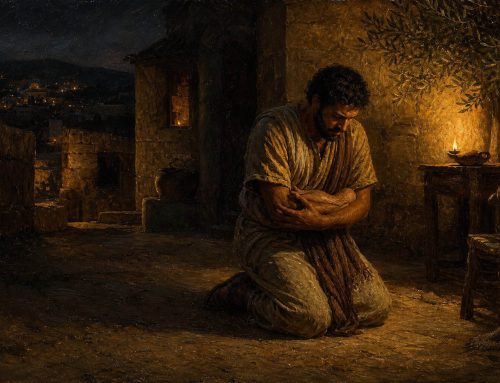
He comes to the window not as a visitor but as a man coming home, chest running ahead of his feet, pressing his face to a mesh so thin it should be nothing and has somehow become the whole geometry of his exile.
Face Pressed to the Wire
He arrives not as a visitor but as someone coming home, gait already softening into the half-step that belongs to familiar ground. The weight in his chest moves faster than his feet, rushing ahead to the imagined embrace waiting inside. Instead he meets a sheet of metal mesh, stretched tight over the frame, humming faintly when his knuckles brush it. On the other side, a face he has loved, skin mapped in lines he once traced with easy trust, now flattened into a grid of tiny squares. Air moves between them but warmth does not. The screen does its simple, brutal work: light passes, sound passes, eyes meet, and nothing else crosses. This is not the dramatic slam of a door or the blunt refusal of locked wood. It is more cruel in its restraint. Sight is allowed. Touch is not. The body understands before language catches up, registering the verdict in the sudden heaviness of his arms.
When Numbers Argue with Nerves
In that suspended space, the nervous system fires one report—this is over—while the mind charges in with charts and proofs. Years together line up in his memory like neat columns: shared jokes, whispered plans, the strange, bright peace he once felt praying for her by name. Each detail becomes a unit in an equation he is sure must balance. The wire between them feels temporary to his intellect, a misunderstanding to be corrected by reminding her, and God, of their history. But the slight angle of her torso, the way her fingers curl not toward the mesh but around the frame, speak a language no theorem can revise. He starts silently dividing time into before and after, measuring days since their last tenderness, counting the seconds her gaze holds and then slips away. Logic becomes a shield against the sting in his chest, a final attempt to turn heartbreak into a miscalculated sum instead of a clear, unarguable no.
Debt Written Across the Mesh
While that no hangs in the afternoon air, another ledger flips open behind his eyes, older than this house and this woman. He remembers the years he aimed his whole life at the altar, offering himself with the secret conviction that God was still waiting on a payment. Celibacy had looked like a coin to drop in a bottomless slot: give up marriage, give up a body’s ordinary consolations, and maybe the scales would finally tip toward enough. Only when the collar was almost within reach did he begin to see the insult hidden inside that bargain—that the Cross had not, in his mind, cleared the account. Now, with his fingers catching on the rough metal, he recognizes the same pattern dressed in different clothes. This hoped-for wife, this imagined table and child, have been dragged into that same economy of repayment. The screen does not explain or soothe any of this; it simply reflects it back, each thin wire a line in the story of a man who keeps trying to buy what has only ever been given.
The thinnest screen can become the whole geometry of exile, and the mind will do any math to deny the distance it cannot cross.
Where Your Skin Meets the Grid
Most people will never stand at this exact window, but almost everyone knows the sting of feeling their cheek close to something they cannot quite touch. Maybe for you it is the glow of a phone in your palm, messages blinking from someone who once held you, now reduced to words that never cross into flesh. Maybe it is an office where your work is praised, your name spoken in meetings, yet real decisions move along tracks you will never set foot on. The body feels these distances before the mind names them: a tightness in the throat at family gatherings where everyone smiles but no one asks the questions that matter, a hollowness in the stomach when prayer begins to feel like speaking through a fine, but unyielding, mesh. This passage refuses to spiritualize that ache away. It insists that grace does not float above such wire barriers, but presses its own wounded hands against them, asking where, in your life, the grid has mistaken itself for the final word.
The Mesh Imprinted on the Palm
There comes a point when even the bravest calculations fall silent and only the imprint remains. After the window, after the careful conversation that never quite steps across the wire, he will walk back down whatever path brought him there. Yet the body carries the scene like a scar that has not yet risen to the skin. In idle moments his thumb will trace the memory of the mesh, almost expecting to find its pattern pressed into his flesh. His thoughts will circle back to that meeting of eye and wire, drafting new timelines where he insisted more, or turned away sooner, or never came at all. The Church’s teaching on grace, once a set of propositions, now throbs against this lived refusal like a bruise under a sleeve. Nothing resolves here. The soul stands, in memory, with its hand still lifted, the faint echo of the screen’s cold rattle lingering in the bones, like the aftertaste of metal on the tongue.