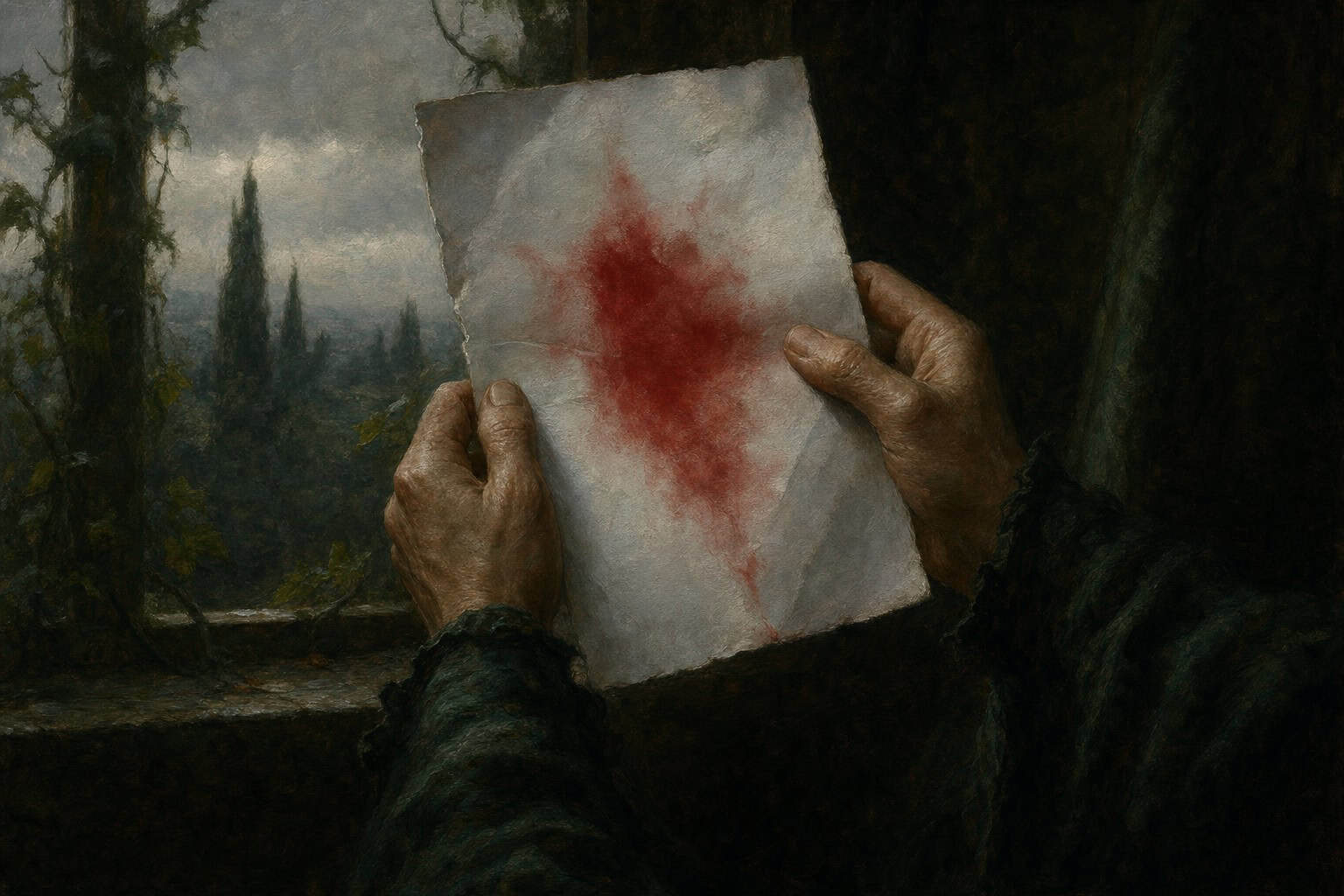
A flimsy sheet of college paper trembles in his hand, a red D-minus carved into the margin like a verdict — the failing grade that will turn out to be the severest mercy, the one that finally breaks his cleverness open.
Red Letter in a Fluorescent Classroom
A flimsy sheet of college paper shakes between his fingers, the red D-minus carved into the margin like a verdict. Fluorescent light hums overhead, turning every blemish on the page into something louder, harsher. Around him students shuffle, joke, shove papers into backpacks, while his stomach drops as if the floor has given way. This is not the quiet disappointment of a missed point; it is the loud collapse of a boy who has bet his dignity on being the clever one. Years of late-night reading, of inward debates won against imagined opponents, now gather into this single red mark that refuses to be explained away. The professor’s pen has cut through the costume, and there is no defense, no charming escape. The paper smells faintly of toner and sweat, and his own name, printed at the top, suddenly feels like it belongs to someone smaller than he believed himself to be.
Bleach Fumes and the Taste of Failure
Back in the dorm, the memory of that paper clings to him like a film he cannot rinse off. He grips a plastic bottle of bleach, pours it straight onto the tile, and starts to scrub until the fumes sting his eyes and throat. His roommate—nicknamed Swamp—has left the usual trail: damp towels, half-eaten food, a sour, heavy smell hanging in the air. Each stroke of the sponge becomes a fury against that smell, against the sticky reality of bodies that sweat and fail and rot. If he can make the room shine, maybe the red mark in his chest will fade, maybe he will not feel so small, so stupid, so ordinary. But the more he scours the floor, the more his arms ache, and the more that grade burns in memory. The bleach cannot reach the part of him that is smarting, and the sting in his lungs feels almost like punishment accepted on purpose.
A Hidden Chapel Behind the Textbooks
At night, when the bleach scent has settled into the grout and Swamp’s breathing grows thick across the room, he turns toward a different kind of ache. In the narrow bed beside the cinderblock wall, he calls up the face of the one he loves but cannot reach. Her voice, once carried by late phone calls, now lives in scraps of memory he revisits with almost ritual care. He tucks those images behind his textbooks and notebooks, a private space in him that no grade report can enter. What began as ordinary longing has become a guarded shrine, a place where he tries to hand his desire back to God without knowing how. He refuses to speak of her to the men on his hall; their crude jokes would profane what he is trying to keep clean. In that hidden place, love and prayer start to blur, and the absence itself feels sharper, almost sacramental in its demand.
Sometimes the humiliation that shatters our cleverness is the severest mercy God can offer, the failing grade that finally frees us.
One Bare Foot on Cold Linoleum
Sometimes the humiliation and the hunger rise together so fast the room starts to tilt. Lying in bed, the ceiling seems to spin, and his thoughts chase themselves until even his own mind feels unreliable. Someone once told him, during a bout of physical vertigo, to plant one foot flat on the floor to steady the spinning. He tries it now: swings one leg over the side of the mattress, presses his bare sole against the cold, slightly sticky linoleum. The chill climbs his calf, the floor’s hard refusal meeting the softness of his skin, and the whirl slows just enough. Whatever he thinks about God, about love, about failure, his weight still has to settle somewhere. The foot on the floor does not restore his pride or resolve his questions, but it drags his scattered attention back into his own body. He breathes, feeling his heel rooted in the cheap dorm tile, as if this stubborn contact with the ground is its own quiet, wordless prayer.
Words That Taste Like Tomorrow’s Fall
In the middle of this spinning season, his mouth keeps betraying him. Over coffee with friends, or in joking boasts thrown out to cover the sting of the D-minus, he hears himself making vows he knows, somewhere deeper, he will not keep. Promises of future brilliance, of unshakeable fidelity to God, to the beloved, spill out too easily, and even as he speaks them, something in his chest winces. It is as if another part of him is already watching the day he will walk away, already tasting the dust of the collapse. This knowledge does not come as noble self-criticism but as a dull, frightening honesty: he is capable of more betrayal than he can imagine right now. The strange mercy is that the warning arrives in his own voice, smuggled inside jokes and bravado. Those words hang in the air after the laughter fades, faint as chalk dust, waiting to be remembered when the fall they foretold finally brushes past his skin.