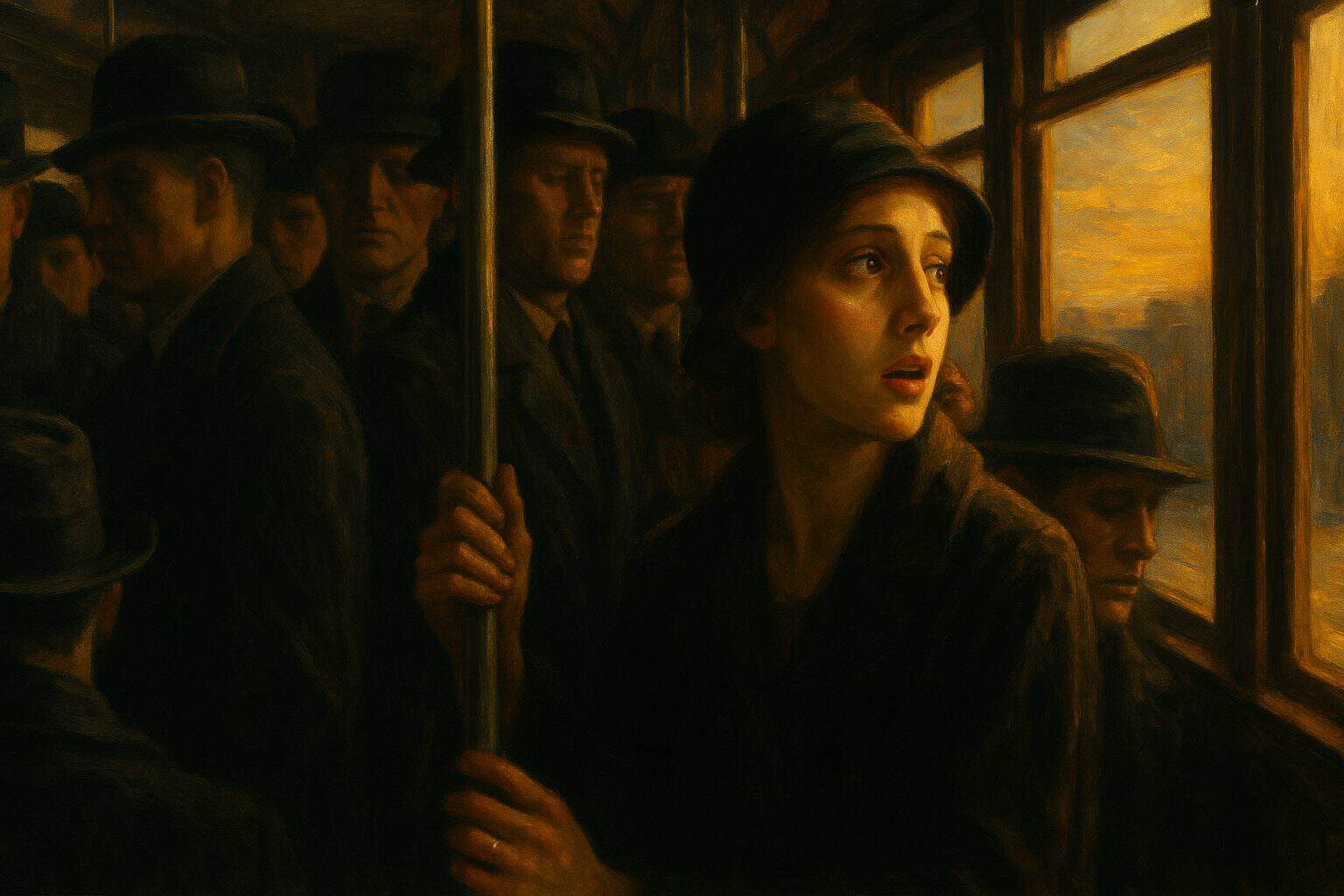
How the anonymous “they” infiltrates consciousness until we cannot distinguish our own voice from the chorus
The morning alarm sounds, and before consciousness fully gathers itself, the day’s obligations already press their weight. Check the phone—how many liked yesterday’s post? The coffee must be the right brand, the clothes must signal the right belonging, the greeting to the neighbor must strike the proper tone of casual friendliness. By the time I arrive at work, I have already performed a hundred small surrenders to what “one does,” what “people think,” what “everyone knows.” The crowd-self has been living my life since before I opened my eyes.
The Anonymous Sovereignty
There is a peculiar quality to how the crowd-self operates—it never announces itself as foreign. When I reach for my phone first thing in the morning, it feels like my desire. When I worry about being seen in yesterday’s clothes, it feels like my concern. The crowd-self doesn’t impose from outside like a tyrant; it colonizes from within, speaking in the first person, using my voice, moving my hands.
Watch how naturally the phrases come: “One doesn’t do that.” “People will think…” “Everyone knows…” Who is this “one”? Who are these “people”? This “everyone” who seems to know so much—have I ever met them? Yet their authority feels more real than my own uncertain judgments. When I defer to what “they say,” I find relief from the terrible burden of choosing, of standing behind my choice, of being seen choosing.
The crowd-self offers the comfort of the already-interpreted world. The restaurant is “good” or “bad” before I taste the food. The movie is “worth seeing” or “overrated” before the lights dim. The career path is “practical” or “risky” before I’ve walked a single step. Everything arrives pre-digested, pre-evaluated, freed from the raw encounter that might demand something from me.
The Legion Made Singular
“The individual then calls each of their involvements back home to themselves… transcribing the legion of their social entanglements with their singular body.” But watch what happens in the ordinary day—the reverse movement, where the singular body becomes a switching station for legion voices.
At the morning meeting, I hear myself speaking in business-speak that would mystify me in any other context. The jargon flows fluently: “leveraging synergies,” “moving the needle,” “low-hanging fruit.” Where did I learn this language that I never chose to learn? In the afternoon, scrolling social media, I find myself outraged by what everyone is outraged by, delighted by what everyone finds delightful. The emotional weather of the crowd moves through me like a front system I cannot resist.
Even in solitude, the crowd-self maintains its presence. Alone in my apartment, I arrange the bookshelf knowing somehow what books should be visible, what music should be playing if someone drops by. The imaginary gaze of the anonymous “they” furnishes my private space, choreographs my solitary movements. I am never alone because the crowd is always already here, in the very structure of my consciousness.
“Most will choose to surrender autonomy and responsibility in order to find comfort in the familiar.”
The comfort is real. When I move with the crowd-self, I move with the momentum of the already-decided. The restaurant everyone goes to, the show everyone watches, the opinion everyone holds—these require no defense, no explanation. They carry the peculiar authority of the obvious. To choose otherwise would mean standing out, being seen, accounting for myself.
The Authentic Eruption
Yet sometimes—often when least expected—something breaks through. A piece of music stops me mid-step, not because it’s critically acclaimed but because something in it speaks to something in me, beneath all the layers of the crowd-self. A person’s face, glimpsed in passing, carries a quality of suffering or joy that no generic category can contain. In these moments, I experience what the memoirs call that recognition: “I know my internal states; this was not generated from within.”
But here’s the delicate point—this “not generated from within” is different from the crowd-self’s colonization. When the crowd-self speaks through me, I mistake its voice for mine. But in these moments of authentic eruption, I know with absolute clarity: this comes from beyond me, yet it calls to what is most deeply me. It’s not the anonymous “they” but a specific address, a particular summons that has my name on it.
The difference is unmistakable once felt. The crowd-self disperses me into generality—I become anyone, everyone, no one. But authentic encounter gathers me into devastating specificity. I am this one, here, now, faced with this choice that no one else can make for me. “Their choices are inauthentic insofar as something else, other than their own consciousness, determines their personal agency.” Yet consciousness itself can be so thoroughly infiltrated by the crowd-self that finding where “I” begin requires a kind of archaeology of the soul.
The False Escape
There’s a trap here that must be named. Sometimes what looks like escape from the crowd-self is merely the crowd-self in different costume. The rebel who reflexively rejects whatever “they” accept, the nonconformist who compulsively does the opposite of what “one does”—these too are forms of possession by the crowd. To be determined by negation is still to be determined.
“We are not seeking to surrender or substitute our individuality on the altar of someone else. Such an abdication of personhood invalidates any insights we might discover from threads, nuances, breadcrumbs, and patterns in their tapestry.” The point isn’t to become someone else’s idea of authentic, not even the idea of authenticity that sophisticated people hold. That would be to exchange one crowd for another, perhaps smaller, perhaps more refined, but still a crowd.
Watch how even the pursuit of authenticity can become a crowd phenomenon. The right spiritual practices, the correct critical stance, the approved forms of self-expression—these too can become what “one does” in certain circles. The crowd-self is endlessly adaptable, capable of wearing any mask, even the mask of unmasking.
The Descent Into Specificity
“Do not resent the descent; it is where the ascent finds its meaning and purpose.” The descent here is into the terrible specificity of one’s actual life—not life in general, not the idea of life, but this life with its particular wounds, its specific failures, its irreplaceable losses. The crowd-self always speaks in generalities: “Everyone goes through this,” “It’s just part of life,” “Time heals all wounds.” But my wound is not everyone’s wound. My loss is not a general loss.
In the descent, I discover what cannot be shared, what cannot be dissolved into common wisdom. “She is both the person standing in front and behind the mirror, herself and her replicant, and her shadow and its source.” This doubling, this self-encounter in the depths—it reveals simultaneously the crowd-self I have been and the irreplaceable self I am called to become.
The crowd-self cannot follow into certain depths. In extreme suffering, in genuine love, in the face of death, its voice grows thin, its authority wavers. “Biochemical organisms in the divine-less material world who create meaning for themselves on their journey toward death”—even this supposedly scientific reduction is another crowd voice, another “everyone knows.” But faced with actual dying, my own or a beloved’s, such formulas crumble. I am thrown back upon resources the crowd cannot provide.
The Daily Struggle
“I would always struggle to remain true to my authentic self and continue my personal journey of becoming, rather than surrendering to the will of others.” But notice—it’s a struggle that would always continue. Not a battle won once and for all, but a daily, hourly vigilance. The crowd-self doesn’t retreat after one defeat; it seeps back in through every unguarded moment.
This morning, writing these very words, I catch myself wondering what “people will think,” whether this captures what “everyone experiences.” The crowd-self infiltrates even the attempt to describe it. It takes constant attention to distinguish: Is this insight emerging from lived encounter, or am I reproducing what “one says” about authenticity?
The struggle happens in the smallest moments. Choosing to sit with discomfort rather than reaching for the phone and its stream of crowd-consciousness. Letting a conversation fall into silence rather than filling it with what “one says” in such moments. Admitting ignorance rather than repeating the opinion everyone has. These tiny resistances, these minor refusals—they create small clearings where something genuine might appear.
The Paradox of Separation
“A relationship with me means casting others into the fire, not for safekeeping until later, but as a step toward owning authentic individuality in solitude.” This sounds harsh, but consider what it actually names: not misanthropy but the recognition that genuine relationship requires genuine selves. Two crowd-selves cannot truly meet; they can only exchange passwords, confirm shared membership in the anonymous “they.”
“Confidence in loneliness and pride in solitude resurged, overtaking any aspiration of my being human again.” Yet this too can become a trap—the crowd-self wearing the mask of the solitary genius, the one who has transcended the need for others. True solitude isn’t the absence of others but the presence of oneself, gathered from dispersion, available for genuine encounter.
The paradox: I must separate from the crowd-self to find myself, but finding myself isn’t the end goal. “Each brings their bodies with them to every act of consciousness, beginning and ending from the perspective of the first-person plural.” The authentic self doesn’t exist in isolation but in the capacity for real relationship, real responsibility, real response to what addresses me specifically.
The Wisdom That Remains
“I took it all in, trusting that beneath these many different masks, a single, authentic self held everything together.” But perhaps the truth is more unsettling—perhaps there is no fixed, authentic self waiting to be uncovered, but rather authenticity is the ongoing struggle itself, the daily work of distinguishing my voice from the crowd’s, my choice from what “one chooses.”
The crowd-self promises rest from this struggle. Follow the patterns, meet the expectations, say what one says—and find peace in dissolution. But “desire is not meant to be an end in itself… but instead requires an object outside of itself, ‘knowing,’ to pursue in order to actualize its purpose.” The crowd-self offers pseudo-knowledge, pre-digested answers. Authentic seeking requires staying with questions the crowd has already answered, remaining open to encounters the crowd has already categorized.
“There is only one God, Yahweh, and He has marked me as His since before I drew my first breath. To Him alone will I answer and ask for mercy.”
This declaration cuts through every crowd voice—neither the religious crowd that would approve nor the secular crowd that would dismiss, but a specific address and a specific response. Whether one shares this particular faith or not, the structure remains: somewhere, something calls to me specifically, knows my name, will not let me dissolve into generality.
The Ongoing Task
The crowd-self never fully retreats. Even now, having traced its movements, having named its strategies, I feel it reforming, adapting to include even this awareness. “The descent reveals the idols; the ascent reveals the God who remains when idols fall.” The crowd-self is perhaps the subtlest idol—the one that doesn’t even appear as something external to be worshipped but as the very voice of reason, normalcy, reality itself.
Tomorrow morning the alarm will sound again. The phone will beckon with its stream of crowd-consciousness. The day will offer a thousand opportunities to dissolve into what “one does.” But perhaps, having seen the structure, having felt the difference between the crowd’s voice and authentic address, I might notice the moment of choice. Not the grand choice to be authentic once and for all, but the small, repeated choice to pause, to listen for what speaks specifically to me, to respond from the irreplaceable place I occupy in being.
“Individuality weaves the threads from each of these divergent roles into a singular tapestry, the self.” But this weaving requires distinguishing which threads are mine to weave and which have been handed to me by the anonymous “they.” It requires what the contemplatives call discretio—the discernment of spirits, the ability to distinguish what comes from within, what from without, and what from beyond both.
The crowd-self lives my life most successfully when I forget it exists. Remembering—again and again, in each new moment—that is the beginning of freedom. Not freedom from others, but freedom for genuine encounter. Not escape from the world, but presence to it. Not the assertion of an isolated self, but the patient emergence of one who can truly say “I” and mean it.