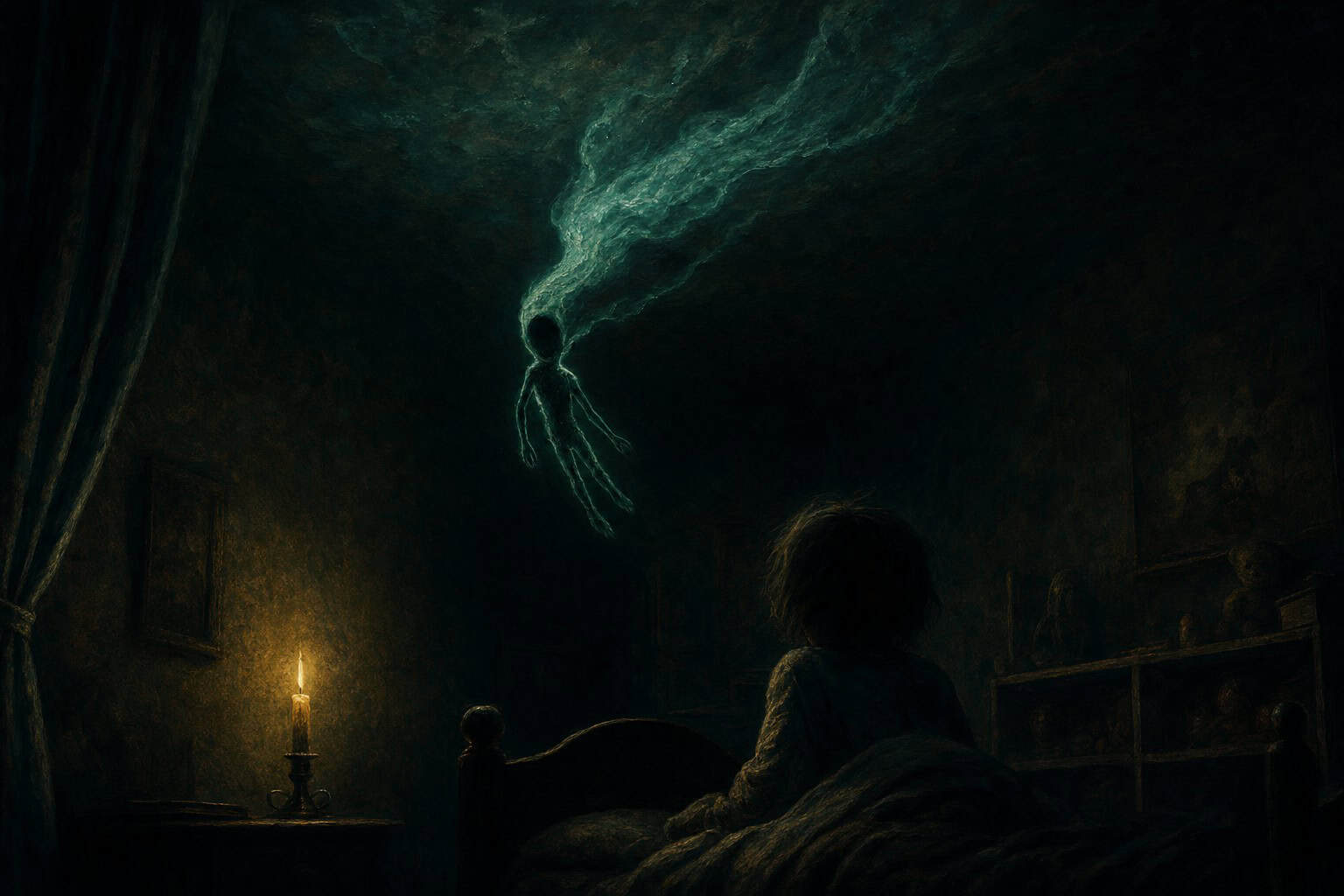
Long before doctrine or confession, one image is planted to haunt the whole book: a small boy in a West Texas bedroom and a green, vapor-thin figure bending over him — a mark meant to damn that will, impossibly, become the eyes by which he learns to see grace in the dark.
A Green Shadow Over a West Texas Bed
Long before doctrine, confession, or adult sin, this chapter plants a single image that will haunt the whole book: a small boy in a West Texas bedroom and a green, vapor-thin figure peeling down from the ceiling toward his bed. Around that bed, ordinary life hums along—parents unwinding after work, a modest house settling into evening, the vague trust placed in a teenage babysitter. Inside that bed, another world has already opened. A ritual the boy never chose has branded his flesh and spirit, thinning the barrier between seen and unseen so that spirits can cross into his nights. The chapter does not linger on the babysitter’s psychology. It names her alliance with ancient names and moves quickly to the deeper reality: a child drafted into a war that predates him, his body used as the battlefield where that war will now localize. From that bed outward, every memory, pleasure, and prayer will be touched by what first entered there.
Stickman: The Enemy Who Fits on a Sheet of Paper
The organizing reckoning of the chapter is not the babysitter’s crime but the visitor she makes possible: a twelve-inch, luminous dark green figure the boy will later call Stickman. He is small enough to fit on a piece of paper yet carries a pressure that seems to push oxygen out of the room. His body is smoke that breathes, joints like gaps in a bad transmission, a head like a windsock turned the wrong way. He advances down invisible stairs while a high, piercing ring drills into the child’s ears and the house’s normal sounds recede. Here the book names, in concrete language, the specific torment assigned: not full possession, not cinematic levitation, but obsession—relentless, invasive thoughts and images that cling to waking and sleeping. The reckoning is simple and terrible: this is not a one-time scare. This is the shape the enemy will take, the pattern of attack that will repeat long after the green shadow itself stops appearing over the bed.
From Marching Heartbeat to Piercing Ring
Across the chapter, feeling travels like a soundscape that gets rewritten. The boy once fell asleep to the steady drum of his own heartbeat, a private marching band that meant safety. After the ritual and the visitation, that rhythm is driven out by the shrill ring that ushers Stickman’s presence, a tinnitus that shoves every gentler sound to the margins. Fear is not described from a distance; it shows up as muscles locked under blankets, breath held against cold air that should show but does not, skin tightening as hair rises along the neck. While televisions murmur on the other side of thin walls, a three-year-old lies trapped between wanting to look and not daring to see. The chapter never rushes to comfort or explanation. It lets that mismatch stand: a tiny body, a modest house, and an intrusion that makes even crickets go silent. In that silence, the boy’s inner weather changes permanently from lullaby to alarm.
The mark that was meant to damn him became the very eyes through which he learned to see grace in the dark.
When a Child’s Night Becomes a Battlefield
What happens around that bed is not treated as an isolated haunting but as the first clear skirmish in the lifelong conflict the memoir will follow. The author names the classic stages of spiritual assault—deception, division, diversion, discouragement—and then situates his own torment within that larger pattern. Obsession is his assigned front line. From this point, his Catholic faith, his sharp mind, and later his misused body will all be conscripted into the same war that began with a teenage girl’s hidden ritual and a green shadow over a toddler’s bed. This chapter keeps its focus narrow—one house, one child, one spirit—but it gestures toward decades of consequence: a man who will lace up his gloves every morning, a priestly call to feed others while still bleeding, a refusal from God to remove the darkness even as He remains in it. The battlefield is not a metaphor. It is a childhood bedroom that never entirely stops being a combat zone.
The Child Who Learns to See in Contaminated Light
The quiet promise under all this terror is not that the green shadow will vanish or that the mark will be erased. The promise is stranger and harsher: this early contamination will train the boy to notice what others miss and to read both horror and grace through the same altered light. The chapter frames his later loves—the taste of steak, the echo in an empty church, the neon of Deep Ellum, the weight of his children in his arms—as moments that do not cancel the dark but teach him how to see within it. The babysitter’s ritual becomes, without softening its evil, a crooked doorway into a vocation: to know the enemy so well that he can name him, and to know his own warped interior enough to offer it back to God. Readers who enter here are not promised a clean story of rescue. They are invited to watch a man learn to pray from the same place where a green, breathing shadow once hovered over a child’s bed.