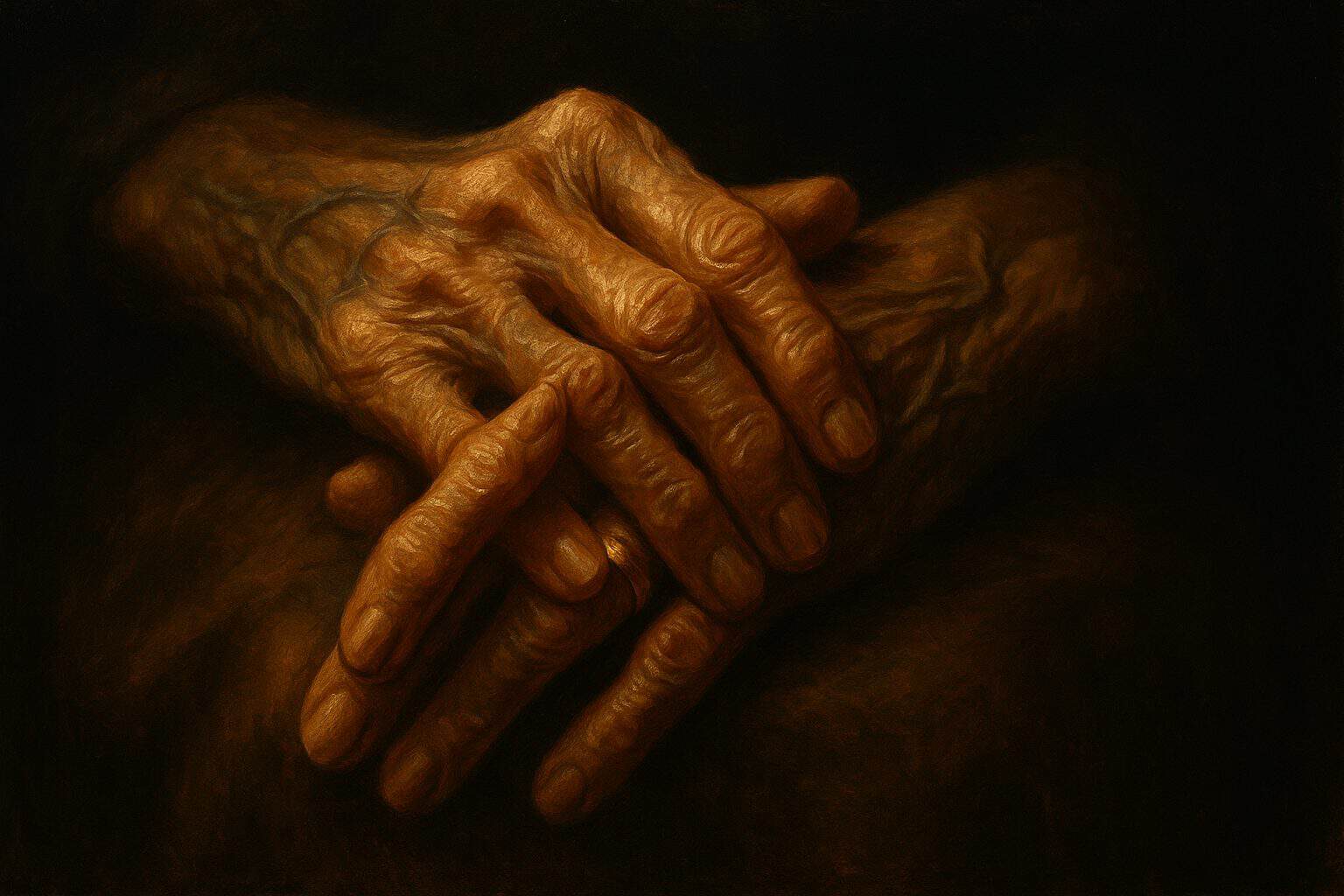
Where touching discovers itself touched, the body reveals its double belonging to both sensing and sensed.
The Chiasm of Touch
Place your right hand upon your left. In this simplest of gestures, something extraordinary occurs—not in thought, not in theory, but in the immediate lived experience of your own flesh. The touching hand explores the touched hand’s warmth, its texture, the slight resistance of bone beneath skin. Yet in the same moment, an uncanny reversal: the touched hand feels itself being explored, knows the weight and warmth of its explorer. Neither hand holds priority. Each is simultaneously subject and object, sensing and sensible, the active touch and the passive touched.
This is not two separate events—one hand touching, another being touched—but a single phenomenon with two faces, like a glove turning itself inside out while remaining whole. The flesh discovers itself as this strange reversibility, this capacity to be both the one who feels and what is felt. Here, in this most ordinary experience, lurks a mystery that no amount of physiological explanation can exhaust: the body’s double life, its existence at the hinge between consciousness and thing.
The Flesh of the World
When lovers unite in that ancient dialogue where “touch becomes a separate dialogue… culminating in sensuality: the point in sex where the spirit of each resonates in the flesh,” they discover this reversibility raised to its highest pitch. The caress that explores another’s skin simultaneously exposes one’s own vulnerability. To touch is to offer oneself to be touched. The “pleasant sight of her soft, curvy, inviting flesh” that “entices his passion” is not merely an object perceived but a call that awakens the perceiver’s own flesh to its possibilities.
In this intertwining, neither remains a pure subject observing an object. Each discovers what Merleau-Ponty calls la chair—the flesh—not as mere physical matter but as the element of reversibility itself, the common tissue from which both sensing and sensed are cut. “The place of their bodily union is also the gateway for channeling the creation of new souls”—here the flesh reveals its deepest mystery, its power to generate not just sensation but existence itself.
The world itself possesses this structure. The visible landscape that surrounds me is cut from the same cloth as my seeing body. The mountain I perceive across the valley is not simply “out there” while I am “in here”—rather, my visible body and the visible mountain share in visibility itself, participate in the same flesh of the world. This is why the world can show itself to me: because I am not a pure consciousness surveying it from outside, but a body among bodies, a visible that can see, a tangible that can touch.
The Anonymous Life of the Body
Beneath our personal choices and conscious decisions runs another current—the pre-personal life of the body that breathes without our thinking about it, that maintains its balance as we walk, that knows how to reach for a glass without calculating distances. “Each brings their bodies with them to every act of consciousness,” yet this body operates largely below the threshold of awareness, managing a thousand micro-adjustments while consciousness attends to other matters.
“What we perceive through our five senses become fodder for the intangible to evaluate and consider and often what is intangible manifests itself in one form or other to the outside world.”
This anonymous bodily life is not unconscious in the sense of repressed or hidden—it is rather pre-conscious, operating according to its own intelligence. The hand knows how to grip, the foot how to find its purchase on uncertain ground, the eyes how to converge on an approaching face. This bodily savoir—this knowing-how rather than knowing-that—underlies all our explicit knowledge like a vast root system beneath visible growth.
When illness strikes—when the body that usually efffaces itself in favor of our projects suddenly announces itself through pain or dysfunction—we discover how much of our existence rests on this anonymous foundation. The person whose “life’s meaning, dependent upon her, leaves him unable to exist apart from her” experiences the collapse not just of conscious purposes but of this whole pre-personal infrastructure that tacitly supported them.
The Intercorporeal Bond
“Each projected themselves into the future, creating the ephemeral road within the realm of the intangible using the tool of giddy expectation to make it real and tangible one day.” This projection happens not through pure thought but through the body’s power to inhabit imagined situations, to feel in advance the weight of anticipated embraces, to rehearse in muscular imagination the movements of reunion.
We understand others not by reasoning from external signs to hidden mental states, but through a kind of bodily resonance. When I see another’s gesture, my body knows from within what that gesture means because it harbors the possibility of making the same gesture. The infant who returns a smile does not first observe facial muscles, then deduce an emotion, then decide to respond—the smile calls forth a smile through a communication more primitive than thought.
This intercorporeality—this pre-personal communion between body-subjects—underlies all explicit communication. Before we exchange words or ideas, we exchange presence, posture, the music of movement. “Their worship is always of themselves; their liturgy, demand”—even in its distortion, worship reveals this fundamental structure of bodies oriented toward and responding to each other in shared space.
The Incarnate Paradox
“The Greek worldview, where the Christian faith later spread, saw dualism—a pure spirit trapped in the corrupting prison of the body. In contrast, the Bible shows the resurrection of all, body and soul reunited.” This reunification is not a future event only but the present structure of incarnate existence. We are not souls using bodies like tools, nor bodies generating consciousness like steam—we are body-souls, spirit-flesh, the hyphen itself rather than either term.
The attempt to separate flesh and spirit, to establish “a clear distinction…between the flesh, the physical and human nature, and the spirit, the immaterial or divine nature,” encounters a stubborn resistance in lived experience. Where exactly would we draw this line? The “passions speak their own language and create the fodder that reason must later digest”—but these passions are neither purely physical nor purely spiritual. They are the body-subject’s way of being toward the world, irreducible to either biology or psychology.
“God created sex and did not recoil from the woman who bled, but healed her private flesh of His own creation—her lady bits.”
The scandal of incarnation—divine concern for “lady bits” and bleeding flesh—points toward this irreducible unity. “Ours is not to remain a disembodied soul in heaven but a reunited and purified body-soul in the New Jerusalem.” The body is not a temporary vessel but the permanent form of human existence, even in its ultimate transfiguration.
The Temporal Flesh
The body carries time in its tissues—not clock time but lived duration, the sedimentation of habit, the weight of memory in muscle and bone. “Meaning, for human beings, unfolds within the framework of time and mortality; they incorporate the knowledge of the dead into their lives.” This incorporation is not metaphorical but literal—we carry the gestures of the dead in our own movements, their words in the patterns of our speech, their presence in the very structure of our bodily being-in-the-world.
When we sit in a chair our grandmother once occupied, our body remembers not through explicit recall but through a kind of postural echo, a resonance between past and present flesh. The “unfashioned souls loving me from heaven, their existence like God’s vision of a painting before the first brushstroke” hover at the edge of bodily perception, not as disembodied spirits but as the continuing reverberation of their incarnate presence in the flesh of the world.
The Flesh and the Divine
“You must love the Lord your God with all your heart, with all your soul, and with all your mind.” This love is not divided among separate faculties but rises from the whole body-subject as a single movement. The heart that loves is not the metaphorical seat of emotion nor the physical pump of blood but the lived center of personal existence where body and soul are indistinguishable.
When consciousness becomes “more attuned the spirit than to the flesh,” this is not an escape from embodiment but a deepening into it, a discovery of the body’s own spiritual depths. The prohibition against “using tarot cards, Ouija boards, mediums, or necromancers to artificially transcend the perceptual limitations of the flesh” protects not just against deception but against the fantasy of bypassing incarnation itself.
True transcendence moves through rather than around the flesh. “If you gaze upon me resting in my coffin with eyes of the flesh, all you will see is the flesh of my hollow corpse—but I am not there.” Yet this absence is known precisely through the presence that is missing, the reversibility that no longer reverses, the flesh that no longer responds to being touched. The dead body is uncanny precisely because it still resembles the lived body while lacking its essential structure—the power to touch back, to return the gaze, to inhabit rather than merely occupy space.
The Wound in Being
In every perception lurks an incompleteness, a gap that cannot be closed. I can never see my own face directly, never catch myself in the act of falling asleep, never touch my touching itself. This is not a failure but the very structure that makes perception possible—if I could see myself completely, I would no longer be a seer but only a thing seen. The reversibility of flesh is never perfect coincidence but always includes this écart, this divergence or spread that keeps the touching and touched from collapsing into identity.
“His life’s meaning, dependent upon her, leaves him unable to exist apart from her”—in this dependency appears not weakness but the fundamental structure of flesh itself, which exists only in relation, only as the possibility of reversibility with another. The isolated body is an abstraction; actual flesh always already implies other flesh, the circuit of touching and being touched that constitutes the sensible world.
This incompleteness is not lack but openness—the permanent possibility of new reversibilities, new ways for flesh to fold back upon itself and discover what it is. Each encounter with another—each moment when “Adam is the flesh that he chooses to comfort him”—reveals new dimensions of our own incarnation, new ways we can be touched and therefore new ways we can touch.
The Resurrection of Flesh
“What is born of human nature is human; what is born of the Spirit is spirit”—yet in the phenomenon of flesh, this division constantly undermines itself. The spirit is not added to flesh from outside but emerges from within flesh’s own reversibility, its power to fold back upon itself and become aware. Consciousness is not a light shining on the body from elsewhere but the body’s own luminosity, its way of being present to itself and world.
The promise that “the original love from the divine is changeless” meets flesh that is essentially temporal, always becoming other than itself. Yet perhaps changelessness itself must be rethought from within the phenomenon of flesh—not as static perfection but as inexhaustible reversibility, the endless capacity to touch and be touched anew, to discover in each moment fresh dimensions of incarnate existence.
“Neither death nor life, nor angels, nor principalities, nothing already in existence and nothing still to come, nor any power, nor the heights nor the depths” can separate us from this love precisely because it is not external to flesh but the very principle of flesh itself—the reversibility that makes flesh flesh, the doubling back that creates both sensing and sensed, the fold in being where consciousness emerges.
The Flesh of Meaning
Words themselves carry flesh—not as arbitrary signs but as gestures of the speaking body, movements of tongue and breath that shape air into significance. When lovers discover “the private language we speak,” they find not a code external to their bodies but the body’s own expressive power raised to articulation. The word is a refinement of the cry, the sentence a development of the gesture, language itself an elaboration of the body’s primordial expressiveness.
This is why “their liturgy, demand” fails—it attempts to use words as tools rather than inhabiting them as gestures. True liturgy emerges when words become flesh again, when speaking returns to its roots in the body’s prayer, when “we bless the Lord” not with disembodied concepts but with the same tongue that tastes bread and wine.
Reading these very words, your eyes do not decode symbols but perform a kind of visual palpation, the gaze touching the text’s texture, following its rhythms, breathing its pauses. Understanding is not translation into pure thought but a resonance between the flesh of writer and reader, a reversibility across time and space where my gestures of meaning become yours, yet remain mine.
The Endless Reversal
The phenomenon of flesh—this reversibility of sensing and sensed—cannot be grasped once and held. Each time we think we have understood it, it reverses again, showing us its other side. The hand that explores this mystery is itself part of the mystery, the consciousness that reflects on flesh is itself enfleshed consciousness, the words that describe reversibility themselves participate in it.
This is not a vicious circle but the very structure of incarnate existence—to be always both subject and object, activity and passivity, the touching and the touched, yet never to coincide perfectly with either side. We exist in the fold, the chiasm, the crossing where flesh discovers itself as the strange being that can sense its own sensibility.
“God also created sex, the private language we speak, and I came to believe He would, somehow, renew that too.” This renewal cannot mean escape from flesh but rather flesh’s own redemption—not the abandonment of reversibility but its perfection, not the end of touching and being touched but their ultimate fulfillment in a love that preserves difference while accomplishing unity.
The flesh we inhabit today—heavy with mortality, clouded with opacity, wounded by separation—carries within itself the promise of transfiguration. Not into pure spirit, not into mere matter, but into glorious flesh, the body-soul that touches and is touched by infinite love, that exists forever at the chiasm where human and divine embrace without confusion, distinction without separation—the eternal reversibility of incarnation itself.