When grown children reject you, the silence feels like exile. A raw, faithful reflection on that ache and where God stays near inside it.
The Plates You Warmed Before Anyone Left
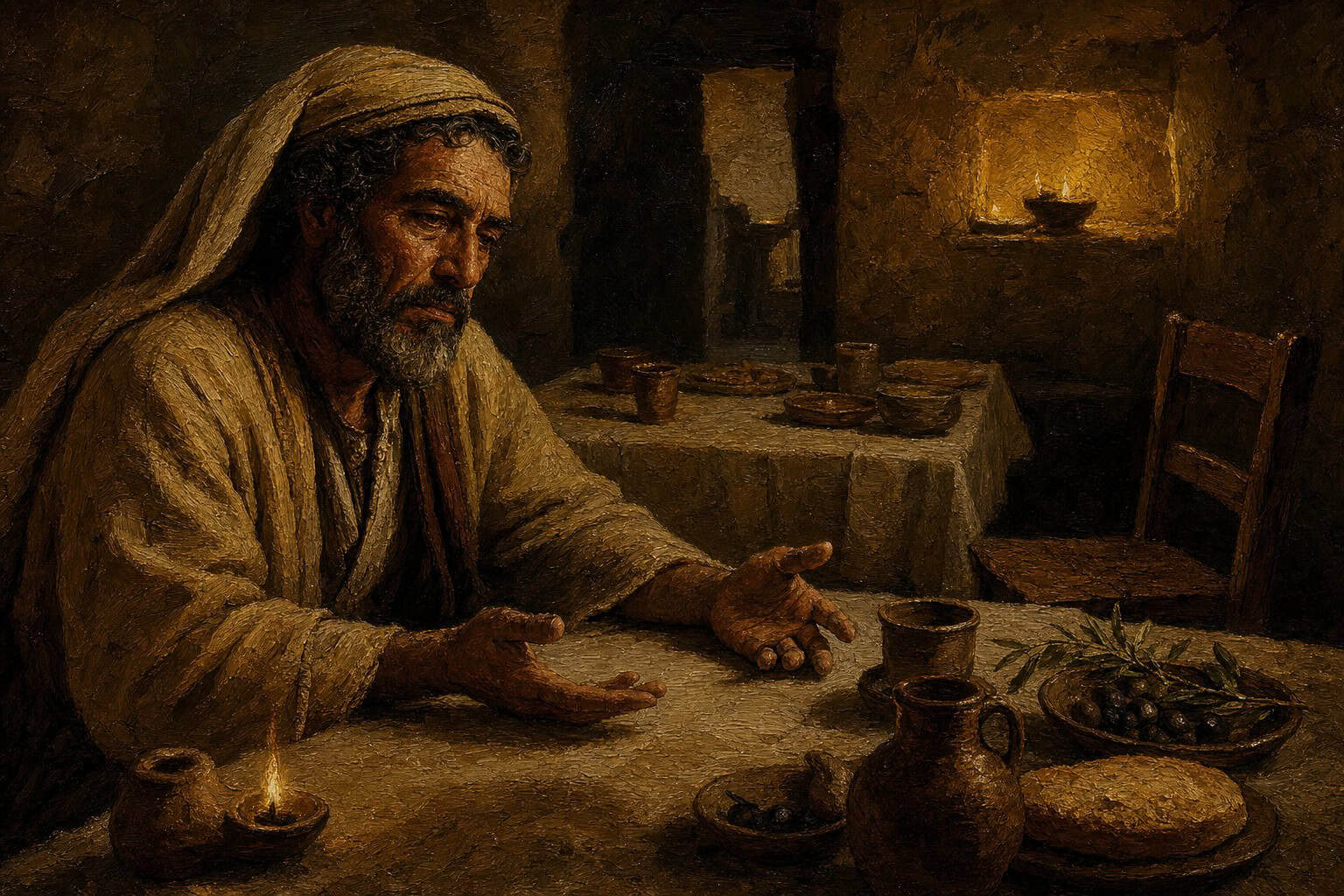
You remember the table. Not the one in the book, but your own — the plates you warmed under the tap so the food would not go cold, the chairs you pulled close, the way you counted heads without knowing you were counting. You were young then, standing over the pot, sure that love given was love kept. You believed the small bodies you fed and carried on your hip would always angle toward you the way a seedling leans into a window. You did not know yet that a child is not an extension of you but a whole cosmos, born into the world through your body and then, year by year, walking out past the reach of your arms. I want to speak to you now, from further down the road, before you learn how much an empty chair actually weighs. Listen. You watched them grow opinions and a way of folding their arms that shut the light off from you, and you called it a phase. You told yourself the sharpness in your own voice did not register on them, that they did not keep the tally of the times you were absent, or too proud to say you were sorry, or so busy guarding your own tenderness that you never once let it show its face. The scene I keep circling is not loud. It is ordinary, mundane, the kind a careless eye slides right past — two people at a table, reading each other with no words, a whole future decided in a shift of posture no one would name. That is how it goes with children too. The turning-away is never one slammed door. It is a thousand imperceptible movements you failed to read: a shoulder angled slightly off, a conversation grown careful, a laugh that lands a half-second late. You thought the quiet between you was peace. It was distance being laid down brick by brick, and you handed over the trowel yourself, sure you were being reasonable. Young as you were, confident as you were, you did not have the eyes to see the gravity already bending the room, pulling everything toward a center you could not name. You could not look at the ache directly; you could only feel its pull in the pit of you, in the slow drop when a phone call ran short. And you gave that pull every name — busyness, growing up, independence — except the true one. I am not here to shame you for the blindness. I am here to tell you the blindness had a cost, and the cost is coming, and it is heavier than you can picture from where you stand, ladle in hand, over that steaming pot.
The Slow Uncrossing That Never Came
In the book’s scene, a woman uncrosses her arms. Her body says yes before her mouth forms a word. Her pupils widen, her breath goes shallow and uneven, her right hand grooms her hair and tucks one long side behind her ear, baring her neck so the earrings catch the low light — permission granted in a language far older than speech. I ask you to hold that image and then turn it inside out. Because with the children who turn from you, the thing you watch for is the uncrossing that never comes. You lean in across the table and their arms stay folded tight. You reach and the neck does not turn, the shoulder stays squared away. The body, which cannot lie the way the mouth can, tells you the dread plainly: I have withdrawn my availability to be approached. And here comes the vertigo, the groundless hour when the floor tilts under you. You understand at last that your fatherhood, your motherhood, was never a thing you owned outright. It was always a gift extended one moment at a time, and now the hand on the far side has quietly closed. You feel it first in the flesh, always the flesh. A tightening across the chest when their name lights the screen and then goes dark. A hollow ache low under the ribs while you rehearse the sentence you will never get to finish. The armoring starts before you decide anything — a hardening in the jaw, a detachment behind the eyes, the old reflex to shrink yourself so the absence will not cut so deep. You did this when they were teenagers too, do you remember? When they pulled back, you pulled back further and christened it giving them space. You told yourself you were being the calm one, the sensible one, the parent who did not cling. I want to be tender with you and also unflinching: much of that so-called calm was cowardice in the costume of wisdom. You could not bear to stand before them unhidden and risk the refusal, so you refused first. You crossed your own arms and called it dignity. And the terrible thing about detachment is that it works — you do feel less. But you also feel less of them, less of the love that only lives in the reaching itself, that dies the instant you stop extending your hand. The soul cannot heal its own crookedness alone in a shut room; it needs another face to see itself truly, the way you cannot see your own eyes without a mirror. That is exactly what the estrangement steals from you — the mirror. Without their gaze you are left guessing at your own reflection, and the guessing sours fast into either self-pity or self-loathing, and neither of those, I promise you, is repentance. Both are just new rooms to hide in.
The Face That Will Not Turn Is Still a Face
Here is the turn I could not make when I was you, so let me make it now on your behalf, standing where you cannot yet stand. You have been reading the estrangement as a verdict on the whole of you — proof that at the root you are unlovable, unforgivable, a failed maker of a life you were entrusted with. That is the lie the ache whispers in the dark. The refusal of your grown child is real and it is grievous and I will not soften it, but it is not the final word about who you are, and it is not the death of the bond. A face turned away is still a face. It is still turned toward something, still breathing, still alive, still able to turn again — only not on your clock, and never by your force. You have spent whole months trying to solve them, hunting for the argument or the gift or the flawless apology that would make the folded arms come loose. Stop. You cannot engineer the yes. The most consequential things between two people move beneath language, in a place your will does not govern. You could not manufacture your child’s love when they were three and clinging to your leg; you cannot manufacture their return now that they are grown and gone. What you can do is remain. Remain unhidden. Quit performing the wounded parent, quit performing the reasonable one, quit managing the story of who was right and who wronged whom.
You cannot force a face to receive you; you can only remain there, unhidden, and let the refusal fall where it falls.
Stand there in your actual failure and your actual love, both at once, unarmored, and let them be seen if they ever choose to look. That is the whole of your part, and it is enough, and it is nearly unbearable. Now hear the harder mercy underneath it. In the hour when the chair stays empty and the phone stays dark, you will beg God to fix it — to soften the child’s heart overnight, to hand the reconciliation back to you like something lost and found again. Sometimes, rarely, He does break in like that, and when He does it is pure unearned gift and you must not forget it. But most nights He will not lift the silence off you. He will sit down inside it instead. He does not wait for you at the far shore of the healing, arms crossed, testing your endurance; He is here, in the raw middle, in the very grief, closer to you than the ache is to your own ribs. He knows precisely what it is to extend love toward a face that will not turn — He has been doing it since the first two people hid themselves in the garden. Your homesickness for your child is only a small echo of His older homesickness for you. Sit with that until it undoes you a little. Let it.
You cannot force a face to receive you; you can only remain there, unhidden, and let the refusal fall where it falls.
What the Empty Chair Teaches the One Who Stays
So the reconciliation does not come, or does not come yet, and you must learn to live in the meantime — which may turn out to be the rest of your days. This is the long falling-away hour, and I refuse to decorate it for you. There is no clean lesson that makes the empty chair fill. You will set the table and count the plates and feel the count come out wrong in your chest. You will hear a stranger’s voice slide across a store and you will turn, because for half a heartbeat it was theirs, the exact pitch of it, and then it is not, and the floor drops again. The body keeps what the mind tries to file away in a drawer. Grief lives in the flesh — in the throat that thickens, in the hands that lift to reach and find nowhere to go, in the small self-congratulatory stories you once told yourself about being the bigger person, now gone to ash. Do not shame yourself for any of it. The ache is love that still has somewhere it longs to travel and no road left open to it. But something does happen to the one who stays and will not harden. Slowly, and mostly against your will, the self begins to widen. You start to hold your child not as a possession you lost but as a mystery you were only ever loaned. You begin to loosen the grip on the need to be justified, to have the story end with you vindicated and them repentant on the porch. You stop rehearsing the case for the defense in your head at three in the morning. That letting-go is a small death, and every small death done in love opens onto something you did not know you were entering. You also, if you are truly honest, begin to see your own turning-away with cleared eyes. All the times someone reached for you and met your folded arms. All the imperceptible signals you once sent — not now, not you, not yet — the ones you never thought registered. Your child’s refusal is teaching you to read your own refusals at last. This is not so God can flatten you with guilt; He keeps no ledger over your shoulder. It is so the hardened ground in you can finally be named and softened, so that if the day of return ever comes, you will meet them with the old armor already off, your hands already open. And if that day never comes — I have to say this to you plainly, without cushioning — you are still not abandoned. The love you carry for a child who will not receive it is not wasted love. It goes somewhere. It is held. Nothing offered in love ever drops out of the universe entirely; it is gathered up by the One who loses nothing, not a sparrow, not a tear, not a single unanswered reaching.
Carrying a Love That Has Nowhere to Land
Let me leave you where I actually live now, further along the road than you can yet imagine from your young kitchen. The estrangement has not tied itself off into a tidy scene of forgiveness on a porch at dusk, the two of us weeping and laughing. Life rarely hands over that ending, and I have stopped demanding it. What I hold instead is stranger and, in its own quiet way, more solid. I have learned to carry a love that has nowhere to land, and to carry it — most days — without letting it curdle into bitterness. I still set a place in my heart for the one who does not come. I still speak toward the empty chair, and I have come to believe the speaking is not madness but a kind of prayer, because the God who sits with me at that table hears the words the child cannot. There is a peculiar grace given to those who stay tender through the long silence. Time itself seems to bend and slacken. The old panic to fix everything before I die has loosened its grip on my throat. I hold my children, the present and the absent both, as part of a wholeness I no longer have to complete by main force. This is not resignation, and it is not the numb detachment I once mistook for peace and wore so proudly. It is closer to a wideness — a sense that the cosmos we made when they were born through my body still exists even in the dark, the way a star keeps burning steadily behind a bank of cloud you cannot see through. I write these confessions, this one among them, partly to say to you, my younger self, and to whoever reads with the same ache in the same hour: you are not the only one who set a full table that no one came to. The human heart does not change; the story of reaching and refusal is as old as the first two people standing shamed in the garden, and God has been walking through that exact grief since the beginning of us. He walks it beside you now, matching your slow steps. So stop trying to earn back the face that will not turn. Stand unhidden in your own kitchen light. Keep the place set. Let yourself weep — the tears are not weakness, they are the love still moving, still alive, still traveling out from you into the dark. And when you cannot feel Him near, do not conclude He has gone. He is nearest in the very hour you feel most alone at that long table, breaking Himself open for a world that keeps turning away, and refusing, still refusing, to stop loving it.