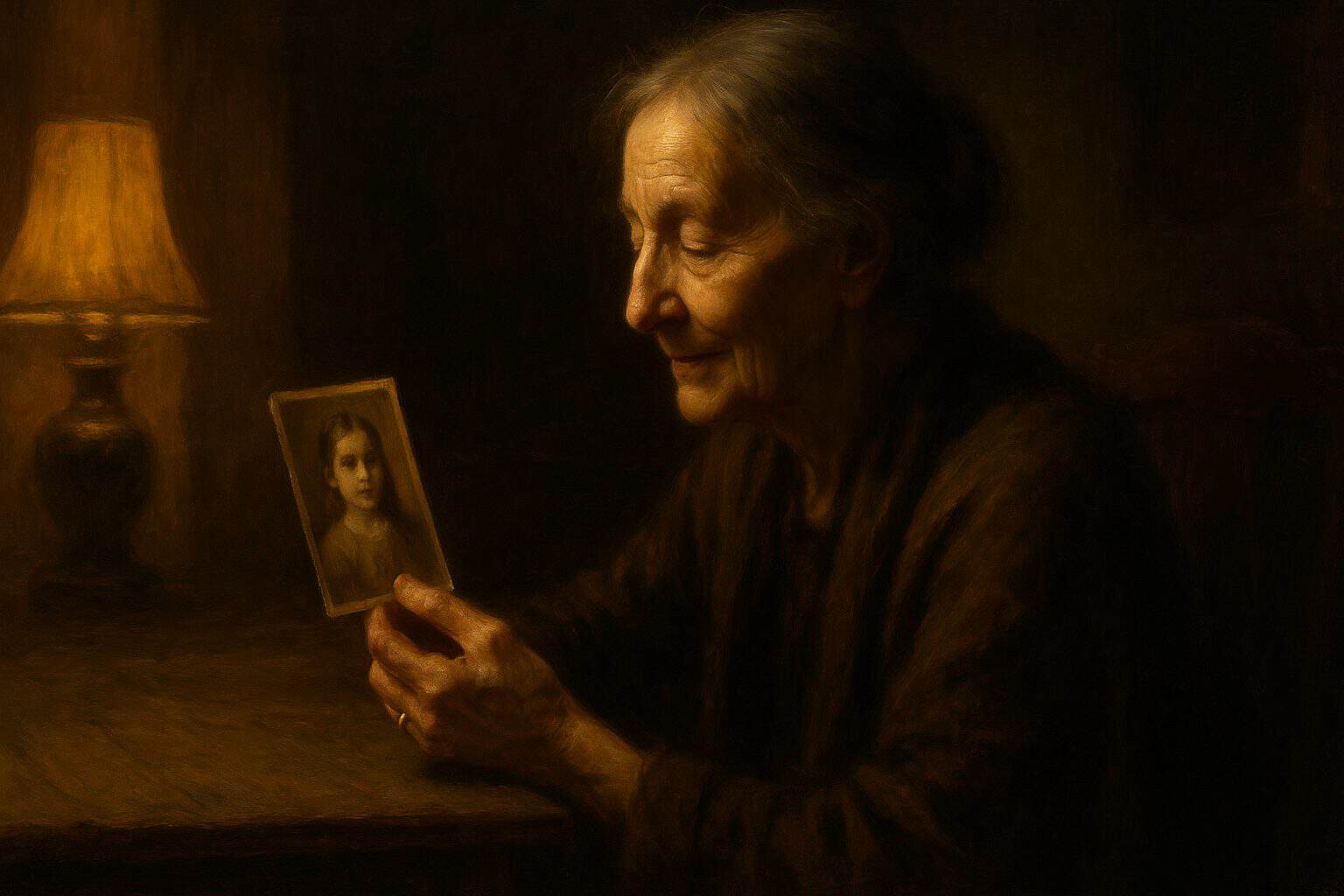
We carry forward every person we have been, even as we become someone new.
The photograph catches you unprepared. There, in sepia or faded color, stands someone wearing your face—yet the eyes that meet yours across the years belong to a stranger. You know those hands, that particular tilt of the head, the way the shoulders carry themselves. But the person inhabiting that familiar body exists now only as memory, as ghost, as the ground from which your present self has grown. This is the peculiar vertigo of encountering yourself across time: recognition and estrangement intertwined, continuity and rupture held in the same frame.
The Paradox of Personal Persistence
Stand before the mirror each morning and witness the quiet mystery of selfhood. The face that greets you bears yesterday’s face, last year’s face, the face from decades past—yet none of these faces remain. Like a river that keeps its name while its waters perpetually flow elsewhere, you persist through transformation. Anthony Adoré captures this paradox when he writes of feeling “like a naïve fool and an old man all at once,” always “a composite of contradictions.” The self does not simply have a history; it is its history, carrying forward every iteration while surpassing each one.
Watch how memory works its strange alchemy. That embarrassment from adolescence still burns in your cheeks twenty years later. The joy of a first love colors how you see spring mornings. Past selves do not vanish but sediment into the bedrock of who you are, each layer pressing upon and reshaping the others. Augustine knew this intimately—how the soul exists as distentio, stretched between what has been and what will be, gathering its scattered moments into the precarious unity of a life.
The Weight of Who We Were
Observe how past relationships haunt present encounters. Adoré describes how “relational repetition with established others forges the template by which one will interpret future others.” The lover who betrayed you years ago still whispers warnings when someone new reaches for your hand. The parent who could never quite see you properly has taught your eyes a particular blindness. We carry these ghosts forward, these “fractions of their relational heart,” each past encounter becoming a lens through which we perceive the present.
“There comes a point in each person’s life when they can no longer blame others for personal decisions, a time when things left unchanged are, in fact, chosen.”
This moment of recognition—when we see that we are not merely victims of our history but its active inheritors—marks a crucial threshold. The patterns we repeat, the wounds we nurture, the defenses we maintain: at some point, these become not what was done to us but what we continue to do. The self that persists is also the self that chooses its persistence, that decides which aspects of its past to carry forward and which to release.
Notice how certain experiences crystallize into permanent features of your inner landscape. That childhood move that taught you homes are temporary. The teacher who first saw your potential. The loss that revealed your capacity to endure. These moments do not simply pass through us; they become structural, part of the architecture through which all subsequent experience must flow. As Joseph Lyons might observe, we develop by incorporating meaningful experiences that become integral to what we are rather than what we possess.
The Labor of Becoming
Feel the tension between who you have been and who you are becoming. Adoré writes of struggling “to remain true to my authentic self and continue my personal journey of becoming, rather than surrendering to the will of others.” But which self is authentic—the one you were, the one you are, or the one emerging? The question reveals its own mistake. Authenticity is not a fixed essence to preserve but a continuous creation, a fidelity to the movement of becoming itself.
Watch yourself in moments of decision. The job offer that would require abandoning a cherished routine. The relationship that demands you grow beyond comfortable patterns. The creative project that calls forth capacities you didn’t know you possessed. In these moments, you feel the self as verb rather than noun—not a thing that changes but a changing, not a being but a becoming. Heidegger knew this: Dasein exists as projection, always ahead-of-itself, its being consisting in its possibilities.
Consider how we narrate our transformations. “I’m not that person anymore,” we say of past mistakes. “I’ve grown beyond that.” Yet the person who made those mistakes, who needed to grow, remains present in the very structure of who we’ve become. We are the tree that includes all its rings, not just the outermost layer. The self persists through its changes, not despite them.
The Mirror of Others
Observe how differently you appear in different relationships. To your mother, you remain partially the child you were. To your newest colleague, you exist only as the professional you’ve become. To yourself in solitary moments, you are something else entirely—what Adoré calls “a solitary side of me—one I never show to anyone.” The self multiplies across its relationships, each other calling forth a different facet, a different possibility.
Yet beneath these variations, something persists. Call it style, temperament, a way of being in the world. The shy child becomes the reserved adult. The one who always asked questions becomes the one who always listens. Adoré notes how his “habit of listening shaped how I approached lovers long before Leigh, how I watched strangers in dormitories, classrooms, churches, and bars.” These continuities run deeper than conscious choice, deeper than memory—they are the signature of a particular existence making its way through time.
Notice how others become mirrors in which we glimpse our own transformation. The friend who knew you before and after a major change. The photograph that captures you between selves. The place you return to after years away, finding yourself suddenly able to measure the distance you’ve traveled. These encounters reveal what daily continuity conceals: that you have been becoming someone else all along.
The Stories We Tell
Listen to how you tell your own story. The same events rearrange themselves depending on your audience, your mood, your current self-understanding. Adoré recognizes this mutability, predicting that “an older Jeannètte will, I suspect, recast our time as youthful naïveté—that familiar polish people apply to past relationships for a new audience.” The past is not fixed but fluid, constantly reinterpreted through the lens of who we’ve become.
“Placing past selves and old conflicts in the empty chair, I now see patterns the original pain obscured.”
This retrospective clarity—seeing patterns invisible during their living—reveals how the self exists in constant dialogue with its own history. We are archaeologists of our own becoming, sifting through layers of experience to understand how we arrived here. Yet each new understanding changes the very self doing the understanding, creating what Sartre might call a perpetual dialectic of facticity and transcendence.
Watch how certain stories crystallize while others remain fluid. The defining moment that explains everything. The turning point when everything changed. These narrative anchors give shape to the flux of becoming, creating islands of meaning in the stream of experience. Yet even these fixed points shift subtly with each retelling, each new context, each evolution of the narrating self.
The Persistence of Purpose
Feel how purpose emerges gradually, retrospectively, through the accumulation of choices and encounters. Adoré writes that “even I became aware of my purpose gradually, over time, across many relationships after looking back and reflecting on the interactions I had.” Purpose is not discovered like a hidden treasure but recognized like a pattern in a tapestry—visible only when enough threads have been woven.
The self that persists carries forward not just memories and habits but also an emerging sense of what it’s for, what it’s about, what it seeks. This telos is not predetermined but emerges from the living itself, each choice and encounter contributing to an increasingly clear direction. MacQuarrie understood this: existence as ex-sistere, standing out into possibilities, creating meaning through projection.
Notice how this sense of purpose both changes and remains constant. The childhood dream of becoming a firefighter transforms into a calling to serve. The love of stories becomes a need to understand human nature. The early wound becomes a capacity for compassion. The content changes but something essential persists—a particular way of reaching toward meaning, a characteristic gesture of the soul.
The Burden and Gift of Continuity
Consider the weight of being unable to escape yourself. Those who seek “the next thing or person to entice them away from themselves,” as Adoré observes, discover the futility of flight. Wherever you go, there you are—carrying forward every self you’ve been, every pattern you’ve developed, every lesson learned and refused. The self persists even through our attempts to abandon it.
Yet this same continuity makes growth possible. Because you remain yourself while changing, you can build upon what you’ve been. Each new capacity emerges from earlier foundations. Each relationship teaches you how to love better. Each failure becomes wisdom. The self that persists is not a prison but a garden where experience can take root and flower into wisdom.
Feel the strange comfort of recognizing yourself across changes. The gesture you’ve always made when thinking. The way you still laugh at certain things. The core values that survive every revolution of belief. These continuities create a home in existence, a familiarity with being yourself that persists through all becomings.
The Mystery of Integration
Watch how the self weaves together its multiplicities. Adoré speaks of how “individuality weaves the threads from each of these divergent roles into a singular tapestry, the self.” Parent, professional, friend, citizen, dreamer—each role calls forth different capacities, different ways of being. Yet somehow these fragments cohere into a single existence, a recognizable someone who persists across contexts.
This integration happens largely below the threshold of consciousness. You don’t decide to be yourself; you find yourself being yourself, already integrated, already whole despite your multiplicities. Merleau-Ponty knew this: the pre-personal life of the body that sustains personal existence, the anonymous functioning that maintains continuity while consciousness attends elsewhere.
Yet integration remains always incomplete, always in process. New experiences must be incorporated. Contradictions must be held or resolved. The person you’re becoming must make peace with the person you’ve been. The self persists not as achieved unity but as ongoing integration, a continuous gathering of its dispersed moments into provisional coherence.
The Horizon of Becoming
Stand at the threshold between who you’ve been and who you’re becoming. Every moment offers this threshold, this possibility of continuity and change. The self that persists is also the self that exceeds itself, that carries forward its history while opening toward an unknown future.
Adoré writes of “human beings evolv[ing] different improved iterations of themselves over time, keeping certain adaptations to stimulus and circumstance.” This evolutionary metaphor captures something essential: the self changes not randomly but responsively, adapting while maintaining its essential structure, like a melody transposed into different keys while keeping its recognizable form.
Feel how the future calls to you through your past. The unfinished business that demands completion. The potential glimpsed but not yet realized. The person you sense yourself becoming based on who you’ve been. The self persists toward something, driven by what Buckley might call the joyful struggle of coming-together within the tension of openness.
The Sacred Continuity
In quiet moments, sometimes, you sense something deeper than psychological continuity. Adoré reflects on “thousands of years after God first breathed life into mud, here we are, caught in that same primal dance.” The self that persists participates in something larger than its individual becoming—a cosmic story, a sacred narrative, an eternal dance between creation and creator.
This is what Augustine knew in his restlessness, what he discovered in his Confessions: the self persists because it is held in being by something beyond itself. Each moment of existence is gift, grace, participation in a love that creates and sustains and calls us forward. The self changes because it is alive; it persists because it is loved.
The paradox resolves not through explanation but through living. You are the same person who began reading these words, yet already slightly changed by the reading. You will wake tomorrow carrying forward everything you’ve been while opening toward everything you might become. This is the mystery you live every day without solving—the self that persists and changes, the continuity that enables transformation, the identity that exists only in its becoming.
In the end, perhaps Adoré says it best when he describes his written reflections as “spectral echoes of my soul, transmuted into lasting form, etched in ink and awaiting a future reckoning.” We are all such spectral echoes, persisting through our transformations, awaiting the future recognitions that will reveal who we’ve been becoming all along. The self persists not as substance but as story, not as thing but as threshold, not as being but as the miraculous interweaving of memory and possibility that we name, with tender inadequacy, “I.”