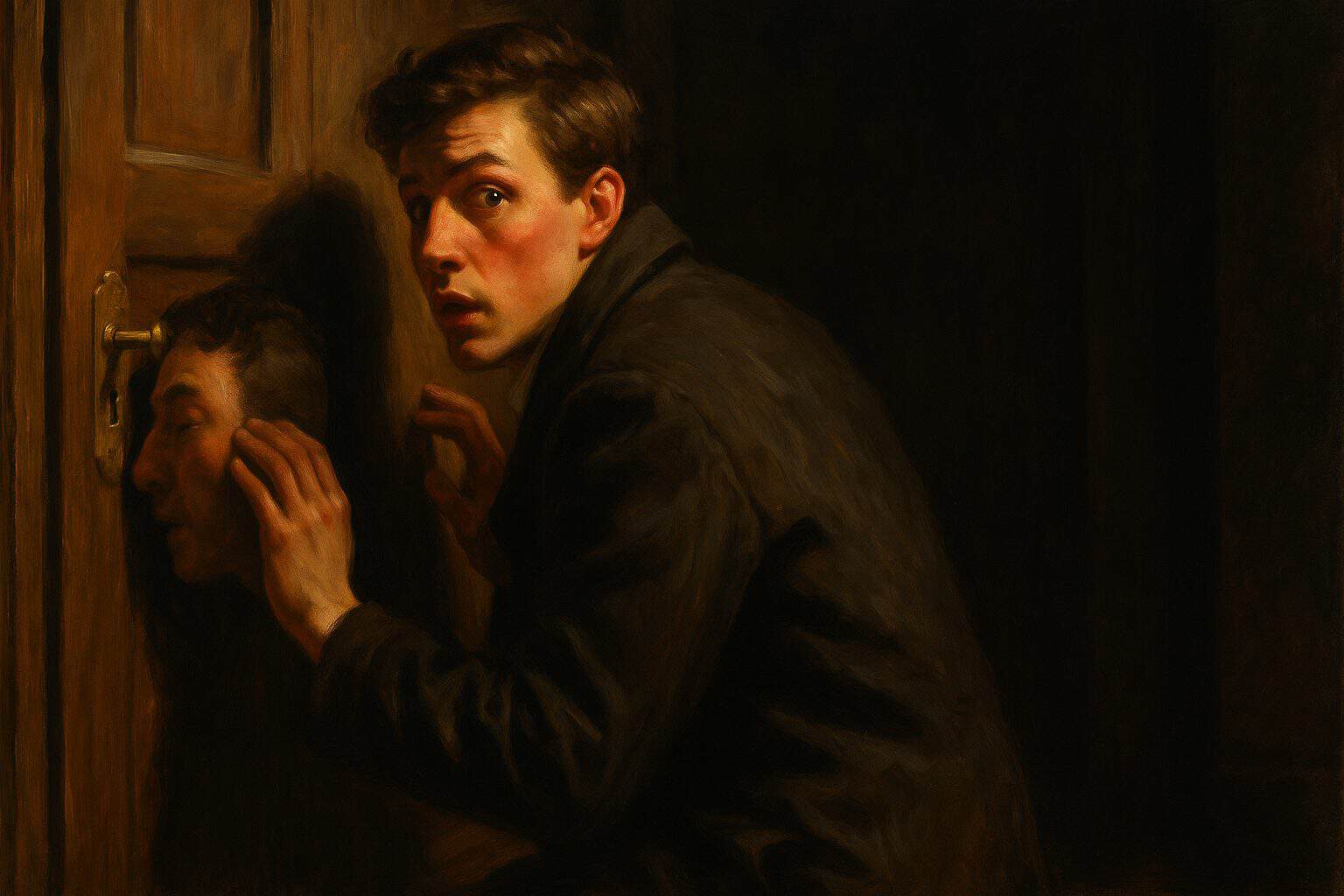
Where another’s gaze suddenly reveals the terrible freedom of being seen
The phenomenon arrives without warning. You are absorbed in your task—reading perhaps, or walking down a familiar street, existing in that comfortable anonymity of self-presence. Then it happens: you feel eyes upon you. Not metaphorically, but as a lived reality more immediate than thought. Before you can turn to confirm the source, your entire mode of being shifts. The book becomes something you are reading for someone. Your walk transforms into a performance of walking. You have become, in that instant, an object in another’s world.
The Sudden Hemorrhage of Interiority
This is not simply being noticed. When a friend calls your name or a colleague greets you in passing, you remain sovereign in your own experience, merely adding their presence to your world. But the look—what Sartre calls le regard—accomplishes something more radical. It doesn’t add to your world; it evacuates it, pulling your very selfhood outside where it congeals under foreign eyes.
Consider that moment when, believing yourself alone, you peer through a keyhole or linger too long watching strangers from a café window. You are pure consciousness flowing toward what you observe, transparent to yourself, coinciding completely with your seeing. Then footsteps approach behind you. Before you turn, before any thought forms, shame floods your entire being. Not because you’ve been caught doing something wrong—though that may follow—but because you’ve been caught being someone who does this. The looker has suddenly become the looked-at.
“Out of the blue, she interrupted, ‘You remind me of a sad angel.’ What? Frozen. I looked at her. Exposed. She saw me.”
The exposure is total. In that crystallizing moment, you discover yourself as you are for another—not as you experience yourself from within, but as a thing with qualities, a character to be read. “Though only feet away, she felt hundreds of miles distant. She was a judge commanding the court of my sentencing—detached, impartial.” The distance isn’t spatial but ontological. You have become evidence in another’s assessment, data for their judgment.
The Flesh Made Visible
“If your only method of perception is through the limits of the flesh, then all you will be able to see is the flesh.” But the look performs precisely this reduction—it pins you to your visible surface, makes you identical with your appearance. You feel your face reddening, your hands becoming awkward objects you don’t know how to position. Your body, usually the transparent medium through which you engage the world, solidifies into thing-hood.
Watch someone realize they’re being photographed without their knowledge. The easy grace of their movement stutters, then either freezes into self-conscious pose or erupts into exaggerated casualness. They are trying to coincide with how they appear, to be adequate to their visibility. But this is impossible—we cannot be simultaneously the one who sees and the thing that is seen. The attempt produces that peculiar grimace we call self-consciousness.
“I watched her face, a clinician observing a reaction. The data meant everything.” Here the phenomenology reverses—you are the one whose gaze transforms another into object, specimen, surface to be read. Yet even as you exercise this terrible freedom, you know yourself equally vulnerable to the same reduction. “By their eyes, you will be able to determine their rank: black eyes for common soldiers, red eyes for warriors, and green eyes for heralds.” The eyes that classify are themselves classified.
The Unbearable Weight of Being Seen
The look need not be hostile to devastate. A lover’s gaze can be more annihilating than an enemy’s glare precisely because it claims to see through surface to essence. “I held her gaze a moment longer than social comfort allowed—not long enough to be aggressive, but long enough for her to register my intent.” In that held moment, two freedoms collide. Each tries to be the one who sees while reducing the other to the seen.
This is why new lovers often close their eyes—not from passion but from the impossibility of sustaining mutual gaze at such close range. To look into another’s eyes from inches away is to experience the vertiginous oscillation between being subject and object, seer and seen, until one must choose: either close your eyes and reclaim your interiority, or look away and grant the other theirs.
“How you look shapes what you see. Perceptions through, with, and because of the intangible reveal co-constituted objects back to consciousness.”
Yet we hunger for this very destruction. “Those with eyes to see, saw me. Those with ears to hear, heard me.” To be truly seen—not just noticed but recognized—promises escape from the prison of private consciousness. We dress carefully, speak deliberately, craft our appearances hoping someone will peer through the surface to glimpse who we really are. But the look that sees deeply is also the look that fixes us in place, that makes us into what it sees.
The Choreography of Mutual Objectification
Social life becomes an elaborate dance of looking and looking away, seeing and granting the reprieve of not-seeing. We develop elaborate protocols: the elevator eyes that stare at nothing, the subway gaze that passes through bodies as if they were transparent, the party scan that takes in everyone while landing on no one.
“Keen observers begin gathering information from what they can see and deduce the immaterial framework from which it came through questioning.” But this clinical distance is itself a strategy, a way of looking that protects the looker from being implicated, from becoming vulnerable to return scrutiny. The observer’s detachment is armor against being observed.
Notice how differently you walk down an empty street versus a crowded one. Alone, your body moves according to its own rhythm, adjusting to terrain, weather, mood. Add witnesses and everything changes—your gait acquires a style, becomes young or old, confident or uncertain, attractive or invisible. You are walking, but you are also performing walking for eyes that may or may not be watching.
“She warns not to stare at her ass as she walks away, which in effect calls attention to the forbidden sight.” The prohibition creates what it forbids, makes visible what it declares off-limits. We are caught in the double bind of social visibility: commanded to be seen but not to acknowledge the seeing, to be available to the look while pretending the look doesn’t exist.
The Impossible Refuge
Where can one hide from the look? “No, it is better to begin observing from afar in disguise, hiding our intelligence and intention as Odysseus did during his long return to Ithaca.” But disguise only deflects the look toward a false surface; it doesn’t eliminate the vulnerability of being visible. Even alone in a locked room, we can feel the pressure of imagined eyes—God’s, perhaps, or our own internalized other who watches and judges.
“From her hospital bed, her eyes greeted each of us, one by one, bidding a silent goodbye with long blinks. When my turn came, I met her gaze.” Here, at the threshold of death, the look acquires different powers. The dying person’s gaze comes from beyond the social world, already half-departed from the realm of mutual objectification. It sees but cannot be seen in the same way—it has begun its withdrawal from visibility.
“If you gaze upon me resting in my coffin with eyes of the flesh, all you will see is the flesh of my hollow corpse—but I am not there.” Death marks the absolute limit of the look. The corpse can be seen but cannot see, can be objectified without possibility of reversal. Perhaps this is why we close the eyes of the dead—not for their peace but for ours, to escape the uncanny presence of eyes that no longer look back.
The Grace of Recognition
Yet sometimes, rarely, the look accomplishes something else. “You, my brother, know all too well what happens when Adam’s ache for union inside you meets Eve’s curved-inward gaze inside her in this fallen world.” In moments of genuine recognition, the look neither objectifies nor possesses but acknowledges—sees the other as another self, equally vulnerable, equally torn between transcendence and facticity.
These moments cannot be sustained. The oscillation between subject and object quickly resumes. But in their brief duration, they offer glimpses of what relation might be beyond the warfare of competing gazes—a mutual vulnerability that doesn’t seek to win but to witness, a seeing that grants rather than takes freedom.
“My commentary, laced with double meanings and ironies, was not for them—it was for her. I curated perception.” Even in our most sophisticated attempts to control how we are seen, we reveal our fundamental dependence on the other’s look. We exist, whether we like it or not, in the space between how we experience ourselves and how we appear to others. The look that turns us to object also, paradoxically, confirms that we are irreducibly more than object—we are the freedom that suffers being seen.