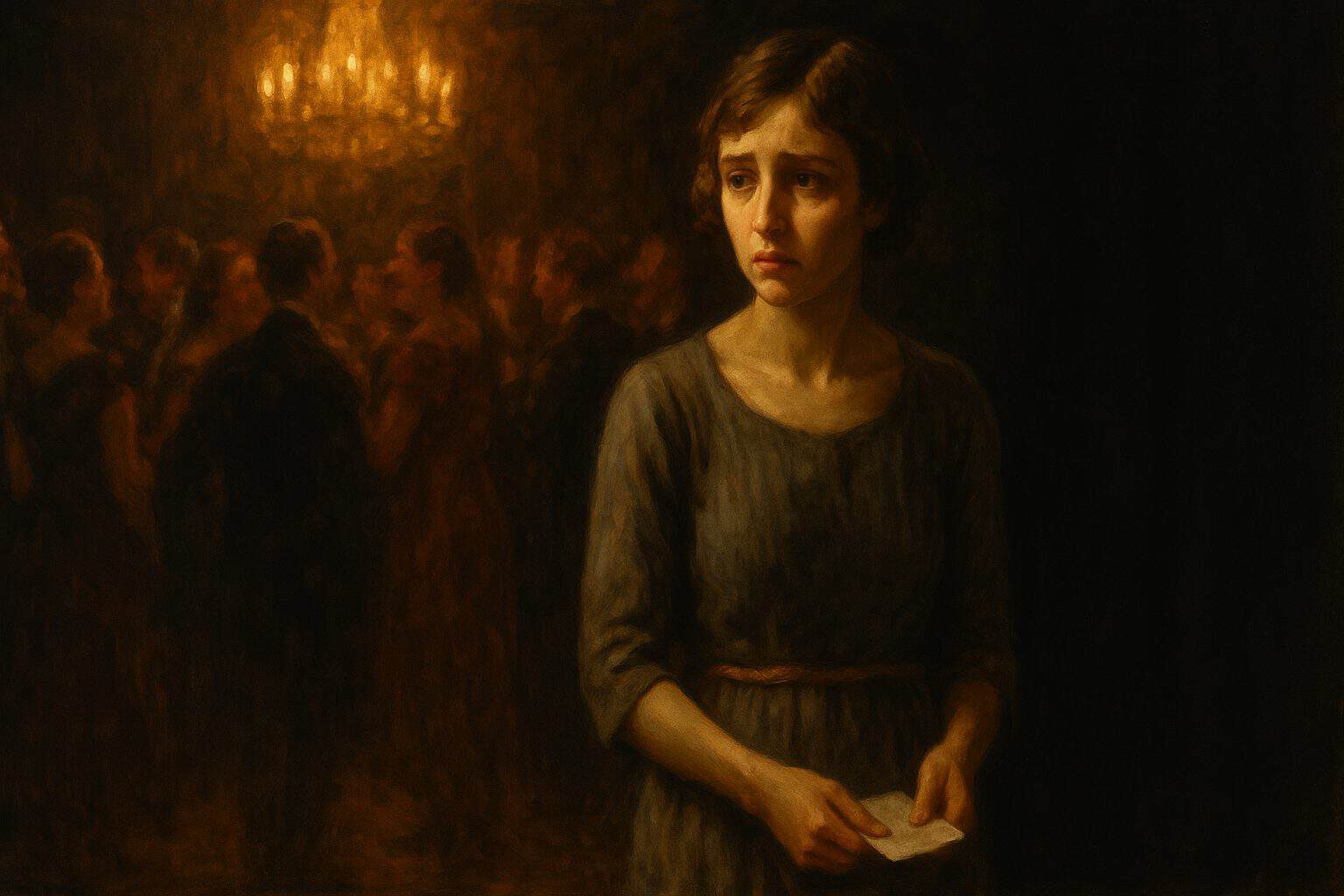
How the soul measures its own weight against the world’s gaze
The moment arrives without warning. You stand before the mirror, not merely seeing but appraising—the shoulders that carry or fail to carry presence, the eyes that hold or cannot hold another’s attention, the entire lived body suddenly revealed as currency in a marketplace you never chose to enter. This is not vanity. This is the primordial scene where self-worth takes shape, where the soul discovers itself as something that can be measured, found wanting, or—more rarely—found sufficient.
The Marketplace of Being
Every social space transforms into an exchange floor where worth circulates like an invisible currency. You enter the room and immediately sense the calculations—not through explicit judgments but through what Sartre called the look, that pre-reflective awareness of being seen, evaluated, positioned within hierarchies that no one names but everyone knows. The practiced gestures of inclusion and exclusion reassert themselves with surgical precision. A turned shoulder here, a brightening of attention there, the subtle choreography by which some are drawn into the center while others drift toward the periphery.
The cruelty lies not in the overt rejection but in the silence—that peculiar absence where acknowledgment should be. You speak and your words seem to dissipate before reaching their target. You move through space as if slightly out of phase with the solid world others inhabit. This marketplace where worth is “appraised quickly, traded often, and lost easily” operates through a logic more brutal than any explicit system of ranking could achieve.
“Exclusion occurred not through overt declarations but through practiced gestures—an instinctive reassertion of an unnamed hierarchy.”
What devastates is not being told you are worthless but discovering you are transparent—that others’ gazes pass through you toward more substantial presences. The beautiful ones, those whose “physical existence—beautiful and shallow—beckoned suitors,” move through this same space as if gravity itself bends around them. They need not prove their worth; their very presence announces it, commands attention, creates a field of possibility that draws others into orbit.
The Wound of Comparison
The question forms itself in the dark hours: “Was I really not charming, not interesting—unappealing?” It arrives not as abstract speculation but as lived anguish, the soul turning upon itself with forensic intensity. You replay conversations searching for the moment you failed, examine your reflection for the flaw that explains everything, dissect your personality for the deficiency that makes sense of the rejection.
This is what Christopher Mruk understood—that self-esteem is not a psychological abstraction but a lived reality where the soul perpetually measures itself against both its own standards and the world’s response. The wound opens precisely where these two measures diverge: when what you believe yourself to be worth collides with what the world reflects back.
The comparison burns because it is never purely external. As Augustine knew, we carry within us an image of what we ought to be, a restless movement toward our own completion. When someone chooses another over us, when our presence fails to hold attention, when our words fall flat in the space between speaker and listener, we experience not just social failure but ontological insufficiency—a sense that we have failed to become what we were meant to be.
The Masculine Trial
For men, the architecture of worth builds itself around a particular trial: “He must become worthy of her choice—forge a physique that draws her gaze, an intellect that holds her interest, and a spirit composed enough to project confidence.” This is not mere social conditioning but something closer to what Frankl called the tension between what one is and what one ought to become—a noo-dynamic field where meaning emerges through striving.
The trial manifests in countless daily negotiations. You enter the gym not just to exercise but to sculpt yourself into someone worthy of being chosen. You read not just for pleasure but to develop the intellect that might hold her attention. You practice composure, learn to project confidence even when you feel none, understanding that “she feels empowered against his contrast”—that your worth becomes the backdrop against which she measures her own power.
What Orion Taraban grasps is that this operates as an economy of exchange, where men offer resources and direction while women offer access and energy. But lived experience reveals something more primal: the terrible knowledge that you might simply not be enough. That no amount of self-improvement can bridge the gap between what you are and what would make you worthy of being chosen.
The Feminine Paradox
Women navigate a different architecture, one built on paradox. They are told simultaneously that they are inherently valuable and that their value depends entirely on being chosen. The result is what the memoirs describe: “women mistake mediocrity for greatness when all they have known is substandard mediocrity all their lives.” The confusion runs deeper than mere misperception—it touches the very ground of self-worth.
A woman learns early, as the infant learns about trust through her parents’ response to hunger, to read her worth in others’ responses. But the responses themselves are contradictory. Beauty brings attention but not necessarily respect. Intelligence threatens even as it impresses. Strength attracts and repels in equal measure.
The “woman of substance” who “will make her capabilities known” faces a particular trial: how to manifest worth without appearing to claim it, how to be chosen while maintaining the dignity of choice. She must navigate between being seen as having “potential versus those who do not” while never appearing to evaluate or judge—a performance of effortless worth that requires tremendous effort to maintain.
The Deception of Surface
“Good-looking people moved on to ‘fresh meat'” because beauty creates its own form of blindness. Those who have always been chosen, whose worth has never been questioned, often fail to develop what lies beneath the surface. Their conversations remain “hollow pleasantries before physical consummation” because they have never needed to cultivate depth to hold another’s attention.
This is the cruel irony that time reveals: “Later, not only will these ‘rejects’ and ‘misfits’ acquire wealth, power, and social status.” Those forced to build worth from within, who could not rely on surface appeal, develop substance that endures. The beautiful ones, having peaked early, often find themselves bewildered when their currency devalues, when the marketplace suddenly demands something more than aesthetic presence.
But this is cold comfort to those living through the wound of present rejection. Knowing that worth might come later does not heal the immediate anguish of being found insufficient now. The soul needs recognition in the present tense, needs to know itself as valuable not in some hypothetical future but in the lived moment of encounter.
The Shield of Indifference
Some learn to protect themselves through practiced indifference, moving through the world “as if observing a rooster chasing a hen,” reducing others to instinct and appetite. This defensive posture—what Sartre might recognize as bad faith—provides temporary relief from the wound of comparison. If others are merely animals driven by base impulses, their rejection loses its sting.
But the shield of indifference carries its own cost. To protect oneself from the wound of not being chosen, one must also close oneself to the possibility of genuine encounter. The same armor that deflects rejection also prevents authentic connection. You become invulnerable but also unreachable, safe but also alone.
“A man’s vulnerability also depends upon deceit, on his self-deception in the face of her deception; he is weak to the degree that he accepts her at face value.”
The alternative—remaining open despite the risk—requires what the memoirs call faith: “something that either one has or one does not have.” Not religious faith necessarily, but the more fundamental trust that genuine worth exists beneath the surface evaluations, that the soul possesses dignity independent of the marketplace’s valuations.
The Stripping Away
“Loneliness, heartbreak, disappointment, weariness, and misunderstanding strip the soul of every false comfort, leaving it raw and exposed.” This stripping away, terrible as it feels, serves a hidden purpose. It removes the illusions, the false measures, the borrowed standards by which we have been measuring our worth.
What John of the Cross understood as the dark night, what the contemporary soul experiences as depression or crisis, often marks the beginning of authentic self-worth. Not the inflated ego that demands recognition nor the deflated self that accepts unworthiness as truth, but something more fundamental—what Mruk calls genuine self-esteem, built on both competence and worthiness, achievement and acceptance.
The stripping away reveals that “we are now born into ignorance and must climb toward wisdom through years of pain and discovery.” Each wound of comparison, each moment of feeling insufficient, each experience of not being chosen becomes part of this climb. Not because suffering inherently builds character, but because it forces us beneath the surface valuations to something more essential.
The Architecture Revealed
The architecture of self-worth, when fully revealed, shows itself as neither purely internal nor purely external but as what Merleau-Ponty would recognize as reversibility—the simultaneous experience of touching and being touched, seeing and being seen, valuing and being valued. Worth emerges not from the self alone nor from others’ recognition alone but from the living tension between them.
This is why the wound of comparison cuts so deep—it touches the very structure through which we exist as social beings. We cannot simply decide our own worth independently of others’ recognition, but neither can we simply accept others’ valuations as truth. We live suspended between these two poles, constantly negotiating, adjusting, asserting, and questioning our place in the hierarchy of being.
The marketplace metaphor, powerful as it is, ultimately fails to capture the full complexity. Yes, there are exchanges, calculations, comparative valuations. But there is also something that transcends economy—moments when worth reveals itself as gift rather than achievement, when being chosen has less to do with meeting criteria than with inexplicable grace, when the soul discovers itself as valuable not because it has proven itself but because it simply is.
The Paradox of Worthiness
The final paradox: those who chase worth most desperately often fail to find it, while those who release the chase sometimes discover worth arriving unbidden. Not because the universe rewards indifference, but because authentic worth cannot be performed or projected—it can only be lived.
“Every new relationship involves a degree of risk, faith, and trust founded in each wanting something good for the other person.” This mutual wanting-good, this orientation toward the other’s flourishing, creates a different economy altogether—one where worth multiplies rather than diminishes through exchange, where being chosen enhances rather than depletes the chooser’s value.
The architecture of self-worth, properly understood, is not a fortress to be defended but a living structure that grows through encounter. Each wound of comparison, each moment of triumph, each experience of being seen or overlooked adds another room, another corridor, another window through which light might enter. The building is never complete, never fully secure, but always under construction—a dwelling place for a soul learning to be at home in its own existence while remaining open to the world’s surprising recognitions.