Grieving the life you wanted? The abundant life begins where you stop ignoring death and confront your own ending head-on.
A Thousand Names That Cost You Nothing
Why does a thousand deaths in a far country cost you nothing, while the one life you truly wanted costs you your sleep? That is the question I sat inside for a long time, and I still cannot lay it down clean. Each morning the world reports its quiet counting of arrivals and departures, and I pour my coffee and feel almost nothing move in me. A name I never learned stops breathing overseas, and I give it the smallest nod of acknowledgement, a shrug of the soul, then I turn to the sink and the day’s small errands. This is not cruelty. This is how a body stays upright. If I paused a full silent minute for every stranger who died while I stood in a checkout line, I would never leave the line; I would fold to the tile and stay folded, useless to everyone. So I built a habit of not-looking, and the habit held, and I mistook the holding for a life. The scene I am reading now, from Fractions of the Soul, sits at the point where the narrator admits this out loud: that to live at all we must ignore death, and that the abstract death of strangers can be shrugged off precisely because it happens elsewhere, to elsewhere people, on the far side of glass. But there is one death the shrug will not cover, and it is not the stranger’s. It is the death of the life I had drawn for myself in private, the marriage I sketched in my head, the years I planned, the man I fully expected to become. That death will not stay overseas. It stands in the kitchen where I eat, close enough to breathe the same air, and it refuses to leave when I ask it to. I used to think grieving was reserved for people lowered into the ground. Now I understand you can grieve a person who never got to exist, the self you were meant to grow into and never met. The older man writing this can say what the younger one could not form the words for: I had been mourning a corpse that walked around all day in my own shoes, ate my meals, answered to my name. The stranger’s ending is abstract, a statistic I can file and forget. My ending, and the ending of everything I wanted, is warm and near and mine. And I am learning, slowly, that only the near one has any power to wake me.
The Warm Blanket That Smothers as It Comforts
For years I traded numbness for peace and never noticed the exchange rate. I moved through the days like a man crossing a familiar field in heavy fog, each footfall sure only because he has crossed it ten thousand times, not because his eyes tell him anything. This is the trick death plays while it stays a distant number: it lets you cross a whole life half-asleep and never once feel the ground could open. I paid the bills on time. I knelt at Mass. I told myself the life I wanted was only delayed, waiting up ahead like a train I had missed but would surely board at the next station. That reassurance is warm. It lies over you like a thick blanket, and it smothers exactly as gently as it comforts, which is why you do not fight it. What I would not face was simpler and harder than delay: some trains do not circle back, some rooms are sealed and stay sealed, and the abundant life I assumed I was owed had been quietly declared void while I was busy ignoring the letter. When the ground finally shifted, it gave no warning at all. One unremarkable afternoon the fog thinned on its own, and I saw how thin the footing beneath me had always been. A vertigo opened under me, the groundless hour, a dread far older than any fear of punishment, the plain terror of standing exposed before my own freedom and my own ending in the same breath. I was not frightened of hell in that hour. I was frightened of the stacked years I had spent not-living while I called the whole heap a life. Here is what I could not see then and can barely stand to see now: the numbness was mine. I chose it. I fed the body and let the spirit go hungry, then blamed the fog for a blindness I had paid good coin to keep. Scripture says a man does not live on bread alone, and I had eaten nothing but bread, thick daily loaves of routine, and then wondered why the inside of me rang hollow when I knocked on it. The comfortable stupor is not innocent. It is a slow refusal wearing patience like a coat. And the mercy hidden in dread, though it arrives feeling like cruelty, is that it will not let the refusal stand forever. Something in me came up hard through the surface of that fog, gulping, and I could not sink back under, however badly I wanted the blanket returned. To grieve the life you wanted, you first have to say the words: it is dead. And saying them is its own small dying, a burial you conduct alone, with no one to lower the box but you.
The Cold Clarity When a Room Is Finally Lit
The turn, when it came, was no voice out of the sky. It came as a cold clarity, the way a room’s true corners jump into place the instant someone finds the switch after you have stumbled in the dark, hands out, guessing at furniture. I stood there and knew, all at once and down in the marrow, that I would die, and that everything I had planned would die folded inside me if I did not begin living it before the light failed. Not the abstract death of the morning report. Not the tidy figure. My death, the one with my own name spelled correctly across it. And ranked behind my death stood every loss I had refused to properly grieve, the endings of people I loved that I carried inside me like scenery for a play no audience would ever attend. I had become a kind of walking tomb, holding the whole unfinished future of what I wanted and of who was gone, rehearsing my lines to rows of empty seats. That is the work grief performs on you when you will not confront it. It makes you the sole keeper of a life no one will witness but you, a caretaker of rooms that will never be entered. And the thing I did not expect, the thing that undid me, was that God was inside the cold clarity itself. Not hauling me out of it. Not reaching for the switch to plunge the room back into merciful dark. He walked in and stood in the exposure with me, present in the very hour I most wanted to bolt. The abstract deaths of strangers had never once brought me low; my own death, confronted, folded my knees under me. This is the paradox that holds up every honest life, and I will set it down as plainly as it has earned.
To keep living, we ignore death; to live abundantly, we must let it look back at us.
The veil I had assumed was solid stone turned out thinner than my fear had painted it. Not because I reached for any forbidden thing, no cards laid in rows, no board with its sliding pointer, no whispered summoning of the dead, for those are only pried-open cracks the enemy widens for his own traffic. It thinned because I had finally begun to feed the right hunger, and different eyes were opening in me, eyes tuned to what the flesh by itself can never register, the way the body catches only a narrow band of all the light that actually fills a room, and calls that thin band the whole of what is there.
To keep living, we ignore death; to live abundantly, we must let it look back at us.
The Guest Who Never Leaves and Never Speaks
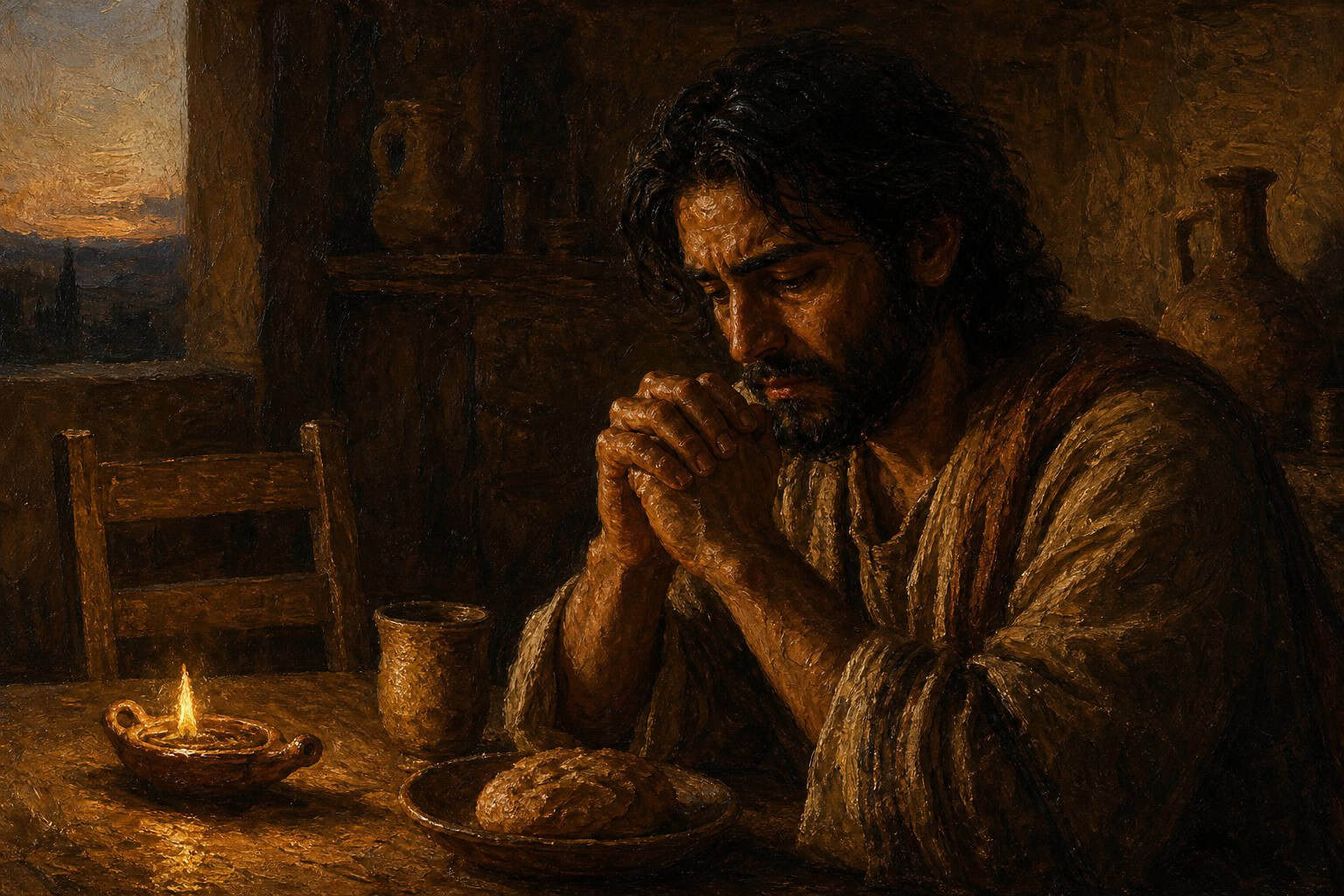
What follows a confrontation like that is not relief. It is a quiet, unglamorous grief that moves in and settles into the furniture like dust you can never fully wipe away. I had to mourn, at last, the life I wanted and would not receive, and mourning it meant admitting how many years I had spent refusing to bury it. There is a particular cruelty in carrying a future that never happened; you feed it, you keep a chair at the table for it, you set out its cup, and it eats you from the inside like a guest who never leaves and never says a word, only watches you shrink. The older man writing this puts hard questions to the younger one now and refuses him the comfort of easy answers. Who did you imagine that planned life truly belonged to? Was it love of the good, or love of control wearing love’s face? Did you grieve the one you lost, or the polished version of yourself that person was supposed to complete and confirm? I do not like every answer I turn up in the dirt. Some of the grief was holy, the clean ache of a real love cut through. And some of it, I see now and wince to see, was pride mourning its own thwarted blueprint, the self enraged that God had declined to stay inside the drawing I handed Him. Both were true at once. Both had to be laid down in the same grave. Confronting death did not dissolve the ache; it did not, at the end, hand me the life I wanted after all, wrapped and ribboned as an apology. That is the lie the world peddles about grief, that if you only feel it honestly enough it will pay you back in peace, coin for coin. It does not settle its accounts that way. What confronting death actually did was strip the numbness off the wound so the wound could finally be a wound instead of a well-kept lie. And down in that raw place, uncushioned, un-tidied, still bleeding, I found that God had never once abandoned the empty house. He sat in it with me, in the dark rehearsal of the life that would never be staged, near enough that I could feel the weight of Him in the next chair. He did not clear the emptiness out. He filled it with His nearness, which is a stranger and harder gift than the rescue I had begged for. I wanted deliverance. I received company. For a long stretch I resented the trade and said so, out loud, in that kitchen. Now I begin to suspect the company was the abundant life all along, and I had been too consumed with grieving the counterfeit to open my hands for the true.
Memory Grown Holy in a Grieving Kitchen
There is a manner of seeing that opens only after you have confronted your own ending, and it arrives at a steep price, never on discount. I had taken the boundary between the living and the dead, between flesh and spirit, for a mortared wall, permanent and blind. It is not a wall. It is a limit I had set with my own hands, a shutter I kept latched because an open shutter lets in far more than comfort, lets in the whole cold field. We are not permitted to perceive past our own desire, and for years my desire had been a narrow slot, fixed only on the life I wanted, blind to the life being handed to me inside the wreckage of the other. When death stepped up out of the background and into the middle of my days, my desire changed shape, and slowly, with a pain I will not pretty up, so did my sight. I began to notice the influence of the dead, not as spirits to be summoned across a table but as presences to be honored, the way the ones I lost still pressed on the man I was becoming, still spoke in the decisions I made in their absence, still corrected my hand on the wheel. This is not the séance, none of the forbidden traffic; this is memory grown holy, love outlasting the flesh, the communion of the saints made plain in a grieving kitchen where the kettle is the only sound. I still do not have the life I wanted. I have set that grief down and taken it up and set it down again, and I expect to keep at that labor to the end of my days, because grief is not a door you can shut for good; it is a tide, and the tide comes back over the same worn stones. But I no longer sleepwalk through the fog and name it peace. I would rather stand in the cold true light, exposed and unsure of my footing, than crawl back beneath the warm blanket that was quietly stopping my breath. If you are grieving the life you wanted, I will not promise it turns easy. I will tell you the confrontation is the beginning and not the finish. Let your own death step out of the background. Let it turn and look at you full in the face. Feed the hunger that bread cannot reach. And then keep watch, in the very dark you were given and cannot walk out of, for the One who steps into the room and lowers Himself into the chair beside you and never once hints that you ought to feel better than you do. That unearned, unhurried nearness is what I could not see then and can scarcely credit now. I have been writing toward it, stumbling, across every page. It is what the whole book was reaching for, and I am reaching still, my hand open on the worn wood of the table.