Trying to weigh someone’s worth—theirs against yours? A reflection on love, freedom, and the one measure that cannot be faked.
Hands Laid Flat on a Seat That Gives No Verdict
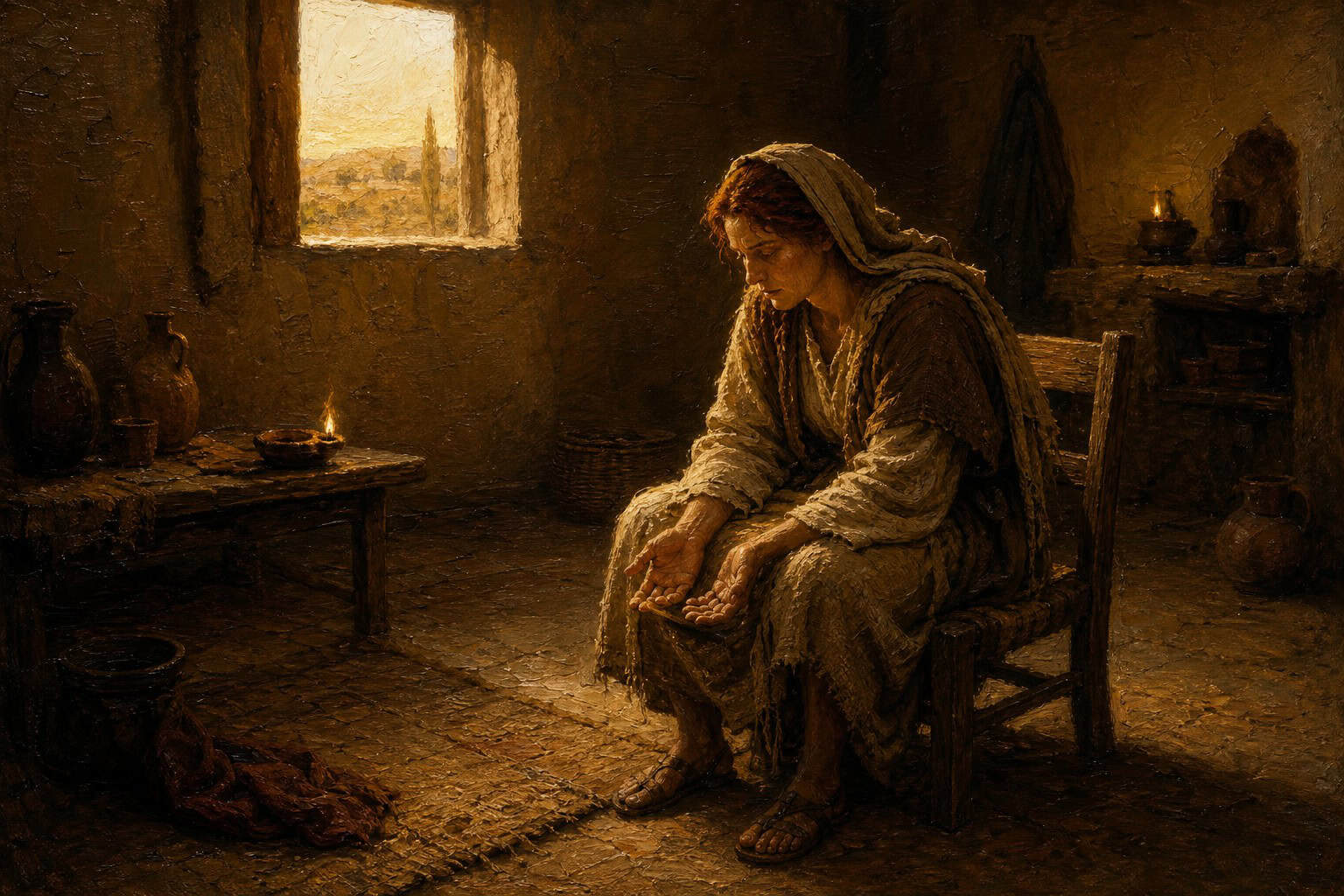
You want to know what a person is worth, and you mean it as a real question, not a slogan. Behind the question is a scale, and you are trying to set two people on it—or set another person against yourself—and read the difference between the pans. I know that scale. I have carried it into rooms where no one could see it, and I have set it down only when my arms gave out. In the pages of Confessions to the Empty Chair the narrator sits with his hands laid flat where mine once rested, straining his ears into a quiet that hands down no ruling at all. He calls that silence multifaceted, and the word earns its place, because he has stopped pretending the quiet means only one thing. Sometimes it is a hard grace that pushes him to keep seeking. Sometimes it is a cleared space where his own spirit can finally speak without being drowned out. The physical detail stays small and exact: breath meeting an unmoving surface, joints that ache from holding one position too long, limbs gone heavy, the whole body pressed forward into a reaching that will not end. That reaching is where the question of worth actually lives. Not in the tidy work of the head, but in the flesh that keeps stretching toward another person and finding, on some days, nothing warm to close its fingers around. When you ask what someone is worth, you are really asking whether your longing for them is justified. You are asking whether the ache low in your chest is a fact about them or only a fact about your own hunger. The narrator does not flinch from that sharpness. He turns the lens back on himself and asks whether his reaching was love or need wearing love’s borrowed face. He does not answer it fast. He lets the question sit and grow uncomfortable. That refusal to answer quickly is itself a kind of honesty, because the instant you weigh a person and hand down a number, you have stopped seeing them and started spending them. The seat under his hands stays silent. The body stays reaching. And the question you carried in—their worth, measured, settled, filed away—begins to feel like the wrong question, or at least a question asked in the wrong room and in the wrong voice. Rest your hands where his rest. Do not rush the arithmetic. The heart moves at the pace the heart allows, and worth, whatever it turns out to be, will not surrender itself to a fast calculation made while you are afraid.
The Appetite That Counts While It Consumes
Notice what pushes you to weigh a person in the first place. It is rarely admiration. It is usually fear—the fear that you might pour yourself out for someone who does not deserve it, or the fear that you yourself are the one on the scale, being read, and found light. The narrator names the currents that pull a soul toward desolation, and he is careful to say they arrive in disguise, dressed as their own opposites. Lust, he writes, mistakes consumption for connection. Read that line slowly, because it goes straight through the worth question like a blade through cloth. When you calculate what another is worth, you are often already handling them as something to be consumed—a supply whose value you must confirm before you agree to spend yourself on it. That is not love. That is taking stock. And here the body tells the truth the mind would rather bury. Desire that is really only appetite feels restless in the flesh, grasping, never full, forever tallying whether the thing was worth the reaching. Desire that is love feels different in the body altogether—slower, steadier, able to wait, able to be told no. The tension he holds here is real, and I will not sand it smooth. A man looks at a woman and something in him measures, sorts, ranks; he would be lying to deny it, and so would I. A woman does the same in her own key, weighing steadiness, weighing whether this reaching hand will still be near her in the cold months. These are not crimes. They are old machinery, running under the floorboards of the mind, and pretending it is not there only sends it deeper, where it works more damage in the dark. But the machinery is one layer, and only one. Under it is a person living her whole life from the inside, who is not a list of traits to be scored against a rival, but a full and separate awareness you will never wholly enter. The moment you shrink her to her worth—her usefulness, her rank, the return you expect on what you invest—you have built the gilded cage the narrator warns against, no matter how noble your stated reasons. Fear is what raises those bars. Fear says: secure this, lock it down, make certain it cannot walk away from you. And the terrible thing the narrator learned on the anvil of his own wreckage is that the cage strangles the very life it was built to protect. Worth measured is worth already ruined. The scale you carried in was never a neutral instrument. It had fear’s smudged fingerprints pressed all over it from the very first weighing, and you simply never turned it toward the light to look.
The Ballast Beaten Out on the Anvil of Failure
Here the question breaks open, and it breaks the wrong way for anyone still hoping to keep the scale. The narrator hands down one truth he calls ballast, hammered out on the anvil of his own experience: love is free. Free to accept, free to refuse. It cannot be coerced, cannot be manipulated, cannot be bought through compliance or propped up by obligation. It comes as a gift or it does not come at all. Sit with what that does to your worth question. If love is a gift and never a wage, then a person’s worth is not something they earn by being valuable to you. It is not a score you total after setting their traits beside someone else’s. Worth comes first. It is the plain fact you either see or refuse to see. God Himself, the narrator writes, respects this boundary—He seeks consent even while He holds sovereignty, courting willing hearts and never manufacturing creatures who love on command. If the One who could compel love refuses to compel it, then your small scale, your quiet ranking of one soul above another, is not merely cruel. It is a lie about how heaven itself moves. Consent is not a courtesy, he insists. It is how love travels at all, the only road it will take. And here the body speaks again, because the flesh remembers what the ledger forgets. Your skin knows the difference between being chosen and being used, between a hand that reaches for you freely and a hand that clamps down because it is afraid to open. You have felt both. You know in your bones which one leaves you standing there a person, and which one leaves you feeling like an item that has just been appraised and priced. So the answer to what someone is worth turns out to be an answer that dissolves the question in your hands. You cannot weigh their worth, because worth was never a quantity to be weighed. You can only receive them freely or refuse them freely, and either way their worth stands untouched by your verdict, because it was never yours to hand down in the first place.
A person’s worth cannot be earned, and so it cannot be lost; it is not a wage but a given fact you either see or refuse to see.
That is the anvil truth, and it brings no comfort. It brings a charge. Because it means that every single time you weighed someone, you were reaching for a power you were never given, sitting as a judge in a court that had no standing to try the case.
A person’s worth cannot be earned, and so it cannot be lost; it is not a wage but a given fact you either see or refuse to see.
What the Judge Loses When the Bench Is Empty
When the scale slips from your hands, something in you grieves, and the grief deserves to be spoken plainly. The scale gave you control. As long as you were weighing others, you were the one doing the measuring, never the one being measured—or so you told yourself in the private room where the scale lived. The narrator is pitiless with this self-deception in his own case. He asks whether his careful appraisals of the people near him were ever really about them, or whether they were armor, a way to keep a surgeon’s distance from love’s dangerous freedom. Early sorrow, he suggests, can permanently narrow a person’s emotional range, leaving them able to observe love’s workings with terrible clarity while unable to fully step inside the thing they see so well. That is his confession, and it lands in the body: the one who maps the territory with such precision often maps it because he cannot bring himself to cross it. He studies the reaching of other people because his own reach learned, long ago and in the cold, to expect an empty surface at the end of it. So the man who weighs the worth of everyone around him may be a man who has quietly ruled that his own worth is provisional, always up for review, never settled—and he protects that soft place by keeping everyone else on the scale beside him. If all are being measured, then no one is safe, and misery at least keeps company. The fallout of laying the scale down is that you must now stand in the open, unweighed and no longer weighing, and let love stay free—which means letting it possibly not arrive at your door at all. The narrator offers no rescue from this exposure. He does not promise the silence will suddenly fill with a voice, or the empty seat suddenly hold a warm face turned toward yours. What he offers instead is the strange, hard grace he found down in the dark: that God does not lift the desolation away but walks down into it, present in every tear, quiet at the side of the seeking soul even in its confusion and its sin. The delicate spiritual sweetness he speaks of comes, when it comes, precisely when least expected, inside the dryness and never as a clean escape from it. That is not a fix. It is company kept. And for the man who spent years weighing everyone, himself included, that company may be the first thing that ever suggested his worth was never on trial—that he had been arguing his own case, day after exhausting day, in a courtroom the Judge had long since closed and left.
Which Way Your Body Leans When You Are Near Them
So set the scale down, and pick up the test the narrator actually offers, which is a truer one. Weigh your bonds, he says, against the truth that love is free. There is the real question, sharper than the one you typed into the search: does freedom draw you closer to this person, or does fear hold you fixed in place? Not their worth—your own motion. When you stand near them, does something in you open, choosing them again this morning as though for the first time, glad they could leave and glad they stay anyway? Or does something in you clench and start keeping accounts, afraid that if you stopped performing or they stopped complying, the whole arrangement would fall in? The first is love. The second is the gilded cage, and its bars are forged from the very measuring you once mistook for wisdom. Forgiveness, he writes, releases false claims on another’s will and returns your own consent to God—which is another way of saying it lifts them off your scale and lifts you off theirs at the same moment. Here the reflection has to walk humbly, because I am speaking of a separate awareness I cannot fully enter. The woman you have been weighing carries her own reasons, her own reaching, her own fears and her own untouched freedom, and she is not a mechanism whose value you can crack open and read. She is choosing too, or refusing, inside a life lived from within that you will only ever glimpse at the edges. The tender reading and the wary reading both hold together: yes, people calculate, sort, guard themselves, and pretending they never do is foolishness—and also, under every calculation lives a person hoping to be received as a gift rather than acquired as a purchase. Hold both at once. Do not shrink her into a strategy, and do not shrink yourself into her victim. The flesh remembers what free love felt like and what its counterfeit felt like, and the body does not lie about the difference between the two. Confessions to the Empty Chair hands you no number for anyone’s worth. It takes the scale out of your grip and sets a harder, freer question there in its place, still warm from the anvil. Read it if you are tired down to the marrow of measuring—if you are ready to learn what love feels like when no one at the table is being weighed, and whether the silence you have feared might, some morning you did not see coming, be found quietly holding your hand instead of judging it.