Want to do missionary work? Learn from an unlikely teacher in Fractions of the Soul: how souls are truly won, one patient watcher at a time.
The Still Pond Where Eve Bent to Look
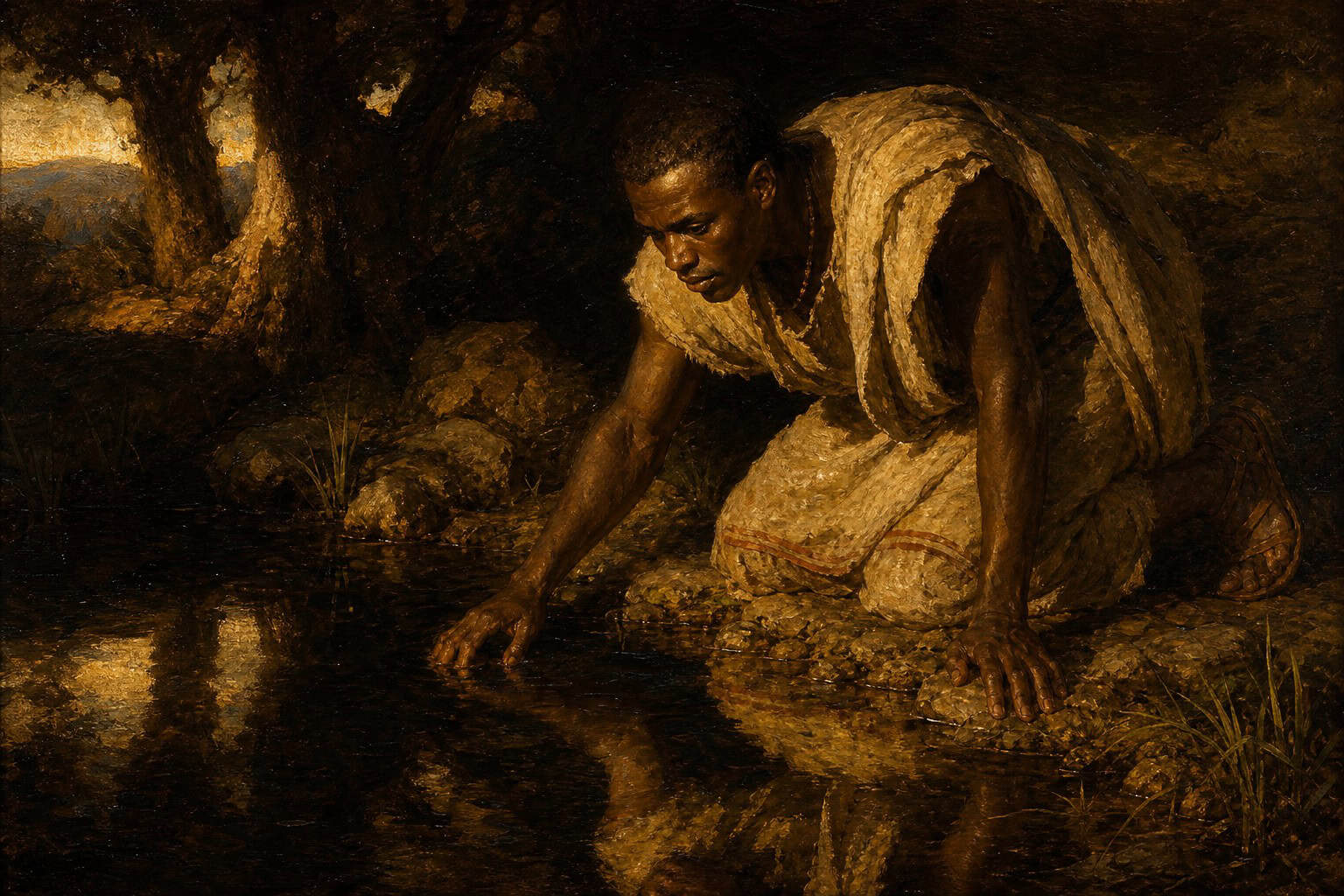
You want to reach a soul, to draw another person toward God, and you have no idea where to start. Start here, in the strangest classroom in Fractions of the Soul, where the fourth chapter turns its eyes on the first garden and the first two people standing in it. Adam and Eve are new and whole, fresh from the Maker’s hands, and yet something already sits uneven between them. Adam loves Eve with everything he is; she fills the empty place God shaped inside him, and he pours himself into her and keeps nothing back. Eve loves Adam too, but not with that same flood. Her loneliness is not his loneliness. She was drawn from his rib, so the ache she carries began as a copy of his—yet her own separate spirit reshaped it into something close but not the same. She knows she was made for him and he for her. Still she never fully hands herself over, not to Adam, not to God. A small distance stays shut in her, a room with the latch down. And there is the pond. She kneels at its calm water and studies her own face, and she likes what she sees, most of all after she has worked to make herself more lovely for her husband. The reflection holds her a little too long. Her body leans toward the surface, drawn by a private pleasure her husband’s plain, useful gaze never once looks for. This is where the chapter plants the question that will haunt anyone who wants to carry faith to another person. How do you reach a heart that has a locked room inside it? You cannot pry it open. God Himself will not. The scene says it plainly: no one may enter a person against their free will—not the Maker, not the enemy, not you. So the work of reaching a soul is not the work of force. It is the work of the invitation, and the invitation has to come from the inside, from the very corner that stays closed. This is the hard thing the searcher trips over first. Mission is not conquest. You do not break down a door; you wait to be let in, and the waiting can take a lifetime. The pond, the reflection, the small withheld corner of Eve’s heart—these lay out the map of every soul you will ever try to reach, including the difficult, half-shut one you carry in your own chest. Before you carry God anywhere, you must accept that some hearts hold something back, and that this holding-back was there before any sin, woven into the fabric of what it means to be a person at all.
The Watcher Who Kept Better Records Than We Do
Now meet the one who understands all this best, and he is not a teacher you would choose. The chapter shows the enemy as a patient student of the human heart, bent over his notes like a scholar who never sleeps. He cannot force his way in, so he does something slower and worse—he watches. He is the first observer, and he does not learn Eve in a single glance. He learns her over long stretches of time, gathering small facts and stacking them, one on top of another, until the pile becomes a picture. He sees her bend to the pond. He sees her fuss over how she looks. He notices the quiet delight she takes in her own face, a delight her husband’s practical eyes do not even think to search for. He notes it. He files it away. He is more often right than wrong, and when he is wrong he sharpens his craft and tries again, patient as water on stone. Here is the detail that should stop the reader cold: the enemy keeps better records of our weakness than we keep ourselves. He sees that Adam’s strength is Eve. He sees that Eve’s weakness is Eve—that turn toward her own reflection, that soft refusal to give herself away completely. And he sees the whole chain in front of him: reach her, and you reach him too, and through both of them you stain the finest work of the Father. He does not rush. He waits for the tell, the soft hour, the moment the latch is loosest. This is the uncomfortable lesson for anyone who wants to reach a soul honestly. The enemy already does mission work, only backward. He studies before he speaks. He earns his opening by knowing the person completely—their patterns, their tender spots, the exact hour they are most likely to bend. And the one who loves must learn from this without stealing its cruelty. To carry God to a person, you first have to truly know them. Not aim a sermon at a stranger’s face, but watch and listen with love until you understand where the ache actually lives in them. The difference is everything, and it is thin as a hair. The enemy studies to exploit. The one who loves studies to serve. Both begin the very same way—with attention, patience, the slow gathering of a real human being from a thousand small signs. So the scene forces the searcher to sit inside a hard question about their own hands. Have you ever really looked at the person you wanted to save? Have you learned their patterns, their fears, the tender places evil already knows by heart? Or did you only look at yourself, wanting to be the one who did the saving, hungry for the role more than for the person kneeling at the water?
When the Reach Outruns the Thing It Reaches For
Then comes the turn, and it lands not in the garden but inside the reader who came here asking how to do this work at all. Watch Adam once more. His love for Eve fills him to the brim; he finds his whole rest in her, the exact wholeness God shaped him to need. But Eve does not hand that same rest back. The love between them is real, and still it runs uneven, and no effort of Adam’s can level it out. This is the ache the chapter names before any sin walks in: one heart can pour itself out completely and meet, in return, a heart that keeps a portion locked away. Here is where the searcher’s own hunger rises up off the page. If you want to lead someone to God, you are already reaching—reaching toward a wholeness you can name with your mouth but cannot hold in your hands. And you feel it first in the body, this reaching, not in the tidy part of the mind where your plans live. The flesh remembers what it lacks. It reaches on its own, without asking your permission, toward the one thing your clever strategies cannot supply. Skin hunger is where every neat system cracks. You can trace Adam’s loneliness and Eve’s turn toward her own image, name it all correctly, and still the body will not be argued with; it leans toward the pond too. This is the trap and the gift, tangled together. You cannot do mission work from a place of needing to be filled. If you go to a soul the way Adam clings to Eve—to fill your own empty room, to be completed by their yes, to make their gratitude the water you drink—you will crush the very person you meant to set free. The hunger is not shameful; it is human, stitched in from the start. But left unwatched, it will bend your reaching toward yourself, the way the still water bent Eve’s gaze back into her own face. The task is not to kill the reach. It is to aim it past the person, toward the God who alone stands at the far end of every longing, so your hands come to them empty of demand and full only of what you were given.
You cannot force a door into a soul; you can only wait, learn, and be invited in.
The Rib-Wound That Will Not Match, Even in the Garden
So the fallout settles quietly, and it is not a rescue. The chapter does not fix the uneven love between Adam and Eve. It lets the imbalance stand as the first tragedy, present before the fruit, before the fall, stitched into two hearts that could not fully meet. And this is where the searcher has to stop hunting for a clean method. No technique will make a withheld soul surrender. You can watch with love, know the person truly, wait for the invitation with all the patience you have—and still the door may stay shut, the way Eve’s small locked corner stayed shut even in paradise, even with God walking near. This is the honest grief the book refuses to sweeten. You will love people you cannot save. You will pour yourself out and then watch the flock eat what you fed them and wander off toward greener grass, your labor trampled flat behind them like bread ground into dirt. The chapter, elsewhere, carries this exact wound: the teacher who hands his whole life’s wisdom to a student who abandons the road, the servant of God who feeds the sheep and is forgotten inside a generation. The missionary’s despair is not imaginary. It has a name, and the name is not quite failure; it is the plain math of a short life, the wide dark water that borders every small island of effort we manage to build. What then? The book does not answer with comfort. It answers with presence. God does not stand outside your defeat with a red pen, correcting it. He walks straight into it. He is nearest not when the work succeeds but when it caves in—present in the tears of the one who tried and could not, sitting down beside the missionary in the very hour the door does not open. That is the strange grace running through this chapter’s bones. The darkness is not lifted. God is found inside it, quiet, walking beside the one who reached and came up with empty hands. This is not a fix, and it will not feel like one. It is company, and it turns out to be the only thing that holds when your best work becomes trampled bread and the person you loved turns back toward the pond, to look at their own face again. You do not get to keep them. You do get the God who stays when they leave, breathing beside you in the ruined quiet.
Attention Is the First and Slowest Prayer
Where does it settle, then, for the one who typed the question and wanted a simple plan? It settles into something humbler and far more costly than a plan. To do mission work is not to master a trick but to become the kind of person who can truly see another human being—patiently, over time, gathering their real shape the way a watcher gathers small facts beside a pond. It is to know someone so well that you understand their ache, and then to refuse, with everything in you, to use that knowledge against them. The enemy in this chapter knows the human heart better than we do, and bends every fact he gathers toward ruin. The whole calling turns on this: to know as thoroughly and love as freely, to study a soul only so you can hand it, gently, the invitation it may still refuse to your face. But you have to do the harder work on yourself first. You must kneel at your own still water and ask why you want to save anyone at all. Is it love, or is it the empty room inside you looking to be furnished with their gratitude, their yes, their need of you? The narrator of this book turns the lens on his own chest without mercy, and so must you, before you touch another person’s wound. Real mission begins the moment you stop reaching to complete yourself through someone else and start reaching, first, toward the God who carved the emptiness and alone can fill it. Only then are your hands clean enough to offer Him to anyone. This is the pull of Fractions of the Soul: it will not sell you a method, and that is precisely why you can trust it. It walks you back into the garden to watch two people who could not fully meet, and it lets you feel, in your own flesh, the ache of loving across a distance you cannot close. It tells you plainly what the search box never will—that you cannot pry a heart open, that you will grieve the ones who wander off, and that God draws closest not when the work wins but when it fails and He simply stays. So go and learn the soul in front of you. Watch with love and not appetite. Wait for the latch to lift from the inside. And when it does not lift, do not sit in that unfinished room alone—Someone is already there in the dark, close as breath, kneeling beside you in the long quiet while the water goes still again.