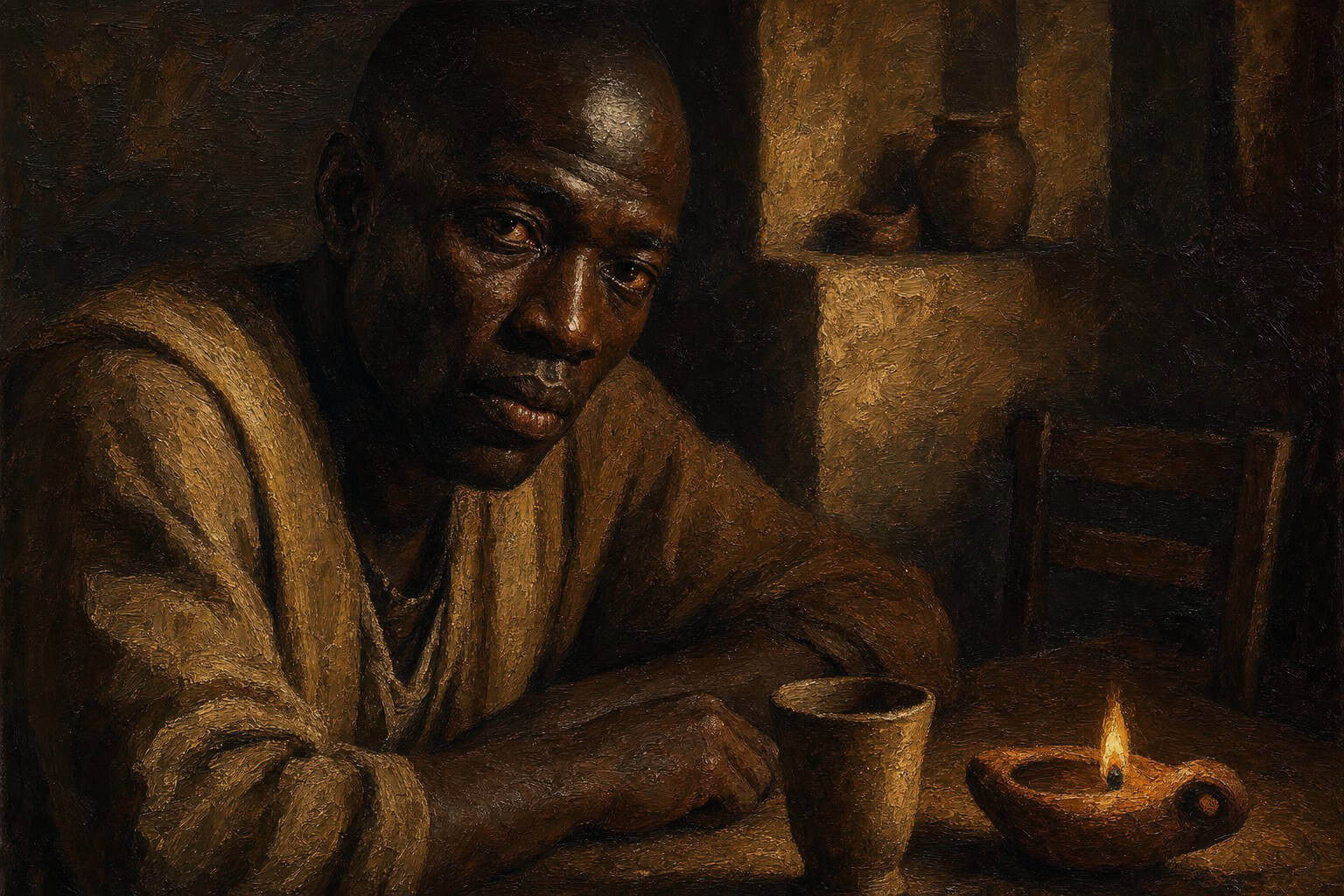
Too quiet, always holding back? Why staying silent keeps you stuck in your own head—and what actually breaks the spell.
The Sentence You Rehearsed and Swallowed
You had it ready. Weeks ago now, or maybe years, but you can still feel the exact shape of it: the dinner table, the fork scraping the plate, the person across from you saying something you knew was wrong. The sentence sat in your throat like a stone you had already shaped with your tongue. You rehearsed it three times behind your teeth. You felt your pulse climb into your ears until the whole room seemed to beat with it. Then the moment passed. You nodded. You said something small and safe instead, some soft agreement that tasted like defeat, and the sentence sank back down into you where it has stayed ever since. That is the ordinary shape of being too quiet, and it is not what people think. It is not a lack of words. You have the words. You have too many of them, in fact, folded and refolded until the edges go soft with handling. What you lack is the willingness to let another person catch them in the open air, where they can be judged, corrected, laughed at, or worse—received. So you keep them. You become a warehouse of unspoken sentences, and you tell yourself this is patience, or humility, or a kind of peace. It is none of those things. It is fear wearing borrowed clothes. The quiet person is not calm. The quiet person is at war behind a still face, and the stillness costs more than any shout would. You learned this young. Maybe it was a parent’s flinch when you spoke out of turn. Maybe a teacher’s correction that stung longer than it should have. Maybe a laugh that landed wrong and left a bruise you still press with your thumb when no one is looking. The lens through which you see the room was ground for you before you could name it, before you could even speak, and that lens whispers the same instruction every time: the safer move is to hold still. You did not choose this inheritance. It was handed to you the way your last name was handed to you. And now, at this table, the old instruction runs faster than your will—say less, risk less, disappear a little. The trouble is that disappearing a little every day adds up to a life spent watching your own hours from the far side of the glass. You see yourself not-speak the way you watch a train pull away without you. The doors seal. The platform empties. You stand there telling yourself you never wanted to go anywhere. But you did. The swallowed sentence is the proof. It is still down there, whole, and it is still yours, and it is still asking to be let out.
The Warm Loop of Your Own Voice
So you take it inward instead. You do the thing quiet people do best, the thing that feels almost like devotion: you replay it. In the car with the engine ticking. In the shower with the water going cold on your shoulders. At two in the morning with the ceiling a gray smear above you and sleep refusing to come. You run the scene again, and this time you say the sentence perfectly. In the private theater behind your eyes you are witty, unshakable, exact. You win the argument you never started. Your face stays calm while the other person, the imagined one, goes quiet in defeat. This feels like progress. It is not. It is a warm loop that circles nowhere, because the mind doing the rehearsing is the same mind that swallowed the words in the first place, seeing through the same eyes that could not see straight when it counted. You cannot correct your own vision by staring harder through the flaw. Every private rerun only wears the groove deeper—the groove of the story you already believe about yourself, that you are the one who holds back, the one who watches, the one who is safest when unseen. The loop is seductive precisely because it costs nothing and demands nothing. No one flinches. No one interrupts. No one hands your words back to you altered. You are the author, the audience, and the applause all at once, and the actual room around you stays empty and dark. This is the quiet person’s particular sin, and I know it in my own bones. For years I watched people the way some men study weather. I read them, mapped their lives from the small crumbs they dropped—a hesitation, a ring turned nervously, a story told one time too many—and I called it depth. It was distance dressed as insight. From behind the glass of my own observing I could feel superior and untouchable at the same time, and I mistook that double comfort for wisdom. But the observer never enters the room. He narrates it. And narration is not living; it is the elegant refusal of it. The more I polished my private reading of others, the more certain I grew of verdicts no living face had ever tested. When you replay the conversation and win, ask who told you that you won. You did. The verdict came from the same courtroom that convicted you of being too quiet. There is no appeal inside your own skull. The loop feels like thinking. It is only spinning. And its warmth—that small, private pleasure of being right where no one can contest you—is exactly the thing that keeps the sentence swallowed, keeps the table silent, and keeps you night after night staring at that gray ceiling, certain and completely alone.
The Correction You Cannot Give Yourself
Here is the turn, and it is not the one you were hoping for. The way out of being too quiet is not to try harder in private. It is not more rehearsal, more journaling, more solemn resolutions made alone in the dark. All of that is still you, working on you, with you—the surgeon bent over his own eyes, holding the very instruments that are broken. The only thing that breaks the loop is another person. A real one, seated across a real table, close enough to see what you cannot. You have a blind spot, and by its nature you cannot find it; that is what makes it blind. Someone else can. Someone else watches you and catches the flinch you never feel yourself make, the sentence you keep folding back down, the mask you have worn so long you mistook it for your own face. And when they name it—when they say, gently or not, that you always go quiet right there—it lands like a wound, because it is one. To be seen truly is to be pierced. It peels off the comfortable verdict you handed yourself and replaces it with one you did not get to write. That is terrifying. It is also the only opening out of the room you locked from the inside. I fought this longer than I want to admit. I believed the observer’s chair was the safe one, the high one, the one that spared me the risk everyone else was taking down at the table. What I could not see was that my watching was itself a wound I kept dressing in fine words. The blemish in how I saw the world could never show itself to me, because I was looking through it. The eye cannot inspect its own scratch. It took a face across from me, patient and unflinching, to say the thing I had spent years not seeing about myself—and to say it kindly, which somehow made it worse and truer at once. I wanted to argue. I had no argument. The only honest answer was to sit still and let the correction land, and feel, for the first time in a long time, that I was not the sole author of the account of my own soul.
You cannot perform surgery on your own eyes while using them to see.
What the Silence Cost the People Around You
This is the thing I resisted longest and now understand best. You cannot use the fruits of your own perspective to climb out of your own perspective. Growth of the mind, the heart, the soul—it does not happen in solitude. It happens in the terrifying grace of letting another person witness your blind spot and trusting them to tell you the truth about it. Not so they can fix you like a stopped clock. So they can see the part of you that stays dark to yourself, and by seeing it, let a thin warmth of light reach it for the first time. The quiet person believes that if he stays hidden he stays safe. But the hidden self does not grow. It hardens. It sets around the same three old fears until they become the whole architecture of a life, load-bearing walls you built in the dark and can no longer knock down. To speak—to say the swallowed sentence out loud to a face that can answer back—is to hand another person the scalpel you could never turn on yourself. It is to say, without shame, that you cannot see yourself clearly and you need help. That sentence, spoken aloud to someone who can answer, is worth more than every flawless argument you ever won alone at two in the morning. Now comes the accounting, and it is not gentle. Your quiet was never only yours to keep. You told yourself it harmed no one—that holding back was, if anything, a kindness, sparing everyone your unfinished thoughts. But silence is not neutral, and it never was. Every sentence you swallowed was something you refused the people sitting right there, waiting. The friend who needed you to disagree so she would not feel crazy. The one who wanted to be known and received, instead, your careful nodding. The love that stalled because you would not say the true thing while there was still time to say it. You were not present at those tables. You were behind the glass again, composing, observing, deciding they could not be trusted with your real voice. And that decision—made a thousand quiet times—told them, without a word, that they were not close enough to be let in. This is the honest accounting: not only what you did, but what you left undone. The comfort you withheld. The truth you owed and buried. The people who reached for you and found only a still surface, cool to the touch. I keep my own list, and I do not get to soften it. I mistook distance for discernment and called my withholding depth, and the people who loved me paid for that with a loneliness I only saw much later, when it was far too late to unsay it. The quiet man is not innocent. His silence is a long series of small refusals, each one a hand quietly lowered when someone reached for it.
The First True Word Is Small
And here is the part that will not resolve neatly, the part I refuse to tie off with a tidy moral: God was there in every one of those swallowed moments. Not to lift the fear away—He rarely does that—but to sit inside it with me, present in the very cowardice, walking with me through the exact sin of my silence, near enough that I could feel Him in the burn of my own shame. That nearness does not excuse the accounting. It makes it bearable. To face what your quiet has cost, without pretending it cost nothing, and to feel yourself accompanied even in the disgrace of it—that is not comfort. It is something harder and truer than comfort, and it is where the ability to speak actually begins. So where does it settle. Not in a triumph. Not in some new confident self who never holds back again—that self does not exist, and chasing him is only another private loop by a prouder name. It settles somewhere smaller and more possible: one true sentence, said out loud, to one person who can answer. That is all. You do not have to become loud. Loud was never the goal; loud is only quiet’s frightened cousin, another way of dodging the risk of being seen. The goal is to be present. To let the words leave the warehouse and enter the air where someone can hold them, weigh them, and hand you back a version of yourself you could never reach alone. It will feel like too much. Your body will do the old thing—the pulse climbing into your ears, the throat tightening, the instinct to swallow it down and stay safe. Let it feel like too much and speak anyway. The wound of being seen is the price of no longer living trapped inside your own head, and it is a price worth paying, and it will not kill you, though for one long second it will feel like it might. What I have learned slowly, against my whole grain, is that the self is not a thing you finish in private. It comes clear only between people, in the narrow space where one sees what the other cannot. You were made for that space. The silence that felt like protection was only a quiet exile. I wrote a book out of exactly this reckoning, Fractions of the Soul, and its opening sits down at a table much like the one in your memory and refuses to look away from what silence does to a life. I will not tell you where it goes. I will only say it begins where you are standing—with a swallowed sentence, a warm and empty loop, and the slow, terrible, freeing knowledge that you cannot see yourself alone. Say the small true word today. Not the perfect one. The true one. And let someone catch it before it sinks back down.