You want to feel whole again. But what if the ache was never a wound to fix? A reading on loneliness, grace, and the completion you were made for.
Before the Fruit, Two Souls Learning Each Other
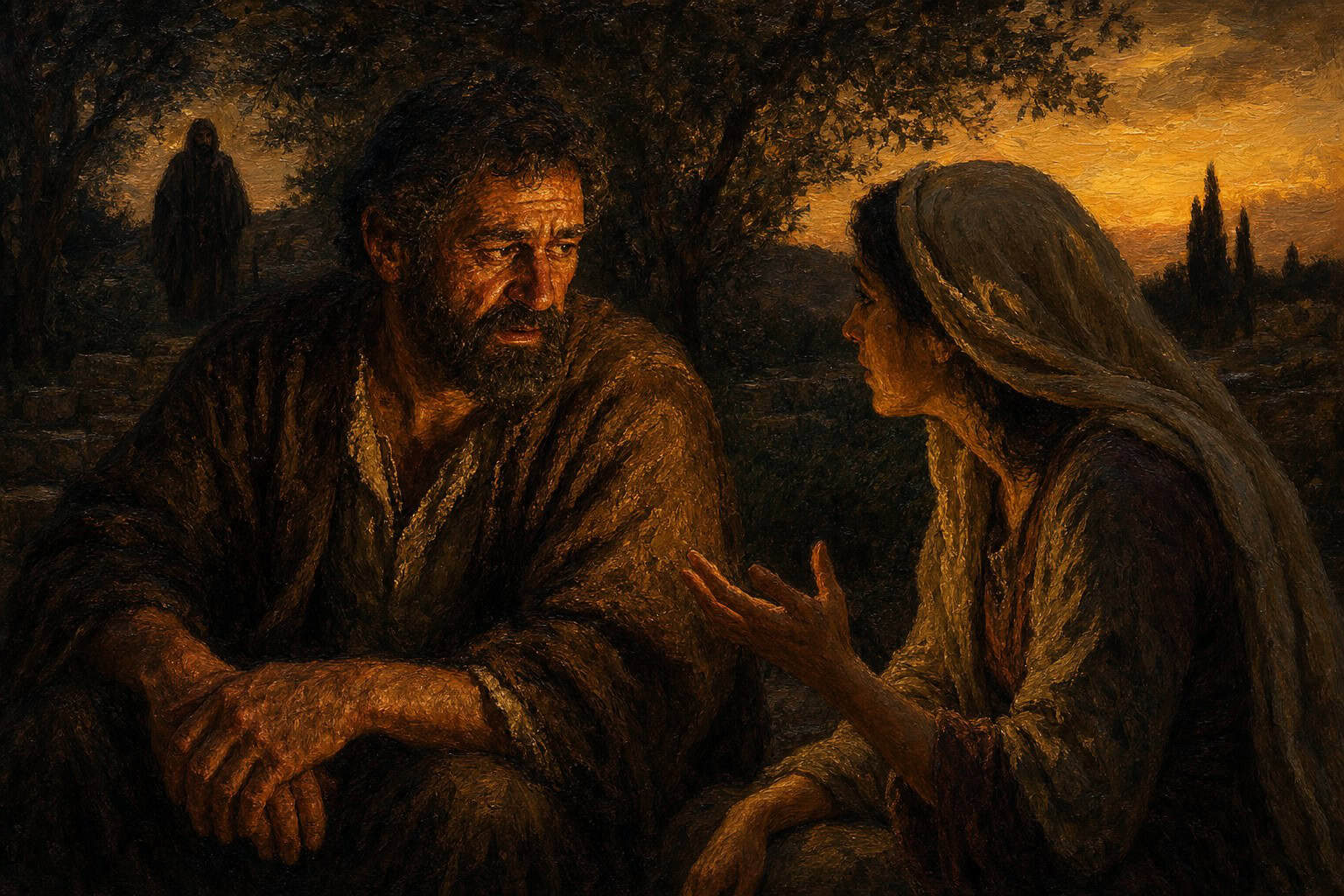
Long before anything broke, there was a stretch of quiet time in the garden that most tellings skip past, and it began with something small. Two people, newly made, learning the sound of each other’s voices. In the third chapter of Fractions of the Soul, the author lingers there on purpose, slowing the tape down. He asks us to picture the first man and woman after her making but before the fall, discovering each other by inches, in flesh and in spirit. They talked. They watched each other move across the same ground, under the same trees. She was like him and unlike him at once, the way a tree differs from an animal and yet shares the same Maker who dreamed them both. Through her, the man came upon parts of himself he had never met, rooms in his own chest he did not know were there until she walked into them. She, in turn, grew into her own knowing—of herself, of him, of the dirt warm under her feet, of the God who set them down together. This slow mutual discovery is where the searcher’s question actually lives, though the searcher rarely names it this way. You type feel whole again into a machine at night because something in you is missing its other half, and you want it back. The garden scene answers before it comforts. It says the ache came first, before sin, before shame, before any loss you can point to on a calendar. God carved a loneliness into the man and drew the woman straight out of it. That hollow was never a defect in the design. It was the design. The author dwells here so we stop reading our own emptiness as a failure to be fixed. Watch how the two of them apprehend each other—that reaching that grasps truly and never fully closes its hand. Each takes hold of the other and still comes up a little short, always a little short. That gap is not the problem to solve. The gap is where love actually happens, the space between two people that keeps them turning toward each other. I read this and think of my own hunger for a person who would complete me, how for years I treated that hunger like a shameful leak in the hull of a boat I was bailing out alone. The book turns the boat over in my hands. The leak is a passage. What if the very need you keep trying to drown is the oldest and cleanest thing about you, older than every wound you keep confusing it with? Before the story goes dark, it shows you this plainly: you were built to lean. The wanting is holy ground.
The Watcher Who Never Needed to Read Your Mind
Then the air cools, because someone else is standing in that garden, back at the treeline, not coming closer. The fallen one watches. God forbids him from entering the two souls directly; free will is a locked house, and he cannot pick that lock no matter how hard he leans on it. So he does the patient thing instead. He observes. He overhears their conversations drifting across the grass. He studies how they hold their bodies, how they turn toward each other and then, in small ways, away. He builds theories about what they will do next, tests those theories, gets some wrong, sharpens the craft, and slowly begins to get more right than wrong. Over long stretches he learns the truths woven into the human heart—not by force, not by reading minds, but by patient, cold watching. This is the part of the chapter that made my own skin go tight. It says your inner life leaks out through your movements and your words, whether you mean it to or not. What you believe is sealed shut inside you is often plainly readable to anyone who knows how to watch a face and a shoulder and a pause. The author does not hand you this to make you paranoid, though he honors the real feeling of being catalogued from somewhere just out of sight. He hands it to you to show how vulnerability gets mapped by a mind that means you harm. The watcher reaches his verdict on the two of them: the man’s weakness is the woman, and the woman’s weakness is herself. Appeal to her, and you capture them both. Here the reading turns on its own maker, because the narrator refuses to stay safe outside it. How much of my own so-called insight, he asks, has been this same cold cataloguing dressed up as care? I have watched people I loved the way a hunter watches a clearing, filing their soft places away for later use and calling it understanding. The chapter draws the exact line between watching to know someone and watching to take them. Suspicion tints the plain facts before the truth even arrives; it turns a neutral gesture into a threat and a kindness into a trap laid just for you. The watcher’s own bent paints the whole scene before he admits it. He finds weakness everywhere because weakness is precisely what he came looking for. And I sit with how often I did that very thing to the people who tried to love me—reading their tenderness as strategy because my own heart was running on strategy the whole time. If you feel watched by something unseen, the book grants that you are not wholly wrong. Your movements do speak. But it presses the harder question into your hand. Which watcher have you become toward the ones nearest you?
The Fulfillment That Runs Only One Direction
Here the chapter leans its full weight on its most unsettling line, and it lands square on the nerve the searcher’s question keeps pressing. The man found his fulfillment in the woman. She filled the exact space God had shaped for her inside his heart, the way water takes the shape of the cup poured into. But she did not find a matching fulfillment in him. She loved him—the text is careful and gentle here, she truly did love him—yet not in the mirrored, answering way that he loved her. God had not planted a fresh and separate loneliness in her when He made her. Instead she was formed out of the loneliness taken from the man’s rib, then individuated, given her own spirit and her own particular flavor of longing that was hers and no one else’s. His hollow lived on inside her, reshaped into something new, but it began as his. So the two of them were never a closed circle of equal and answering need. The author sits down inside this asymmetry instead of smoothing it flat, and he stays there longer than is comfortable. This is precisely where the easy promise of the search term dies its clean, necessary death. You will feel whole again—as though wholeness were a settled state you once possessed and then misplaced somewhere, a file you could simply download back onto the machine of yourself and restart. The garden says no such perfect symmetry ever existed to lose. Even before the first sin, before a single tear, the completion ran in one direction and left an edge unfilled. The man poured himself into a space God had already carved for him; the woman carried a need she could never fully hand across to him, no matter how she loved. The narrator turns this over slowly, and he does not spare himself in it. He remembers the marriages, the closenesses, where he demanded a returning fullness that the other person was simply never built to give back at his exact size. He mistook their unmatched shape for their failure, or worse, for a coldness he could accuse them of. He wanted a mirror and blamed the person for being a window instead. The despair here is not cheap and it is not fixed with a warm sentence. This is not a tidy comfort. It is the truest map of love I have read in a very long time, and it hurts to hold it. The wound you are trying to heal by finding your other half may be a wound that no other half was ever meant to close. And still—still—the ache itself was placed there by a loving hand before anything went wrong. That is the strange grace hidden in the ache: the hollow is not your punishment. It is your invitation.
The hunger for another is not the crack in you; it is the shape God carved so love could find its room.
What the Rib Was Never Asked to Carry
After a line like that, the ground shifts under you, and you have to stand somewhere new. The chapter does not let you off with a rescue. It lets the asymmetry stand, and it makes you live in the aftermath of learning it. If the woman could never fully answer the man’s need, and if that was true in the garden’s own innocent morning, then every hope you have pinned on a single person has been asking that person to be God for you. That is the fallout the author walks through with his own past in hand. He looks back at the faces he loved and sees now what he could not see then: he was handing them a burden shaped like the whole sky and then grieving when their arms gave out. He turns the lens hard on himself and asks the question without flinching. Did I love them, or did I love the wholeness I demanded they manufacture in me? The book will not answer that for him quickly, and it will not answer it for you. It only shows how the demand poisons the very love it claims to protect. When you ask a person to fill the space that only God fits, you begin to resent them for the leftover emptiness that was never theirs to fill. You start watching them the way the watcher in the garden watched, cataloguing the ways they fall short. The past keeps pressing forward into the present here; the narrator cannot narrate this coldly because he is still inside the consequences of it, still carrying the names. And this is where the register of accompaniment quietly enters, not as a fix but as a presence. God does not remove the hollow. He does not hand you a finished person who completes the circle at last. Instead the author senses Him near inside the unfinished ache itself, walking alongside in the very place where the longing goes unmet. The loneliness that was carved into the man before sin turns out to be the exact place where the Maker meets you—not the wound He forgot to close, but the opening He left in you on purpose so He could come through it. There is a peculiar mercy in learning that your deepest hunger was drawn by love. It reframes the whole long ache of your life. The emptiness is not proof that you are broken or unloved. It is the proof that you were made for a fullness larger than any human arms. The chapter does not celebrate this. It simply lays it down beside you, plainly, and lets you feel its weight settle into the quiet after the storm has passed through.
A Hunger Older Than the Loss
So where does this leave the person who typed those three tired words into the dark and waited for a machine to answer? The garden gives you back your ache, but it hands it back changed, warmer in your palm than it was. The author does not promise you the seamless wholeness the search bar dangles, because he has learned too honestly that no such thing waits at the end of a good enough marriage or friendship or love. What he offers instead is stranger and more durable. He offers the news that your longing is not a symptom of damage but a signature of your design, drawn before the first shadow ever fell across the grass. The loneliness came first. It came from a loving hand, individuated into you the way it was individuated into the woman, given your own spirit and your own particular shape of wanting that belongs to no one else who has ever lived. That is not a life sentence. It is a homing signal. Throughout Fractions of the Soul the narrator keeps returning to this recognition, worrying it like a stone in his pocket, and he refuses to tie it off with a bow because his own life would not let him. He still aches. He still remembers the people he asked to be God and the resentment that curdled when they could not be. But he no longer reads the ache as an accusation against himself or against them. He reads it now as the truest and oldest thing he owns, the part of him that predates every failure and outlives every loss. You will not, in the end, feel whole in the way you meant when you searched for it. The circle will not close by human hands, not in this life. What the book leaves in your grip is smaller and heavier than that promise and worth more. Your hunger for another person is holy. Your need to lean is not weakness dressed as neediness; it is the first architecture, the room built into you so that love could find a place to stand. And the One who carved that room walks in it now, in the plain hours, in the empty seat across the table, in the very want that never fully quiets. If you want to know how a man learns to stop cursing his own hunger and start following it home, the rest of the chapter is where he begins to walk that road, name by name, wound by unhealed wound. He does not arrive. He goes looking, and he takes you with him into the going. That is the pull of the book: not the whole, but the honest hunger for it, and the God who was already there inside the wanting before you ever thought to search.