Dealing with rejection in relationships? A raw look at how we misread the ones we love—and what the body knows before the mind admits it.
Her Squinted Eye Across the Table
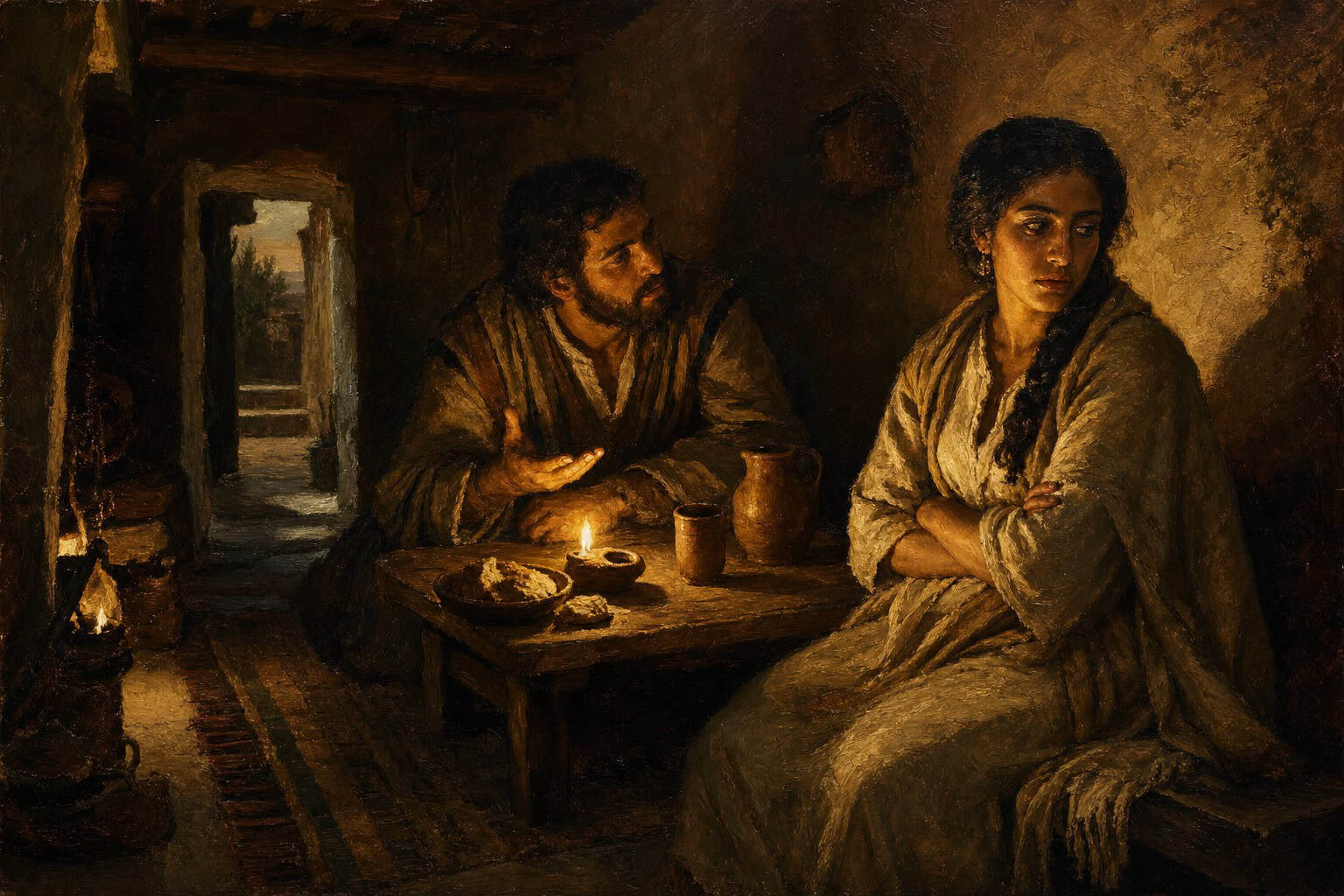
You have felt it: the moment the person you love goes quiet in a way that is not peace. Her eye squints against you. Her brow gathers into a small knot of held-back words. One arm folds across her chest like a shutter drawn against weather. And you keep talking anyway, because you have a point to make, a destination in mind, a place you are certain she will thank you for reaching once she finally sees what you see. This is the scene that opens Fractions of the Soul, where a man sits across a table from a woman and mistakes her body’s refusal for interference he can simply push through. He believes he is offering her light. He believes his insight is pure, clean, unclouded, and that her resistance is only the fog of an unexamined life he has arrived to burn off. What he does not see, or will not let himself see, is that her folded arm is not empty air. It is speech. The body says its no before the mouth finds the words, and he has trained his eyes to skate over that language as though it were nothing. If you have ever sat where he sits—sure of your love and just as sure of your rightness—you know the peculiar blindness of that posture. You grow so busy being generous that you cannot register the flinch happening a foot away from your face. The muscles around her eye tighten. Her breath shortens. Her weight shifts toward the edge of the chair as if measuring the distance to the door. None of it reaches him. Rejection, in this scene, is not something being done to him from the outside. It is something he is manufacturing, breath by breath, by refusing to read the flesh that is already telling him the plain truth. The wound of rejection so often begins right here, long before anyone says the word aloud. It begins the instant we treat another person’s discomfort as an obstacle to our momentum rather than as sacred testimony we are bound to receive. He wants their talk to be direct, stripped of the ordinary distortions that gum up every human exchange. He wants her to show herself to him without the filter of her own history sitting in the way. But there is no such purity between two people who share a table and a past. There is only her squinting eye, her gathered brow, and his choice—already being made, word after word—to keep going. The scene sets the trap the whole book will spend itself trying to name. And it presses a question against you too: what does it cost the ones we love when we cannot bear to be told no?
The Word That Smooths Over the Gradations
The book lingers here on something small and devastating: the way we use a single word for a dozen different feelings and call it honesty. Its narrator argues that errors between a man and a woman multiply exactly as their inner rigor thins out. When you cannot dissect your own thoughts, when you smooth over the fine gradations of what stirs in you and clump them all under one lazy word, you hand your partner a blur instead of a self. He calls this the unexamined life, and he is severe about it, nearly cruel. He splits humanity into simpletons ruled by instinct and true persons capable of examining themselves. There is real arrogance in the split, and part of me writing this knows it. But underneath the arrogance there sits a truth that stings when you touch it. When you refuse to name what you feel with any precision, you starve the person across from you of anything to actually meet. You say fine when you mean afraid. You go silent when you mean I need you and cannot make my mouth form the asking. The rejection you dread is sometimes only the echo of your own vagueness bouncing back at you. The tension in the scene sharpens here, because he applies all his rigor to everyone but himself. He wants her to investigate her nuanced meaning, to subcategorize her feelings, to spend real energy dragging her inner chaos into order—while he never once turns that same lens on his own hunger to be agreed with. He wants her contemplative and pried open. He wants himself untouched and sealed. This is precisely where the ache of rejection lives in ordinary rooms. We ask our partners to be honest, transparent, examined, while we guard one tender corner of ourselves from any such searching light. We name their vagueness a flaw and rename our own privacy. The body, meanwhile, keeps its own quiet ledger through all of it. His mind races ahead with its agenda, sentence stacking on sentence, while her crossed arm records in real time exactly what he is doing to her. The flesh remembers what the intellect is too proud to admit. And running under everything is a desire the book does not bother to hide—a longing to be truly known by another person, to close the distance between two skins and two minds in the same instant. But you cannot be known while refusing to know. You cannot demand precision from a woman you are already talking over. Her furrowed brow is precision; it is her nuance made visible, and he reads it as static. The scene holds this contradiction open, unresolved, and lets it throb. The grayness so many couples describe—the sense that the light between them has gone dull and neither can say when—begins in exactly this smoothing over, this one flat word laid across a whole trembling field of feeling.
The Gratitude He Was Already Rehearsing
Then comes the turn that makes this scene impossible to shake loose. His whole confidence rests not on her consent in the present but on a future he has already written for her. He tells himself she will thank him later. Once she reaches the destination he has picked out on her behalf, she will understand, and her gratitude will vindicate everything he is trampling now. This is the quiet violence the book drags into the open. It is a trick with time. He takes her refusal in the present tense and files it under her future thanks, and by that single move he makes her responsible for validating her own overriding. Her no becomes a not-yet. Her discomfort becomes proof of how far she still has to travel toward him. Here the scene bares its teeth, because it names a thing many of us have done and never once called by its real name. We excuse our controlling love by imagining the gratitude waiting downstream. We roll over the flesh right in front of us for the sake of a soul we have decided we are saving. He never asks whether the destination was hers to want. He only assumes she will arrive there and be glad. That assumption does its work in the dark, dressing coercion as kindness, hiding the wound inside the promise of thanks. And the woman across the table feels every ounce of it in her tightening jaw, her shortening breath, the small retreat of her body toward the chair’s edge, even as his voice keeps rolling forward as though nothing were being crushed beneath it.
Love that will not receive a no is not love; it is appetite wearing love’s face.
What the Trembling Afterward Confessed
The fallout does not arrive as an argument. It arrives in the body. After she gathers her things and goes, the narrator feels his own inner defenses begin to shake, and in that shaking something surfaces that his eye had refused for the whole conversation. The flesh knew before the mind would consent to know. His body had already registered her as both threat and rescue—the woman who could unmake him and the woman who could save him at once—and he had spent the entire hour talking over that recognition to keep his tidy insight intact. This is the cruelty of perception the book keeps circling back to. We so often know the truth of a person in our nerves and our shortened breath long before we permit ourselves the thought. The knowledge that belongs to love does not idle at the surface; it drives down to the core—but only when we stop guarding ourselves long enough to let it through. He would not stop. So the knowledge came late, as it always does when we override the body’s plain testimony, arriving as tremor and dread instead of as tenderness in the one moment tenderness could have mattered. Here the reflection turns inward, and the older voice telling the story starts to interrogate the younger man he was. Who was she, really, to him? Not the unevolved student he cast her as. Not the fog waiting to be burned off. A whole person with her own history pressed down into her over years, a way of filtering the world that he experienced as an obstacle when it was in fact the very shape of her selfhood. What did he refuse to see? That her resistance was not a lower rung of consciousness but a valid and holy no, complete in itself, needing no permission from him. What did he do with it? He filed it away and kept talking. The rejection he feared from her he had already committed against her, only in reverse—he abandoned her presence while she sat right there. And this is what the book will not tie off with a clean moral. It leaves him shaking in the space her chair left behind, alone with an intelligence that came too late to be of any use. The desire has not gone anywhere. The longing for union, for the closing of distance, for flesh answering flesh in the same breath rather than one voice running headlong in one direction—all of it is still there, aching in the emptied room. But the mutual exchange he wanted was never possible while he was talking over her body. You cannot be met by someone you are busy correcting. The fallout is not that she left. The fallout is what her leaving finally forces him to feel: the exact temperature of what he did, arriving in his own trembling hands.
Reading the No You Were Given
So what does this scene hold out to you, sitting with your own rejection, the one that still stings when you turn it over? It offers no comfort that wipes the sting away. Fractions of the Soul is severe about that; it will not press a tidy peace into your palm. What it offers instead is harder and more useful: the suggestion that the rejection you carry may have been trying to tell you something true, and that the way through it is not to argue but to read. When someone folds their arms against you, that is testimony, not interference. When someone says no, that no is holy—it is the place where they stop and you begin, the boundary that makes real love possible instead of consumption wearing love’s clothes. The narrator’s failure is a mirror many of us need to stand in front of. He was so busy being right, so busy collecting a gratitude he imagined for later, so busy examining her while sealing himself off, that he never let the trembling knowledge reach him while it could still change anything. You can do differently. You can turn the lens on yourself first—name what you actually feel with rigor and precision, refuse the lazy single word that flattens your fear into fine. You can let the other person be wholly other, with a history and a self that filters the world through her own eyes, and quit treating that filter as a defect to be corrected. And you can trust that God is not missing from the ache of being refused. He does not always lift the pain off you. Far more often He walks inside it—present in the tremor after the chair scrapes back, near in the tear you did not expect, quiet in the dark where you finally see what your own hunger did to a person you claimed to love. That is where the book sets you down—not rescued, but accompanied; not resolved, but honestly known. The scene that opens this memoir is a portrait of a man who could not survive a no, and the whole book that follows is the long, unsparing reckoning with what that cost him and the woman across the table. If you have ever mistaken your appetite for devotion, or sat on the receiving end of someone who did, you will find yourself on these pages, uncomfortably seen. That discomfort is not the end of you. It is the light beginning to return—the light that dims the moment we stop examining our own hearts, and that comes back slowly, at real cost, in the hour we finally do.