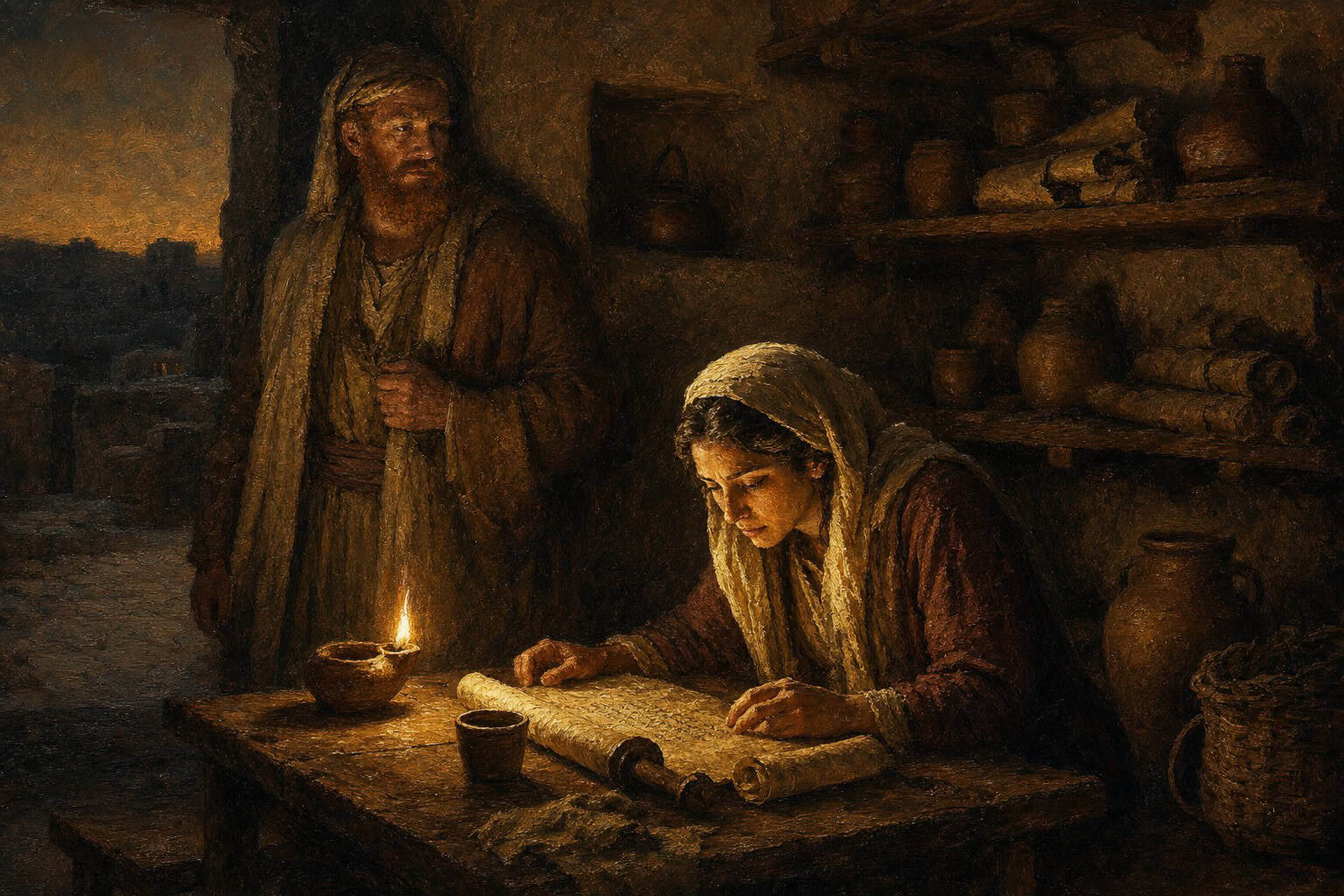
Comfort found in good old books is real, but it can also become a hiding place. A reflection on the ache beneath our beloved pages.
Her Fingers Returning to the Same Worn Pages
She reads the same book again. Her fingers find the corners already soft from handling, the spine loose from years of return, the paper gone limp where her thumb has rested a thousand times. She reaches for those pages the way a cold person reaches for a fire, because the world outside offers her nothing so steady. I understand this. There is a mercy in an old book that living people rarely give. The page does not change its mind about you. It does not grow tired, or turn cruel, or leave the room in the middle of a sentence. It waits exactly where you left it, holding the same words in the same order, and that faithfulness feels almost like being loved. This is the comfort you are looking for when you type your question into the dark, and it is a real comfort, not a foolish one. In Confessions to the Empty Chair I watched a woman I loved take this shelter, and I mistook it for a small habit, a charming quirk of a scholar’s daughter. Her parents were medievalists. She was raised inside old words the way other children are raised inside a house, and those words became her true home long before I arrived. When the day pressed on her, when the room grew loud or a person came too close, she went back to the familiar text and let it hold her. I did not see, at first, that the holding was total. I did not see that she had built a whole life inside those pages and left only a small window open to the rest of us. She found in re-reading a peace that no person in her waking life could match, and I told myself this was refinement. I called it culture. I admired it out loud, the way you admire a thing you do not yet understand. What I would not admit, standing so close to her that I could smell the dust of the old covers, was that the same books that comforted her also sealed her. She could vanish into them mid-conversation. She could close the cover of the world and be, for a while, untouchable, gone somewhere I was not invited. And I wanted to be the thing that touched her. I wanted to be the reason she looked up. So the very shelter that saved her from her fear became the wall between us, and I circled that wall like a man who has lost the door and refuses to believe there ever was one, running my hands along smooth stone, sure that if I only pressed hard enough it would give.
The Sterile Appreciation and My Loud Hunger
In her family, love wore the dress of the mind. Desire was studied, admired from a proper distance, kept behind glass like a manuscript too precious to touch with a bare hand. Her parents loved carnal things the way a scholar loves a painted battle, with knowledge and cool delight and no blood on their hands. They could speak of the body for hours and never once tremble. I came in loud. My love did not look like theirs, not even distantly. I did not want to admire pleasure from across a lecture hall; I wanted to consume it, to drink it down, to draw peace from its taste the way she drew peace from her pages. My hunger was not sterile. It was gluttonous, and I felt no shame about that then, though the shame arrives now, in my hands, as I write this. Here the two of us stood, both starving, both reaching for comfort, but we reached toward opposite altars. She wanted desire framed and studied, softened by learning until it became safe enough to keep in the house. I wanted it raw, unframed, alive and breathing in the body. And I made the fatal mistake of the clever man. I decided her heart was a lock and my mind was the key. I told myself that if I studied her coordinates, learned her rules, offered up my bruised heart on a clean white plate, I could negotiate my way into her love. I read her the way she read her books, hunting for the passage that would unlock her, underlining her moods, searching her silences for a hidden meaning. This was a tragic misuse of my intellect. There was a smudge on my own lens, and I could not see it because it sat on the very glass I was looking through. I mistook her polite distance for a puzzle. I thought her quiet meant a problem I could solve if I only worked hard enough. But she was not a text to be decoded, and I never once did the humble thing, which would have been to sit beside her and learn the shape of her heart from the very books that comforted her. I never asked her to read me a passage she loved. I wanted her surrender. I never wanted her syllabus. I wanted a relationship free of complication, full of passion, with only my imagination as its limit, and I called that love and believed myself. Looking back, I am not sure it was love at all. A man who treats desire as a transaction is still shopping, even when he tells himself he is worshipping. I dressed my appetite in the language of devotion, and she, trained since childhood to hear the difference between the real coin and the counterfeit, heard it at once. She placed my gluttony on one side of a line and something quieter on the other, and I never learned the name of the line until I was already standing on the wrong side of it.
The Trial I Never Knew Was Being Held
There was a court. I did not know it had convened. Somewhere in the private rooms of her heart, behind a door I never found, a trial was held, evidence was weighed, a verdict was reached, and I was found unworthy to be her husband. The strange horror of it is that the ruling came before I even knew I stood accused. My disqualification was a foregone conclusion, decided in a chamber I was never permitted to enter, judged by rules I was never handed, sentenced while I was still buying flowers. She was searching, I think, for a certain kind of man, one with the quiet authority of her father the scholar, a man who could humble her pride without ever raising his voice, who could master her simply by being still. I brought her strength and lust and open want, all of it loud, all of it plain on my face. Her father’s protégé brought her something else, something in her father’s own key, and she accepted his and rejected mine. And here is the wound that will not close: she could not accept my strength as strength, because I was not the man her imagination had already drawn. To love a man, she first had to paint a version of herself onto him and then love that painting. When she looked at me, she did not see me. She checked me against the sketch and found the lines did not match. She saw whether I could carry the image she needed to see, and I could not. I was too much myself, too loud, too hungry, too far from her father’s spirit. And so she sorted me, the way, I have come to believe, we all quietly sort the people who draw near, into the ones who are prospects and the ones who never will be, a filing done in silence, behind a smile. I already knew which drawer she had shut me in. The proof of it broke my composure completely. She was taking pills to quiet the protest inside her, the rebellion of her own heart against my presence in her days. My nearness made her ill enough to need medicine. Sit with that a moment, as I have had to sit with it for years. The man who wanted only to comfort her had become the very disturbance she needed to be soothed against. I was the ache she medicated. I was the noise she took something to bear.
The cruelest verdicts are handed down in silence, in a courtroom of the heart where the accused is never called to testify.
The book that shelters your heart can also become the wall you build so no one reaches it.
Comforting the Remains of a Woman I Disturbed
So I stayed to comfort what my presence had wrecked. Read that sentence slowly, because I lived it slowly, hour by hour, in the same rooms. I held the remains of a woman who needed medicine to bear the space I was standing in. There is no clean feeling for that, no word that fits it without lying. Shame is not a loud thing here; it is a low tone under everything, a weather that colors the whole house gray, seeping into the coffee and the bedsheets and the silence between our sentences. I wanted to cover myself and vanish from my own sight. I could not stand to be the thing that made her sick, and I could not stop being it, because the thing that sickened her was not a habit I could break but simply my desire, my want, my whole raw self reaching toward her. What do you do with a self that is the wound? I turn the question on myself now with no mercy at all. Did I ever love the woman standing in front of me, or did I love the version of her that would finally choose me? I accused her of painting herself onto me, but I had done the very same thing to her. I had drawn a wife over her body and worshipped my own drawing, kissing the paint. I wanted a partner whose core I loved, and I told myself that was noble, that it made me irreplaceable, a giver of a love no other man could offer her. But irreplaceable to whom? To her, or to my own hunger to matter to someone? I do not know if I can answer that even now, with all these years behind me. And her books, those worn and re-read pages, I finally see them for what they were. Not refinement. Not a charming habit of a scholar’s daughter. They were the armor she assembled from beautiful words, plate by plate. She built her prison out of the finest sentences ever written, and it looked so much like a library that I mistook the bars for shelves and admired the craftsmanship. She hid inside high culture the way a frightened animal hides in a beautiful cave, and I stood outside calling her name, never understanding that the cave was the only thing keeping her alive. I wanted to pull her out into the light. I did not stop to ask what she was hiding from, or whether I was one of the things she was right to hide from. That is the part I cannot tie off. Maybe both were true at once. Maybe she was wounded and building walls, and maybe I was a wall worth building against. Grace did not lift me out of that room. It stayed with me inside it, quiet, walking beside me in the very failure I could not undo.
The Peace That No Page Can Give You
So return to your question, the one you carried here in the dark: is there comfort in good old books? Yes. There truly is, and I would be a liar to say otherwise. The page will hold you when people cannot. It will not tire of you or turn its face away, and on the nights when the living have all gone cold and quiet, a well-loved book is a real fire and not a false one. I will never tell you to close the cover. But I have watched what happens when the shelter becomes the whole house, when the fire is the only warmth you will let near you. I have loved a woman who lived so deeply inside her pages that no living hand could reach the person on the other side of the paper, and I have been the one standing in the cold outside her beautiful wall, and I have also, God help me, been the danger she was right to wall out. Both. The book comforts. That is its mercy and its trap folded into one binding. It comforts you so completely that you can forget you were made for a love that changes its mind, that grows tired, that leaves the room and comes back with red eyes, that sees the whole of you and stays anyway. A page cannot see you. That is exactly why it is safe, and exactly why it can never save you. The peace it gives is real but it is small, the size of a lamp, and it will not do the one thing you most need, which is to know you can be fully known and still not left. I did not offer her that gift. I offered her negotiation, appetite, a puzzle-solver’s love that circled her wall by night looking for the seam. And in the wreckage of all of it, in the room where she needed medicine to endure the sight of me, I found something I did not expect. God did not lift the darkness away like a curtain. He stayed inside it with me, near in every tear, present even in the middle of my sin, walking slowly beside the man I had become. That is the strange thing I carry now, instead of a happy ending. Not rescue. Accompaniment. If you have hidden in your books because the world could not hold you, I understand, and I will not shame you for it, not for a second. But I will tell you, as a man who lost more than he can put into a sentence, that the goal was never to stay safe behind the pages until the light went out. The goal was to let yourself be seen and stay in the room anyway, trembling, uncovered, and not run. That is the harder book, and mine is still being written, page by unfinished page.