Trying is the first step to failure? A memoir of a shattered first love argues the failure was the forge—and God stood inside it.
The Boy Who Loved Too Truly to Be Spared
You typed that line because you are tired of reaching for things that break in your hands. Trying is the first step to failure—it has the ring of a shield, a way to keep your fingers curled in your pockets so nothing can be pried loose from them. In Chapter 16 of Confessions to the Empty Chair, the narrator turns back toward a first love named Jeannètte, and he refuses to file the ruin of it under accidents to be avoided. He says the opposite of what you came here to hear. He says the bond had to be true, because a shallow one would have made only a shallow wound, and a shallow wound would never have cut deep enough to move anything else into motion. Read that slowly. A young man loved a girl the whole way through, without holding back, without the small mercy of a half-measure kept in reserve. And precisely because he did not guard himself, the loss went all the way down to the floor of him. The old man writing the page does not pat that boy on the shoulder for being sensible, because he was not sensible. He was wide open, both hands out. Here is what your search is missing while it hides its hands: the man who never tries also never bleeds, and the man who never bleeds is sealed shut like a jar no one can open. The narrator does not want to be that sealed jar. He wants to know what the wound was for, what it drilled down into, what it made possible. So he does not stand at a clean distance from his own wreckage and narrate it from safety. He climbs down into the pit of it, hand over hand. The chapter carries a memory that still holds heat in it thirty years on—not some dusty relic stored in the attic of his skull, but a room he can still step into and feel the plaster warm under his palm. That is where you meet him. He is not lecturing you about the dangers of hoping. He is standing inside his own failure with his breath coming from his belly, not his throat, saying one true sentence out loud so the room will hold still. The whole scene runs in the key of honest accounting: what did I do, what was done to me, and which of the two have I been quietly mistaking for the other all these years. He is not asking whether trying is safe. He learned long ago it is not. He is asking whether the failure that trying leads to is the punishment it looks like, or something far stranger, standing in the dark and waiting for him to arrive.
The Black Flame That Was Never Black
Watch what happens next, because the whole chapter pivots on it. The young man, cast out and shaking with real anguish, gives the fire a name. He calls it a black flame—sorrow, the gray weight of depression, the ugly pull toward hurting himself, the whole downward drag of a soul that had built its entire house on one person and just watched that person walk away. He is not wrong that something is burning him alive. He can feel the heat on his skin, in his sleep, in the hours that will not pass. But he is wrong about the color of it. The old man writing the page knows something the boy had no way to see: the flame only looked black because of the eye watching it. A blemished lens sees blackness where the fire is actually clean. Here the narrator names his own instrument, and this is where the accounting turns on himself. He built a habit of watching, of taking his own pain apart to understand it, an observer’s stance he assembled plank by plank to survive being broken. He calls it a fortress, and he is savage in his honesty about it: it worked. It kept him upright. It let him narrate his own drowning while he drowned. But understanding, he confesses, curdled into control, and control kept him at a clinical arm’s length from the very nearness he was starving to death for. This is the reckoning underneath everything else in the scene. The tool that saved his life also became the bars of his cell. He forged a lens so he could endure the shattering, and the lens turned him into a stranger at the edge of every room he later tried to enter. So when he says the flame was never black, he is not handing you a warm blanket. He is accusing his own eyesight of lying to him. He is saying: I misread my own suffering because the very thing I used to read it was itself part of the wound. And now the older self leans hard on the younger with a question that does not let go. Did the boy suffer because God turned His back, or because the boy had trained himself to watch his pain from the corner instead of stand in it and feel it? Was the depression a foothold something dark had climbed into, or was it the smoke his own smoky lens made of a fire that burned clean? The chapter refuses to make that easy for either of them. It holds the boy’s real anguish in one hand—the tears were true, the wanting-to-vanish was true, none of it was performance—and in the other it holds the terrible possibility that some of the darkness was a shadow he himself was casting. It will not separate wound from violation, what happened to him from what he did with it. Both sit there on the table under a bare bulb. Neither is let off cheap. That is the accounting, and it is hard to watch a man do it to himself with this little flinch.
The Fourth Man Was Standing in It
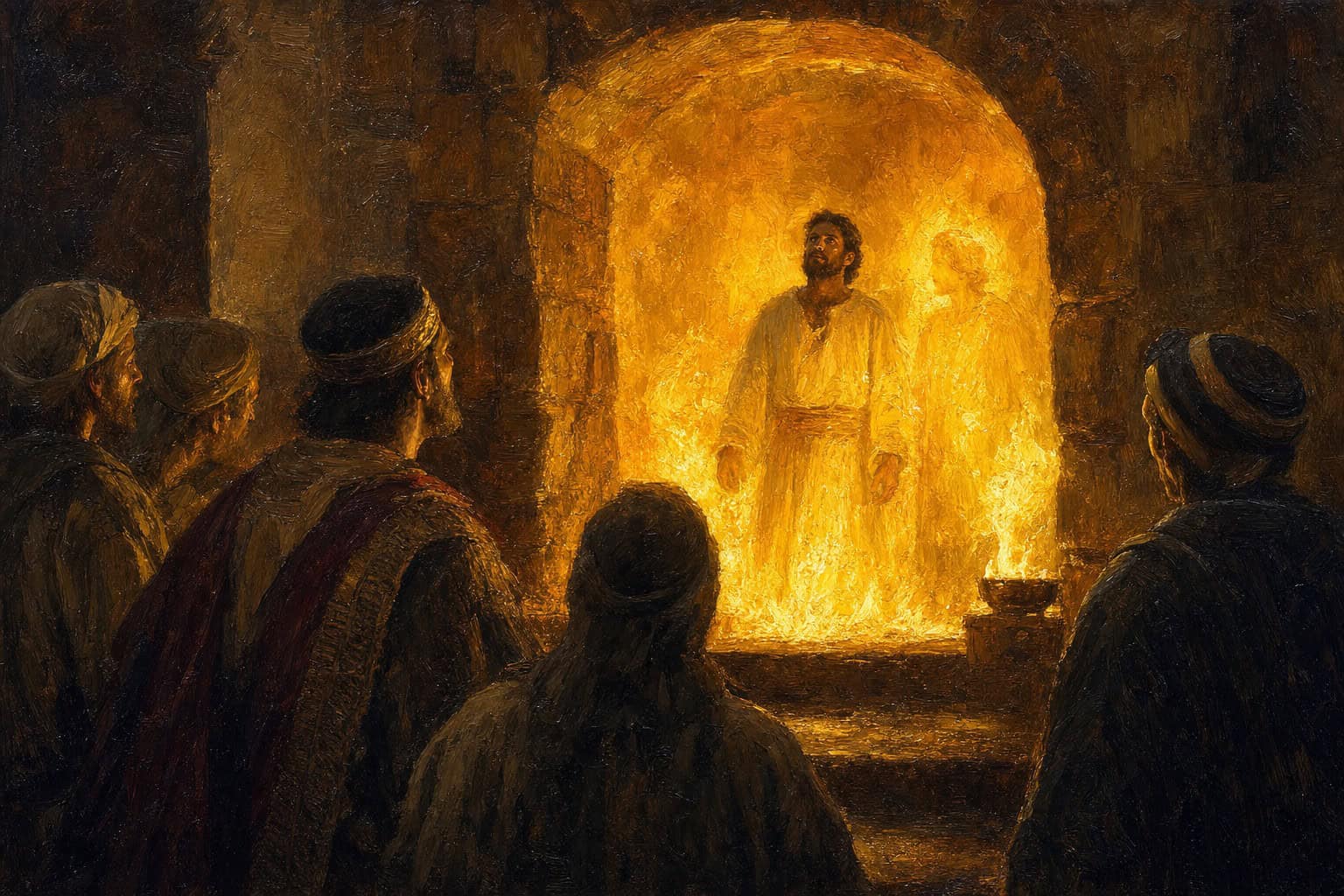
Then the turn arrives, and it is not the turn you brace for. He does not say the fire finally went out. He does not say God reached down and lifted him free of the pain, wiped him clean, the way he swears God once did when he was thirteen—that was a miracle, and miracles come rarely, the exception that breaks in once and does not run on a schedule you can count on. This time God did something harder and far quieter. He did not haul the boy out of the fire. He drew him up into it, to the place where He was already standing, like the fourth figure walking unburned through the furnace in the old story the narrator can’t stop returning to. The flame the boy had named black was the refining flame the entire time—the very breath passing between the Father and the Son, present down in the sorrow, not lifting it away. Here your search finds its real answer, and it is not the answer the slogan promised. Trying is the first step to failure. Fine. Keep it. But the narrator has just shown you where the failure delivered him: to a forge, and to a Presence standing in the middle of the forge who had arrived before he did. God stayed silent through all of it, but silence is not the same as absence. The hand was working the whole time in the dark, unseen by anyone, including the boy it was working on. The old man now prays backward across thirty years, asking God to do whatever it takes to drag that young man closer to His heart—and he believes, with a kind of vertigo, that the eternal God answered the prayer inside the past itself, because for God time is not a road you walk away down but a room He already fills at both ends at once. So the failure you are so afraid of is not the last word of the sentence. The failure was the doorway into the room where God was waiting with the light on. The suffering was not deleted. It was moved into. He burned exactly to the degree that he clung to other things—to Jeannètte, to the whole life he had stacked on her, to the comforting lie that time runs in a straight line safely away from the flame. The clinging was the fuel he kept feeding it. The fire only scorched him where his fingers were still closed.
Grace rarely rescues us from the dark; far more often it walks with us inside it, so near we mistake its warmth for the burning.
That is the line to underline and go back to. The narrator makes you no promise of escape. He offers you company on the furnace floor, which is a stranger and much larger thing than escape, and he confesses he only learned it by failing all the way down to the coals.
Grace rarely rescues us from the dark; far more often it walks with us inside it, so near we mistake its warmth for the burning.
An Ossuary Someone Else Built Her House On
Now sit down in the fallout, because he does, and he does not rush you out of it. The transmutation he describes—anguish pressed into structure, a black flame revealed as a bright one—did not come without a bill, and he refuses to pretend otherwise. Jeannètte moved on. She built a new life on the far side of him, and in the coldest, most load-bearing image of the whole chapter he says his own bones became the ossuary she raised that life upon. Sit inside that a moment. The bones of the young man who loved her all the way through became the foundation stones under someone else’s house, someone who kept walking while he stayed behind in the ash, breathing it. That is not resolved. It is not forgiven in one clean sentence and folded away. He names her act as the instrument and his own anguish as the fuel, but naming the machinery does not blunt the plain fact that a person he loved cast him out and did not turn around. And the reckoning cuts back toward him just as hard, which is the part this book keeps circling. He does not grant himself an exit. The lens he forged in the fire—the observer’s habit, the analytical fortress he calls his own—he has not retired it. Thirty years on he still runs it. He chose, on purpose, to keep the mechanism of detachment, and he says so out loud, which is a rawer confession than any charge he lays at Jeannètte’s feet. He can still watch his own grief from across the room like a specimen. He can still quietly turn a living person into a thing to be understood instead of someone to sit beside. When a later woman, Leigh, saw a steady light in him, he tells us it was not the ghost of the old love still smoldering. It was the light of a man walking out of the forge, remade by the heat. But the same page admits the forge left him fluent in distance, at home in it, safe in it. So the fallout comes doubled. He came out of the fire carrying a light and a limp. He learned to survive by watching, and the watching became a cell he still lives in, one he has decided, with open eyes, not to leave. The older self genuinely does not know whether that is faithfulness or cowardice dressed up as wisdom. He sets the question in front of himself and refuses to answer it: is the fortress a discipline he was given, or a hiding place he chose? Is keeping the lens honest humility about his own frailty, or the last locked door he will not open to anyone? He does not decide for you. He lets the ossuary stand there in the daylight, white and bearing weight, under a house that will never be his.
The Same Walls, Now an Altar
Where it finally settles is nowhere you would guess a book about a shattered first love would put down its head. He does not tear the fortress down to rubble. He does not weep over the observer’s cold habit and vow to become soft and unguarded and easy, the way a lesser and more comforting book would close its final page. He does something stranger, and more stubbornly Catholic than that. He hands the whole structure over, keys and stones and all. The same walls he raised to keep himself at a clinical distance—under a different ruler, he says, those very walls become a chapel. The page he once used to analyze his own pain into obedience turns beneath his hand into an altar. He does not stop being the man who watches. He offers the watching up like bread. The instrument stays exactly what it is; only its master changes, and that single change alters everything the instrument goes on to make. This is the quiet way the chapter comes to rest, and it answers your search more honestly than any bumper-sticker could. Trying is the first step to failure—yes, granted. And failure, walked all the way through to its floor, is the first step to the forge. And the forge, if you do not bolt from it, is where you meet the One who was already standing in the flame before your feet ever touched it. He makes you no promise that the fire goes out. He does not promise Jeannètte comes back, or that the ossuary is ever pried up and reburied properly, or that the long loneliness of the observer is fully healed this side of the grave. What he offers is smaller and far truer: the possibility that the very defense you built in your worst hour, the exact habit that seals you off from everyone, can be reconsecrated and put to holier use. The past is not a corpse gone stiff in the attic. It is a room he is still rebuilding board by board, still walking back into, still arguing with in the dark. And the God he found down there is not the God of the rope dropped from a clean sky. He is the God of the furnace floor, present in each falling tear, near enough to feel like the burning itself. Confessions to the Empty Chair does not tie a bow on this. It leaves the narrator kneeling on the same stone that once caged him, in the chapel his cell became, saying the last thing a broken and honest man can say. He will serve. Not because the failing ever stopped aching in him. Because he finally saw who had been walking beside him in the flame the whole time, and understood at long last what the burning was for.