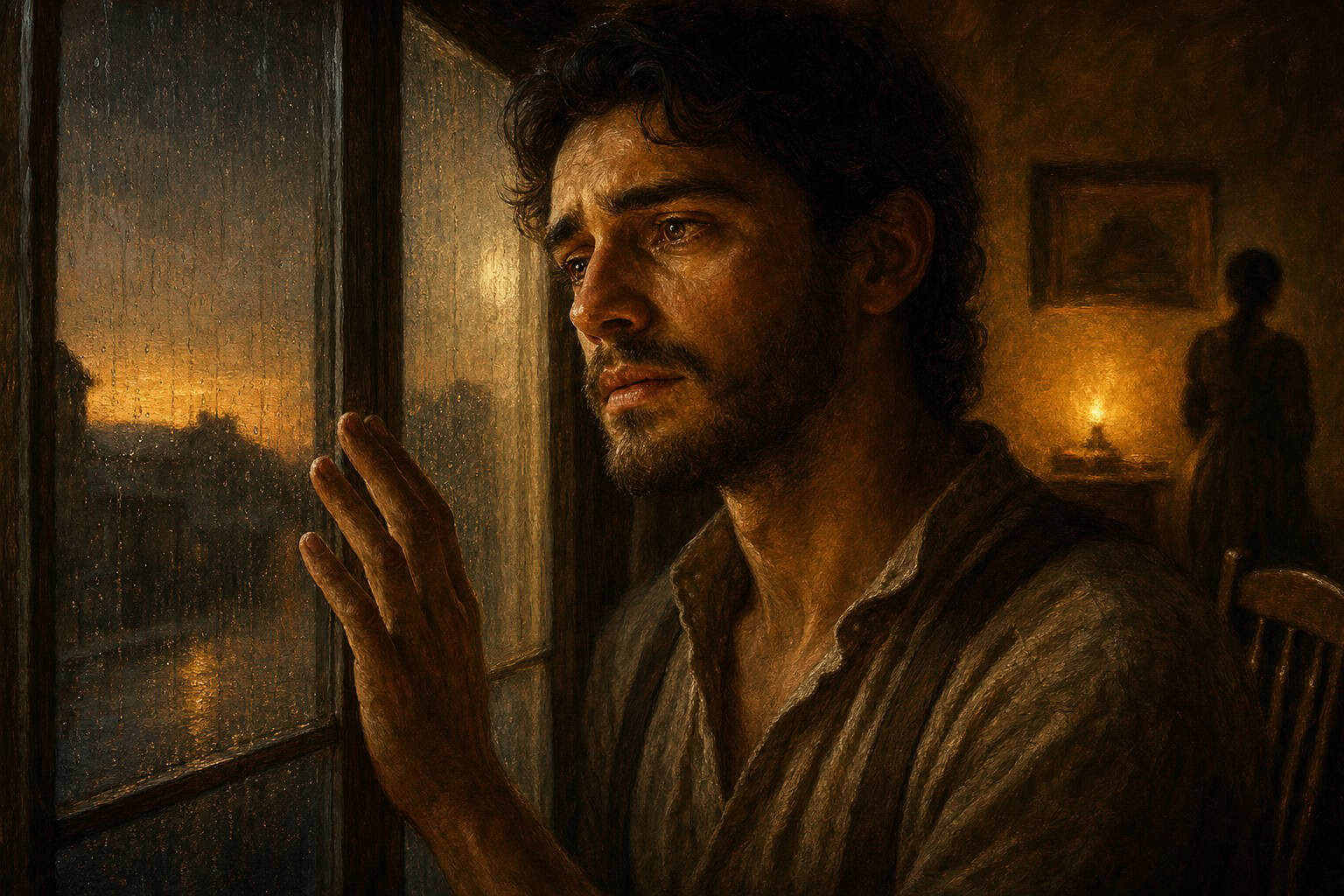
From strangers to lovers to strangers again—why the circle closes, and what it means when the one who dismissed you returns.
The Girl Who Spent His Affection Like Loose Coins
A phone lights up in the dark, and the name on it is one he has known since the eighth grade. That single detail carries the whole ache before a word gets spoken. You know the shape of it already. Someone was a stranger, then the center of your world, and now they are a stranger again, and you cannot understand how the same face went cold both times. In the fourteenth chapter of Confessions to the Empty Chair, the narrator meets this exact wound with a name attached: Alex, his old reliable, the girl who has orbited his life since childhood. She was the tomboy, the self-crowned firebird, and she kept a rotation of boys circling her while she held him just out of reach in the place he calls the friend zone. He handed her his affection and she spent it like loose coins, pocketing what he offered and turning her real warmth toward others—older boys, younger boys, always the reckless ones, always the ones who thrilled her more than he ever could. This is where so many of us have stood: near enough to be useful, never near enough to be chosen. The narrator does not pretend he floated above it. He wanted her. He carried that wanting for years, benched in a nearness that gave him nothing and cost him everything he had to give. That kind of longing has a specific taste in the mouth—hope that will not die, humiliation that never lands hard enough to free you. It is the reach toward a wholeness you can name and cannot hold, and it sits in the chest like a coin you keep flipping and keep losing. If you have loved someone who kept you as spare change, you feel that old bruise pressing back right now, tender under the shirt. The chapter opens here on purpose, so we understand exactly what he was: not a man who was loved and lost, but a boy who was tolerated and set to one side. The distance between those two things is the entire story. And the question that hangs over the scene—the one you typed into the search bar at some late hour—is whether the circle ever truly closes, whether the one who dismissed you can come back and mean it. He is about to answer, and his answer is harder than either love or grief. It will not comfort the boy in you. It will do something stranger. It will make him grow up in a single sentence, and it will cost him the very hope that kept him warm all those benched and useless years.
Years Passed, and the Ledger Balanced Itself
Time did what time does to the people who survive it. The narrator left. He built a new life alone in a distant city, without the ballast of high school history dragging behind his heels, and slowly he became someone the eighth-grade version of himself would not recognize on the street. The awkwardness that once made him invisible—the very thing that kept him benched—turned into something useful. He learned to read a room the way some men learn a trade. He learned to hold his own longing in two hands without mistaking its heat for love. He formed relationships, some deep and lasting, some brief and cutting, and he carried both the wreckage of heartbreak and the odd grace that arrives only after you have survived it. This is the quiet engine underneath the chapter, and it speaks straight to anyone who ever felt their own strangeness as a curse laid on them at birth. What isolates you in youth can become the ground you stand on later—but only if you refuse to trade it away the first moment someone offers you a warm seat at the table. He stopped fearing to be alone. That one change rearranged the whole floor plan of his life. Meanwhile, on the far side of the country, Alex’s story ran the opposite direction, like water finding a different slope. Her options thinned as his widened. The choices she made to feel exciting and unbound began to fold in on her, one after another. Her confidence, once so casual and so cruel, started to crack at the edges. The narrator watches this from a distance with a clarity that is neither gloating nor gentle—it is simply the sound of a ledger balancing itself, column against column. He had grown into a man worthy of real desire: sharp at reading people, steady in his own feelings, weathered down to something durable in the soul. And then, after all of it, she made herself available to him. The tension here is exquisite and awful at once. Part of you, reading, wants him to take the win and lie down in it. Part of you wants the boy who waited to finally be chosen, to feel the circle close in his own favor for once. But he has already spoken the deeper law of the scene: patience does not always deliver the prize you dreamed of when you were fifteen and aching. Sometimes it delivers something colder and far more useful—the ability to see plainly what is actually being handed to you. And what is being handed to him, he begins to sense in his gut before his mind will say it, is not affection at all. Her return smells of calculation dressed as longing, a last resort wrapped in the soft cloth of nostalgia. The strangers-to-lovers arc is about to complete itself, and he is the only one standing in the room who already knows the ending, who can feel it coming the way you feel weather change in an old wound.
One Sentence That Shut the Door Behind Her
Then comes the moment the whole chapter has been sharpening itself against, like a blade drawn slow over stone. She tells him not to use protection. She says she does not think she can get pregnant. She offers her body without a barrier, and to a younger man—to the boy he used to be—that offer would have looked like trust breaking open at last. It would have felt like the wall finally coming down, like being let all the way inside a room he had pressed his ear against for years. This is exactly where most people mistake the snare for the surrender, where the hunter’s hand looks like an open palm. The narrator does not. He hears the sentence, and behind it he hears the whole machine turning. If she said it to him, she has said it to others; it is a practiced line, a lure that promises heightened sensation to any man who wants badly to believe he is the exception. Or worse, it is aimed at him precisely because she still thinks he is the weak, controllable boy from the eighth grade—the one who would marry her after a brief honeymoon and then let her walk over him for the rest of his days. He has become a student of behavior, and the data, as he puts it, is in. What wears the face of vulnerability is a maneuver. True vulnerability never announces itself as recklessness; it does not arrive as a gamble with a child’s whole existence set down on the table as the chip.
The most dangerous manipulation comes dressed as surrender, asking you to mistake desperation for trust.
That is the coldest and clearest water this chapter throws in the face. The narrator sees the trap for what it is because he did the slow, unglamorous work of becoming a man who could see it—years of it, alone, with nobody watching. That is the true reward for all those seasons benched in purgatory: not her love, never her love, but his own steady eyes. And here the strangers-to-lovers-to-strangers question finds its brutal, quiet answer at last. The circle does close. It closes hard. But it does not close on the reunion the boy rehearsed in the dark for years. It closes because the man has finally become a stranger to the boy who would have said yes with his whole grateful heart, would have taken the lure as a gift and thanked her for it. The sentence she offered as a key was a hook, and he felt the barb of it against the roof of his mouth and did not bite. Something in the boy dies in that instant. Something in the man wakes up cold and certain in the same breath, and the two of them will never share a body again.
The one who benched you in youth returns not with love but with calculation, and the man you became can finally tell the difference.
The Cold Comfort of Eyes That Finally Work
There is no triumph in his voice, and that absence is what makes the fallout ring so honest. He does not celebrate. He does not humiliate her, does not take what is offered and then walk out laughing. He simply refuses to go blind on command, and the refusal turns out to be a lonely, aching thing to hold. This is where shame runs quietly beneath the whole scene—not his shame now, but the long memory of it, the years he spent being looked at and found wanting, the boy who wished he could pull his own skin over his head and vanish from his own sight every time she gazed past him toward someone more exciting. That old shame does not evaporate when the ledger turns. It only changes hands. Now it is her confidence that has cracked, her options that have thinned to nothing, her turn to reach and find the reaching no longer works the way it used to. And the narrator, who once would have traded years off his life for this exact moment, discovers that holding it feels nothing like the dream promised. Clarity is not a warm thing. To know a person well enough to read the lure at a glance, to have the data in and closed, is to lose the sweet blindness that once let him hope against every sign. A regular man, he says plainly, unfamiliar with any of this, might have taken her invitation as intimacy and been glad down to his shoes. He cannot. He has paid for his sight with the very innocence that once made him easy to love. This is the true price of survival the chapter refuses to hide behind pretty language. When you rebuild yourself in exile, when you teach your body to move through a world that no longer rewards the soft and trusting parts of a person, you gain a fortress and you bury a garden under it. He can guard himself now. He can spot the snare set in the grass from across a room. But he will never again walk in believing that an open hand is only an open hand, nothing more. The falling action of this chapter is barely action at all—it is the ringing quiet after a decision, the strange grief of watching a fantasy die not because someone slammed a door on it but because you finally understood what it truly was and could not go on wanting it. The strangers you once were, the lovers you almost became, the strangers you are again: the wheel turns full circle, and he stands in the middle of it holding the plain truth in both hands, neither happy nor wrecked, only wide awake in a way he can never take back.
Awake in the Grass Where the Snare Was Set
So the searcher’s question gets its whole answer, and it is not the one most of us drove here hoping to find. From strangers to lovers to strangers is not always the sad story of two people drifting apart on separate currents. Sometimes it is the story of one person growing eyes. The circle closes because the man he became can no longer fold himself back into the small shape the boy was cut into all those years ago. Confessions to the Empty Chair does not hand this over as advice, and it never once pretends the wisdom came cheap or came fast. It came from years of being the awkward one, the benched one, the one who mistook longing for love and had to unlearn that mistake in a distant city, alone, with only heartbreak and slow recovery for teachers. The chapter’s deepest note is one the wider world almost never says out loud: what isolated you in youth can become your fortress in maturity, but only if you resist the sweet, constant temptation to trade that hard-won solitude for a little acceptance from someone who never valued you. Alex offered him acceptance at last. The boy would have swallowed it whole and been ruined for a lifetime. The man tasted it, named it, and set it down. That is the inversion the book keeps circling back toward—the maladapted turning out to be the only ones equipped to walk clear-eyed through a world that has quietly stopped rewarding the ones who blend in. But do not mistake any of this for a victory lap, because the narrator will not permit it. There is real loss threaded all through his clarity, like grey in dark hair: the loss of the dream, the loss of the innocence, the loss of the man he might have grown into if she had chosen him back when choosing him would have meant everything in the world. He does not get that man back. Neither will you. What this chapter offers instead is the harder gift—the nerve to see an old love clearly and let the seeing set you loose, even when freedom arrives feeling exactly like grief. If you have watched someone circle back to you only after their own choices caved in, if you have felt the strange power and the stranger sorrow of being wanted at last by the one who once stared straight through you, this scene will settle in your chest like a stone that has finally stopped rolling downhill. Read the fourteenth chapter to watch a man decline a snare and quietly mourn the boy who would have stepped into it grateful and grinning. Read it to learn that becoming a stranger to the person who wronged you sometimes means first becoming a stranger to the self who once begged them for love. The wheel turned all the way around. He stayed standing in the middle of it. That is the whole and difficult mercy of the thing.