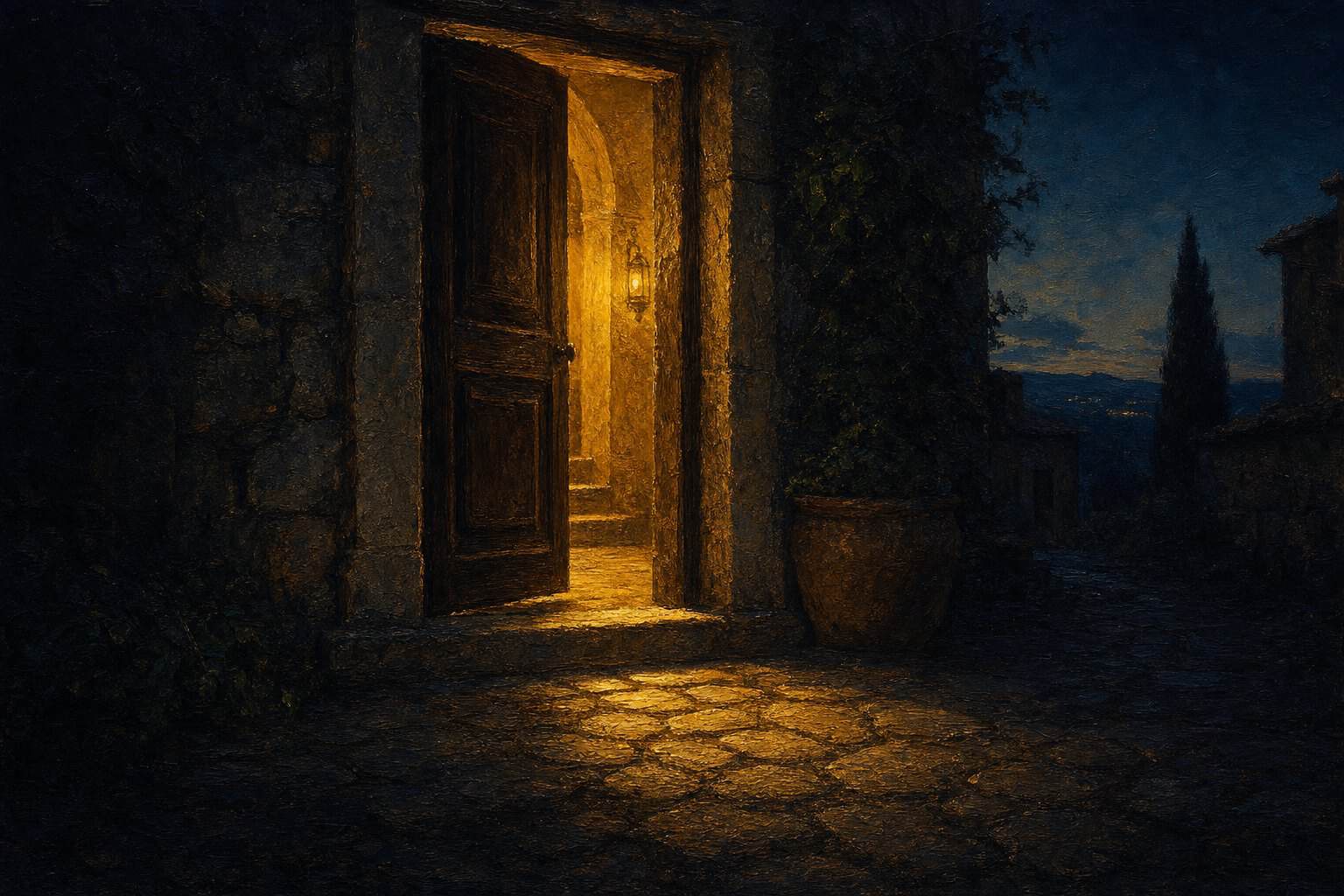
Bernd Jager teaches that to dwell is to keep a threshold, and that homecoming is never a return but a decision made where inside meets outside.
The Misty Fringe Where World Begins
Bernd Jager grounds all dwelling in the horizon, that misty fringe Husserl found surrounding every perception, and he traces its origin to the maternal face that first backs the child and calls it forth into a world. Before there is a house there is a facing; before there is a threshold there is the horizon that a face opens, an inviting beyond in which ‘what is this’ and ‘who am I’ arise together. This is the deep grammar beneath your theme of the secret self. When you say that returning home means locking your true self three hundred and fifty miles away behind memory’s closed door, you are speaking Jager’s spatial language exactly: home is not neutral geometry but a charged field of facing and backing, and to lock a self behind a door is to refuse the horizontal encounter that alone lets a self manifest.
Horizontal Dwelling And Vertical Exile
For Jager the crucial dialectic is not near and far but horizontal and vertical. The horizontal is the maternal realm of facing, of meeting between equals, of the horizon that recedes ahead of the walking body; here we dwell, because here nothing is possessed and everything can be approached. The vertical is the realm of the tower, of power and abstraction and dissolution, where the one who climbs becomes both ‘king and speck of dust,’ surveying everything and belonging to nothing. Depression, he shows, is precisely the loss of horizontal dwelling and the fall into vertical abstraction. Read this way, exile is not merely absence from a place. Exile is the collapse of facing, the moment the self stops meeting the world across a horizon and instead surveys it from a height, or plummets beneath it. The locked door of your secret self is a vertical gesture inside a horizontal need: you have climbed away from the very facing that could carry you home.
The Threshold As The Decided Place
A threshold is where inside meets outside, and Jager’s phenomenology insists that such a place is never merely a line but a lived structure carrying existential weight. To cross a threshold is to submit oneself to being seen from the other side; it is the point at which perception can become Sartre’s Look, where seeing hardens into ‘falling upon’ its object, or where seeing can instead remain facing, an encounter between two who each keep their horizon. This is why the threshold is the charged place where the self is decided. Stand at the door of the childhood home and you feel the whole corps propre become a problem to itself, ‘present-absent, embarrassing,’ the anxious body at the edge that no longer knows how to move because motor intentionality has failed. The threshold asks the one question the fallen self most fears: will you let yourself be faced, or will you lock the door and survey your old life from three hundred and fifty miles of protective height?
You do not return home; you keep a threshold open until the exiled self can be faced, backed, and received — and that receiving is what home has always meant.
Homecoming As Hospitality, Not Return
The oldest error about homecoming is that it is a journey backward, a retrieval of the intact self one left behind. Jager’s genetic phenomenology dissolves this. The horizon that first opened through the maternal face was never a possession; it was a gift of being backed so that one could face forward. Homecoming, then, cannot be reversal, because there is no fixed self waiting behind the door — there is only the ongoing question of whether facing can be resumed. This is where hospitality enters as the deep grammar of your world. Post-edenically, no one is at home in the naive sense; the self is always-already fallen, always already a stranger at its own threshold. To come home is therefore to be received, to be granted backing by another so that one can once again face. The empty chair in your Confessions to the Empty Chair is exactly this: not a judge on a tower but a horizontal field of address, a hospitality offered by the unseen listener, a threshold kept open so that confession can become facing rather than surveillance.
Writing As The Kept Threshold
What, then, does one do with a secret self locked behind memory’s door? Jager would not counsel a triumphant kicking-open, for that is only another vertical assault. He would counsel the patient, exploratory movement of the horizontal body — and writing, in your hands, is precisely such movement. To write is to let the eyes be instructed by the feet, to approach the buried self not to possess it but to face it across a page that functions as horizon. The sentence is a threshold you keep open on purpose. Here the fractured self of Fractions of the Soul can stop oscillating between grandiosity and dissolution, between king and speck of dust, and recover the Sorge of dwelling: care as tending, care as staying at the door without slamming or storming it. You cannot go back the three hundred and fifty miles to reclaim who you were. But you can, at the threshold of the sentence, offer that locked self the one thing it was denied — a face that backs it, a hospitality that lets it come forth, so that the exile becomes, not a return, but a homecoming that was never possible until now.