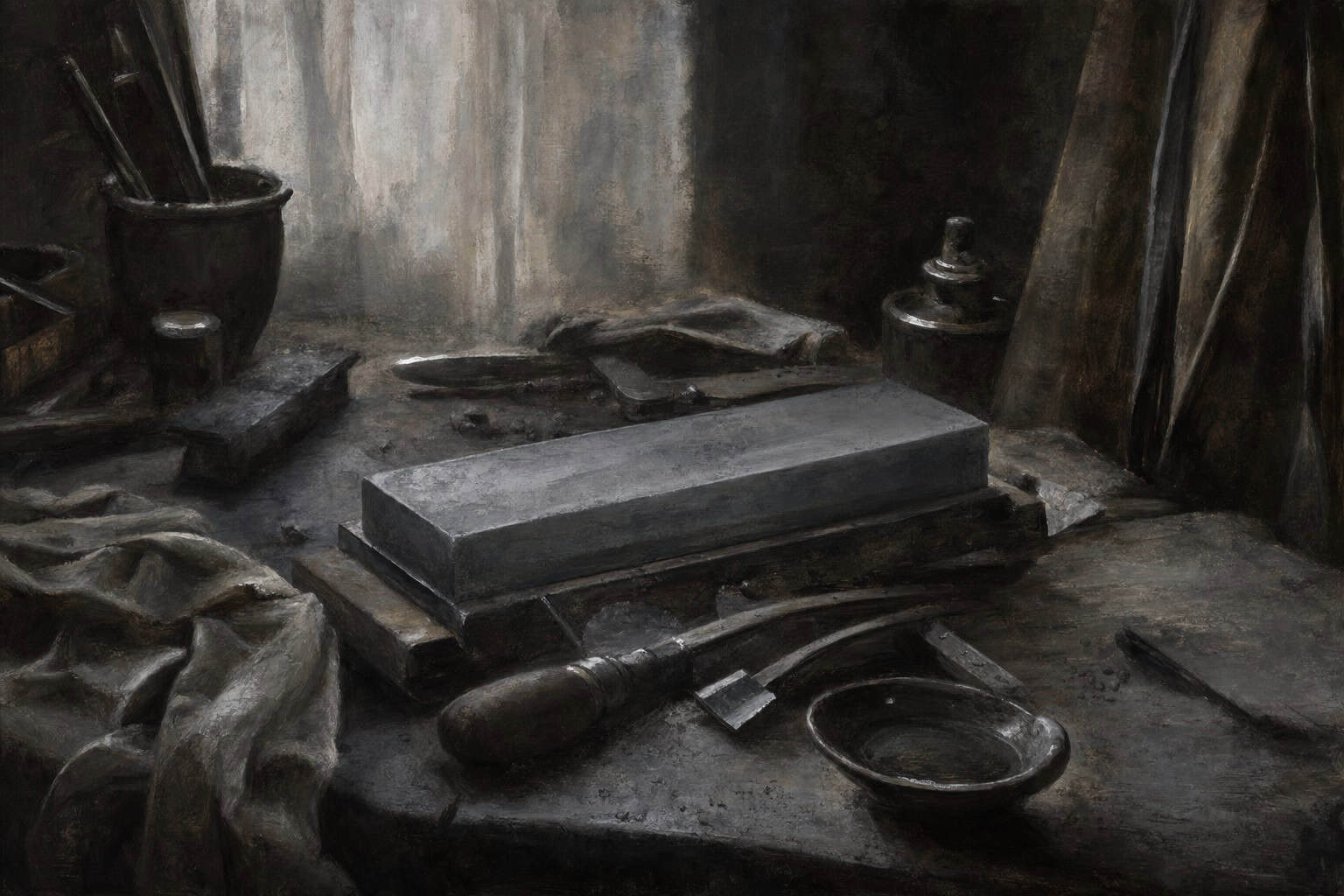
She handles every conversation as pressure and drag, and he does not yet know her rigor is a test — that they will grind against each other for warmth and stay cold.
Metal Kisses Stone and Sparks Answer
Metal kisses stone and a small spray of sparks answers back. That is how she handles conversation: not as idle talk, but as pressure, angle, steady drag. Her questions come like the slow pull of a blade along a whetstone, even across the table of a cheap restaurant or the front seat of a parked car. She watches his face as carefully as a craftswoman watches the line of steel, checking for burrs, soft spots, any sign that this is more than dressed-up ore. Where another woman might relax into flirtation, she tightens, listening for misused words, lazy assumptions, shallow certainties. This is not sport for her. It is the only way she knows to protect herself from sinking into a life yoked to a dull mind. Each joke, each biographical detail, is tested for weight. Under the polite warmth, something hard grinds on, hunting for a mind she can finally trust enough to rest inside.
The Blade That Never Gets to Rest
The quiet sorrow under her sharpness is simple: she is desperate to lay this constant testing down and lean against someone whose thought she does not need to supervise. Yet each man she meets arrives like an unsharpened kitchen knife, all promise, no edge. So she becomes tutor without wanting to, explaining basic logic in the middle of a movie, trying to coax self-examination out of a man who has never watched his own interior life. Dates turn into seminars. Pillow talk turns into lectures on cause and effect in relationships. She corrects, reframes, hands over books, suggests he try silence before speaking. At first some of them are flattered, mistaking her labor for admiration. Over time, she sees the familiar glaze in their eyes, the boredom of students forced into a class they never signed up for. Her mind stays alone, even while her body lies beside someone who calls this intimacy.
Skin Pressed Close, Minds Miles Apart
When they finally move from words to bodies, nothing in her basic posture changes. The light is low, the sheets tangled, skin damp with effort, but underneath the motions she is still alone with herself. He touches her as if following a script he learned from pictures and locker-room folklore, chasing his own release inside her body like a man running laps in a borrowed stadium. She feels his weight, his heat, the surge of his pulse, and at the same time feels him nowhere near the actual country of her. She knows this is supposed to be union, but it feels like two closed circuits brushing for a moment, then returning to their separate loops. She uses his body too, in a different way—trying to pretend the sharp hunger in her mind can be quieted by muscle and sweat. When it is over, they lie side by side, hearts slowing, each one facing the inner blank screen the other never even saw.
When we make our rigor the test every lover must pass, we grind against each other for warmth and remain, in the end, utterly alone.
Hands Learning the Same Wrong Motions
The men she tests do not arrive this way by accident. Their hands were trained in small living rooms where no one named feelings, where fathers sat in front of blue television light and mothers swallowed words. They learned that love meant not being hit, that attention came only when something broke, that wanting to be known was embarrassing. In that house, no one took their inner life seriously enough to question it. So he grows up copying the only moves he saw: ignore what you do not understand, joke when you feel cornered, change the subject when another person’s depth stirs a discomfort you cannot name. She, in turn, comes from her own unfinished school, where disappointment hardened into vigilance. Without letting anyone else sit inside their thinking long enough to point out the crooked lines, both keep repeating what raised them. They enter each other’s arms carrying their parents’ gestures, and without confession or real scrutiny, those gestures will leave through their children’s bones one day.
A Fine Dust on the Workbench
By the end of this passage, what gathers is not clarity but residue. Picture the bench after a long night of sharpening: a thin gray dust at the base of the stone, ghost of every blade that failed its test. That dust is her fatigue, his shame, the small, unnamed grief of both bodies used without their souls ever being welcomed. She grows smoother with each attempt to draw an edge out of unready metal; her once-rough standards get ground down into bitter efficiency. He leaves with faint scratches in his self-image, just enough to sting, not enough to cut through his blindness. The pattern threatens to become their whole story: she grinding, he enduring, both confusing heat for closeness while their inner lives drift further apart. The dust remains on the workbench, waiting for someone to notice it is not just waste, but a record of everything that has been worn away and never yet reckoned with.