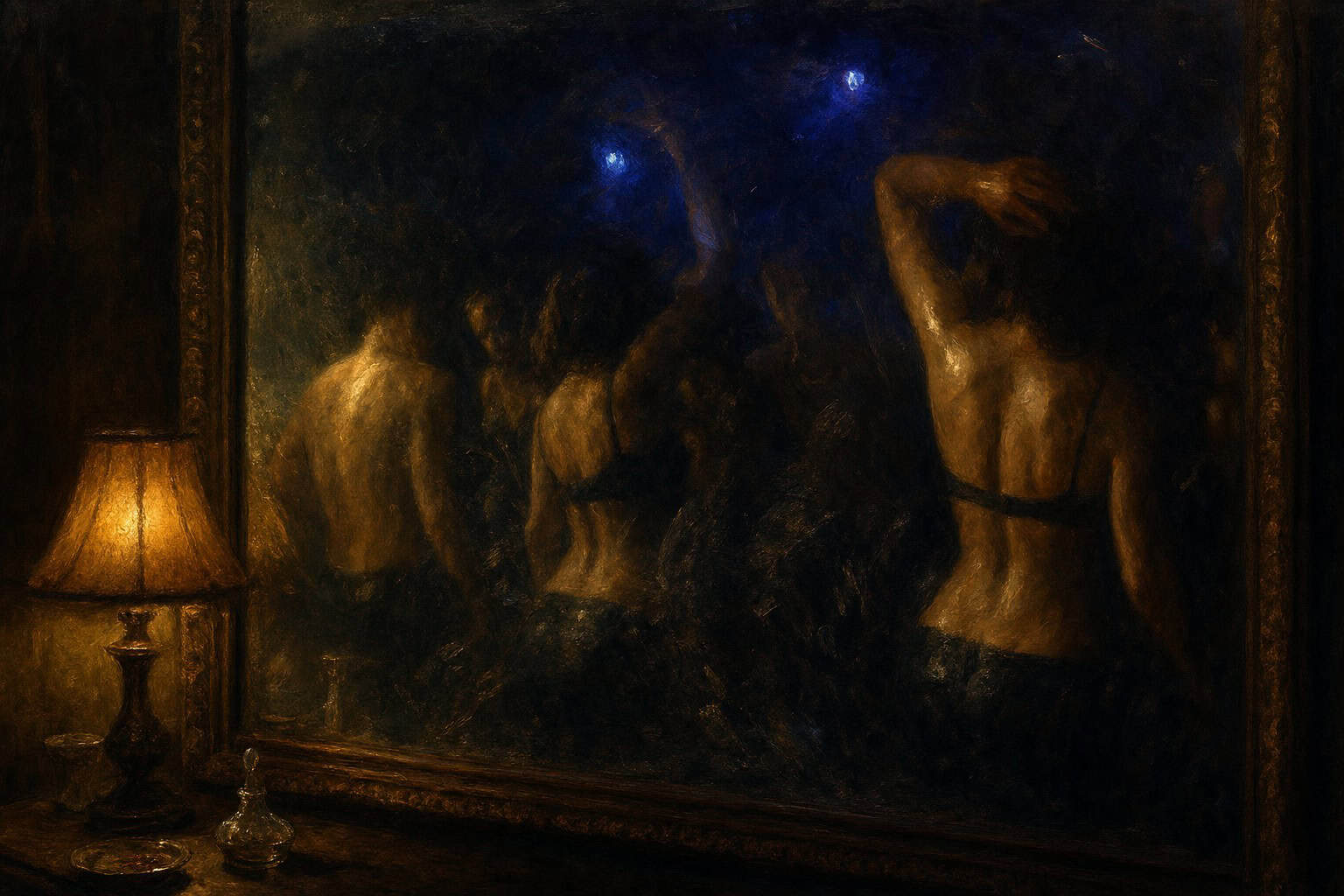
Colored lights smear across a mirror already fogged with breath, and the bodies circle it like a tide, returning again to the one station that never breaks them open.
Sweat On Glass Under Flashing Color
Colored lights sweep the club and smear themselves across a long mirror, already fogged with sweat and breath. Bodies move in front of that glass like a tide, pressing close, pulling back, always returning to the same few shapes. A young couple locks together in the crowd, their hands mapping familiar routes over hips and shoulders, their mouths pulled into the practiced curve of conquest. The bass drills through ribs and teeth, and for a moment it feels like this is the summit of being alive: sweat on skin, perfume mixing with spilled alcohol, a stranger’s body answering your own. But from a few paces back, where the mirror holds their reflections, the pattern shows itself. The movements are limited, almost choreographed: the first look, the flirt, the lean-in, the claim, the fade. Five stations traced again and again on that glass, the smudges thickening where people keep touching the same spots.
Five Moves Where Seven Should Be
The mind inside this scene begins to count. Not the drink orders or the beats per minute, but the stages each encounter runs through before collapsing back to the start. Attraction flares in a glance, then comes the approach, the little test of ego in a joke or a compliment. Validation follows when the other leans closer instead of away, and soon there is possession: mouths joined, hands gripping, bodies claiming space that will not belong to them in an hour. Then the strange quiet inside the noise—the brief emptiness when the song ends or the couple breaks apart to catch breath. Five moves, and then they scatter or repeat. The deeper steps that would demand self-risk, mutual unveiling, surrender beyond performance—those do not appear here. Desire stops at what can still be managed, still be walked back, as if something in the human core flinches at the thought of moving past this safe, hollow victory.
Counting Hearts In A Strobe-Lit Cage
Off to the side, away from the heaviest press of bodies, the narrator becomes a human tally counter. Eyes track the couple, then another, then another, watching how often the same five moves appear no matter who plays the parts. Some faces are hardened by experience, some still flushed with first-time thrill, but the choreography barely shifts. The watcher feels both inside and outside this world—aware of the tug of the music and heat, yet unable to forget the numbers stacking up. Underneath the counting runs a harsher knowledge: this is not just about youth killing time on a Friday night. It is the visible form of an inner defect, a heart that cannot move cleanly toward the good because another pulse beats inside it. Every gesture toward intimacy carries this double current—one parentage that longs for truth, another that bends the arc back toward itself. The cage is not the club; the cage is built into the blood.
We circle endlessly through the same familiar stations of desire, never reaching the one that would finally break us open and change us.
When Your Weekend Feels Like This Dance Floor
The club’s pattern is easy to dismiss until you recognize it in your own routines. The dating app turns into its own loop: swipe, match, flirt, meet, drift—then back to swipe. The job goes the same way: rush of a new role, praise, promotion, brief sense of power, then gray boredom that sends you searching for the next ladder. Even prayer can fall into this: early fervor, small consolations, a flash of perceived progress, then dryness that sends you back to distraction. The passage names this not as clumsiness but as structural limitation, a heart split at its source, carrying both God’s breath and the rebellion that twisted it. Knowing that undercuts the fantasy of self-fixing. It also shreds the excuse that these small satisfactions are neutral. Each cycle shapes you. Every time you settle for the five-count, the muscles that would reach for a sixth and seventh step grow a little weaker, a little more unsure they even exist.
Fingerprints Left On A Darkened Mirror
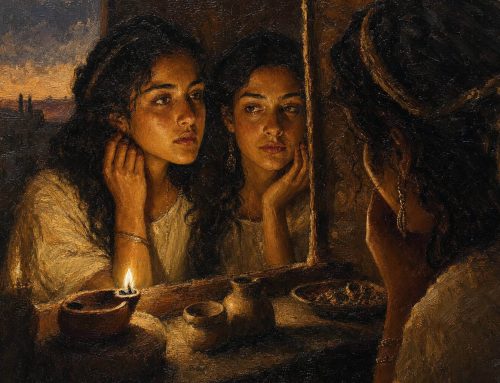
The scene does not end with a sermon or a clean escape from the club. It leaves us with that mirror, filmed with breath and fingerprints, holding the faint echoes of bodies that have already disappeared back into the night. The watcher walks away knowing the math will repeat tomorrow with new faces, that the pattern is larger than any single couple’s choices. Yet something has shifted: the cycle has been seen, counted, named as inadequate to the hunger that keeps driving people back under those lights. What to do with that knowledge remains unsettled. The heart is still split, the night still loud, the easier circuits of desire still open and ready. For now, all that stands against them is this hard awareness and the stubborn trace of those prints on the glass, proof that flesh once pressed there and could, one day, learn to reach for a different shape.