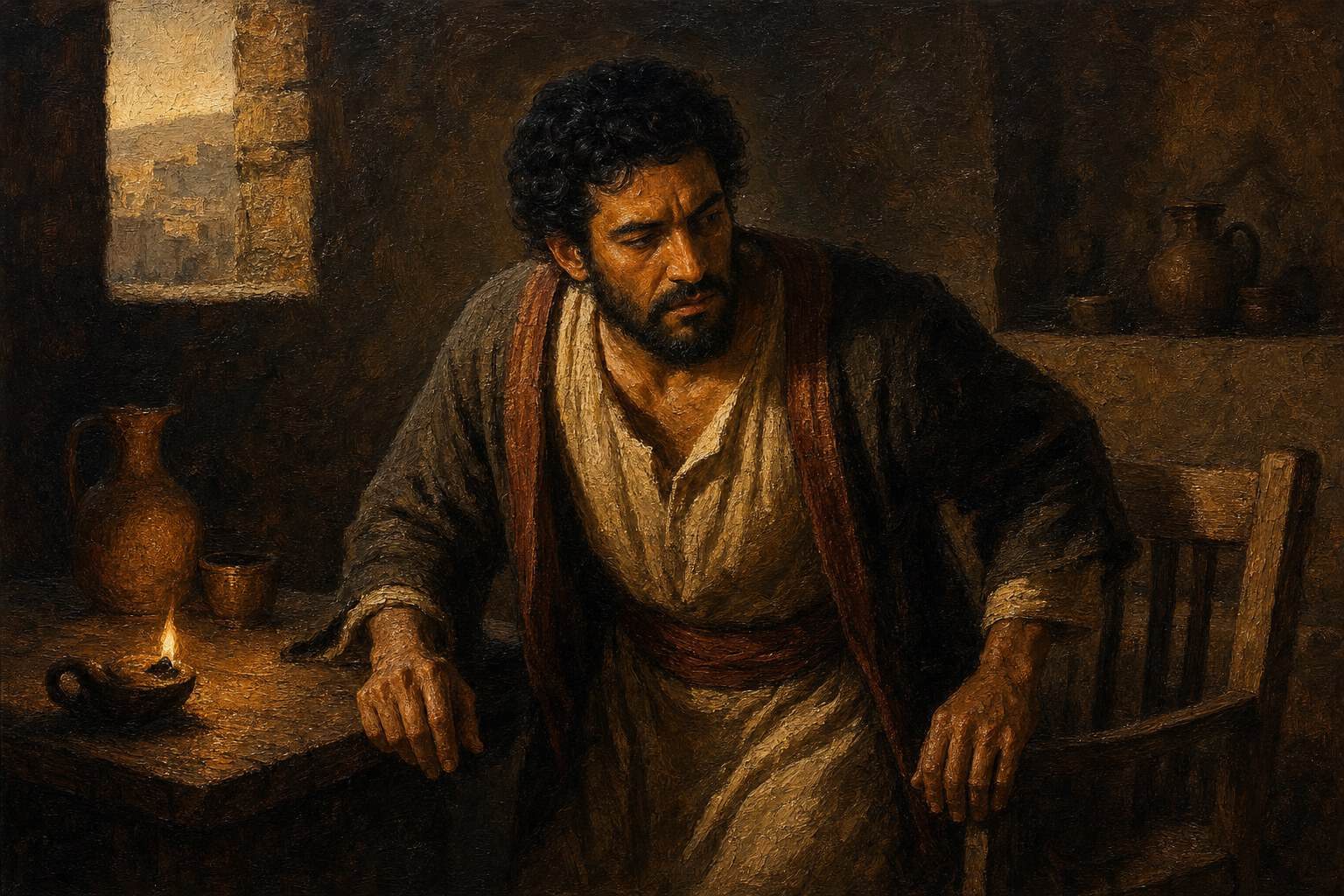
When you lock in, something in you hardens or heals. Here is what that moment really asks of you, and why it costs what it costs.
The Chair You Never Got Up From
You remember the exact chair. Maybe it was a kitchen table with a cigarette burn worn into the varnish, or a desk you leaned over long past midnight with the lamp buzzing, or the edge of a bed where you sat with your shoes still laced because taking them off would have meant staying. That was the night you told yourself this is what my life is now. You did not say it out loud. You said it in your shoulders, in the slow way you stopped reaching for the phone, for the door, for the person across the room. Something in you sat down that night and refused to get back up. That is what it feels like to lock in — not a decision with any fanfare, no signature, no witness, just a quiet settling, the body agreeing to a shape it will hold for years without ever renewing the agreement. You told yourself you were being realistic. You called it strength. You called it acceptance. You called it, on the better nights, maturity. But some low part of you knew you were also laying something down and walking away from it. The mind loves a clean story, and the cleanest story is the one that ends the arguing, so you locked the door on hope because hope had cost you too much the last time you let it in. You cannot now remember the last time you wanted something without flinching first, without bracing for the strike that taught you wanting is dangerous. And now you sit here, years downstream, wondering why nothing moves. The same faces cycle back wearing new clothes. The job changes its name and keeps its weight. The prayers go up and seem to hit a low ceiling and slide back down onto your chest. You press your eye to one small opening in the wall and you call what you can see through it the whole world. That table you sat down at — you never actually left it. You built the rest of your life around that one chair, arranged the rooms of your days so you would never have to stand. And the strange grief of it is that the settling felt like peace at the time. It felt like finally knowing your place, finally stopping the fight that was tearing you. But knowing your place and burying yourself alive can wear the same steady face for a long while before you learn, in the aching gut, how to tell them apart. So we begin here, at the remembered table, because the real question is not what you decided that night. It is what decided in you — and whether it was fear, wearing the mask of wisdom well enough to fool even the man who put it on.
The Tiredness You Kept Calling Rest
There is a particular tiredness that comes from holding still. Not the honest ache of labor, when the muscles have earned their soreness, but the low grinding hum of an engine idling all night with the brake jammed down. You feel it in your jaw the second you wake, already tight, already set against the day. You feel it in your hands, which are always slightly curled even when there is nothing to hold. You feel it at three in the afternoon as a flatness behind the eyes, a gray coming down over things that should have color. When you locked in, you were certain you were choosing rest. The fight was over. You had made your treaty with disappointment and now you would lie in the bed you had accepted. What you could not see was that refusal takes as much strength as reaching — more, maybe, because refusal has to fight against your own life pressing up from underneath, wanting out. Something in you still wants. That is the cruelty of it, the part that will not let you settle into the numbness you bargained for. The wanting does not die when you lock the door on it; it goes quiet and starts pushing at the walls, patient and constant, all night. You call that pressure anxiety. You call it restlessness, a bad temperament, a chemical you can name and treat. You scroll past it, drink it down, work through it. But it is the longing itself — the part of you built to move toward something, straining against the exact position you froze it in. And here is the harder thing the older self begins to see with sick clarity: the wound was never only what was done to you back then. The wound became the way you looked at everything afterward — through the same cracked pane, from the same defended crouch, gathering proof again and again that you were small, that the door was too heavy for any hands, that reaching only ever ends in being struck. You built a whole grim theology out of one bad year. You made a permanent house out of a shelter meant for one storm. And you called it humility, this lying low, this expecting nothing. But real humility knows its place and still stands upright before God; what you have been calling humility is closer to a man pressed face-down on the floor because he is terrified of how high the ceiling is. The tension gathers right here, in the gap between the rest you announced to yourself and the exhaustion you actually live inside every hour. You are worn to the bone by a thing you keep insisting is peace. And somewhere beneath the fatigue lies a question you have not dared to say plainly: what if the stillness was never obedience at all? What if it was fear, dressed so carefully that even you stopped being able to see under the cloth?
The Blade That Turns Out to Be Kindness
Then comes the turn, and it does not arrive as comfort. It arrives as a cut. There is a moment — you may already have had it, standing at the sink, or halfway through a sentence you have said a thousand times — when you can no longer pretend the life you are living was simply handed to you. The people who hurt you are years back now, some of them dead, some of them changed, some of them barely thinking of you at all. The circumstances have shifted more than once. And still the pattern holds its exact shape, because you are the one holding it, closing your fingers around it every single morning. This is the revelation that changes the weather inside the chest: what stays unchanged in your life is what you are choosing, this hour, to keep. Not what was done to you long ago. What you preserve now, with your own hands, on purpose, while telling yourself you have no choice. That knowledge does not feel like freedom when it lands. It feels like a blade going in. It cuts away the story you have leaned your whole weight on — the one where you are only the thing that was done to, never the one who kept the door shut afterward. And here is where the strange grace hides, unwelcome and real: the God who meets you does not only comfort you. He prunes. He cuts. Not from cruelty but because a love that never cuts anything away is not love at all; it is sentiment, a soft warm thing that leaves you exactly as broken as it found you and calls that acceptance. The severity is the tenderness. To be worth the pruning is to be seen as something that could still grow, still bear. The blade in the hand means He has not written you off, has not walked away from the dry branch. So the moment you truly lock in — not back into the old crouch but into the plain truth of your own responsibility — feels less like resolve and far more like being disciplined by something that loves you enough to hurt you toward life. You are the clay, and you have been fighting the hands the entire time, calling the pressure of them pain, calling the slow shaping an attack, an invasion, a wound freshly opened. And now, cut open at last, you see the hands were never the enemy standing over you. The enemy was your own grip on the shape you already were, your refusal to become anything you had not already been.
The day you stop blaming the wound is the day the life you keep living becomes the life you are choosing.
That one line is the blade and the mercy at once. It will not let you keep the alibi you have carried so long it feels like your own name. But it hands back the single thing the alibi stole from you in the taking: the power to move.
The day you stop blaming the wound is the day the life you keep living becomes the life you are choosing.
The Wilderness With Your Name On It
After the cut there is a strange and lonely quiet, the kind that rings. You cannot go back to the old story now; you have seen your own hands on the wheel, and you cannot unsee them. And yet the ache does not vanish — this is the part no one warns you about, the part that sends men crawling back toward the chair. You expected that once you took the weight of responsibility onto yourself, relief would come flooding in like morning through an east window. Instead you get the harder gift: a clear-eyed grief, the slow mourning of every year you spent at that table swearing to yourself you had no choice, no say, no hand in it. You feel the exile of it sharply now, in the body — cast out from the self you used to be, unable to walk back into the comfortable smallness that at least had walls, and not yet arrived anywhere you could call home. This is the middle country, the wilderness with no fixed address, no name on the map. You are separated from the man who could blame, and you have not yet become the man who can build. The past still presses in from behind. You still hear the old voice most mornings — lock the door, sit down, do not reach, it only ends in being struck — and some days you obey it out of pure worn habit before you are even awake enough to choose otherwise. And the future presses in from the front, wanting you to move, to want, to risk the blow again, and you are so tired you could weep at the asking. The honest thing to say is that responsibility does not feel like power at the start. It feels like weight in the arms. It feels like being handed the full bill for a life you had assumed someone else was quietly paying all along. But something has shifted underneath that weight, quietly, without any announcement. The God who cut you is still in the room. He did not open the wound and step out. He is there in the tears at the low hours, walking beside you inside the very thing you are most ashamed of — not lifting you clear of the dark but sitting down in it with you, close, His shoulder near yours in the dirt. That is the accompaniment you never asked for and did not expect: not rescue, not a repaired life delivered whole overnight, just Presence, near and patient, in the mess of a man learning to stand upright for the first time in years. And you begin to suspect that this raw, unfinished, aching middle is not the failure of the road. It is the road itself. It is what growth actually costs, felt from the inside, long before any of it starts to look like healing to anyone watching.
Further Up Into a Life Not Yet Lived
Where does it settle? Not into arrival — that is the last illusion left to fall, and it falls hardest. There is no day when the lessons stop, when the pruning is finished, when you sit back knowing all there is to know and rest at last on a completed self. They do not stop. And this is not a threat held over you; it is a promise made to you. There is always further up and further in, always another layer of the false and frightened self to lay down in the dirt, another outgrown shape you have clung to out of nothing but familiarity. And here is the thing that turns the long grief slowly toward something you could almost call joy: you are capable of more now than you were at that burned kitchen table. The student who could not bear the blade at the beginning can bear it now, and stranger still, can want it, can come to trust the hand that holds it steady over him. The burden was never more than you could carry. You only believed it was, and so you left it on the floor and never once bent to lift it. What changes when you truly lock in is not that the life ahead turns easy. It is that you stop mistaking the small opening in the wall for the whole width of the sky. You get up from the chair — you actually feel the wood scrape back — and you find, for the first time in longer than you can measure, that the door was never too heavy after all. It was your own hands, the whole time, leaning their weight against it, keeping it shut, calling the effort defeat. The exile does not end in a homecoming you can mark on any map or point to for the people who doubted you. It ends, if it ends at all, in learning to walk with the One who walks the wilderness at your side, so that even the wandering has company, even the ache carries a witness who does not look away. This is the country of a man who has stopped explaining his stuck life and started, unsteadily, to live the unstuck one — wound and grief and all of it. If any of this has found the raw place in you — the settling you called peace, the tiredness you called rest, the story you are finally worn out enough to stop telling — then you already sense there is more here than a page can hold. Fractions of the Soul was written from inside this exact grinding, by a man who sat at that table far too long and one day, aching, got up. It offers no easy exit out the back. It offers you company on the hard, honest way through, which turns out to be the only kind of help that has ever actually moved anyone an inch.