How do you deal with failure that cuts to the root? A slow, honest reflection on grinding the soul back to an edge when everything says quit.
The Blade That Would Not Take an Edge
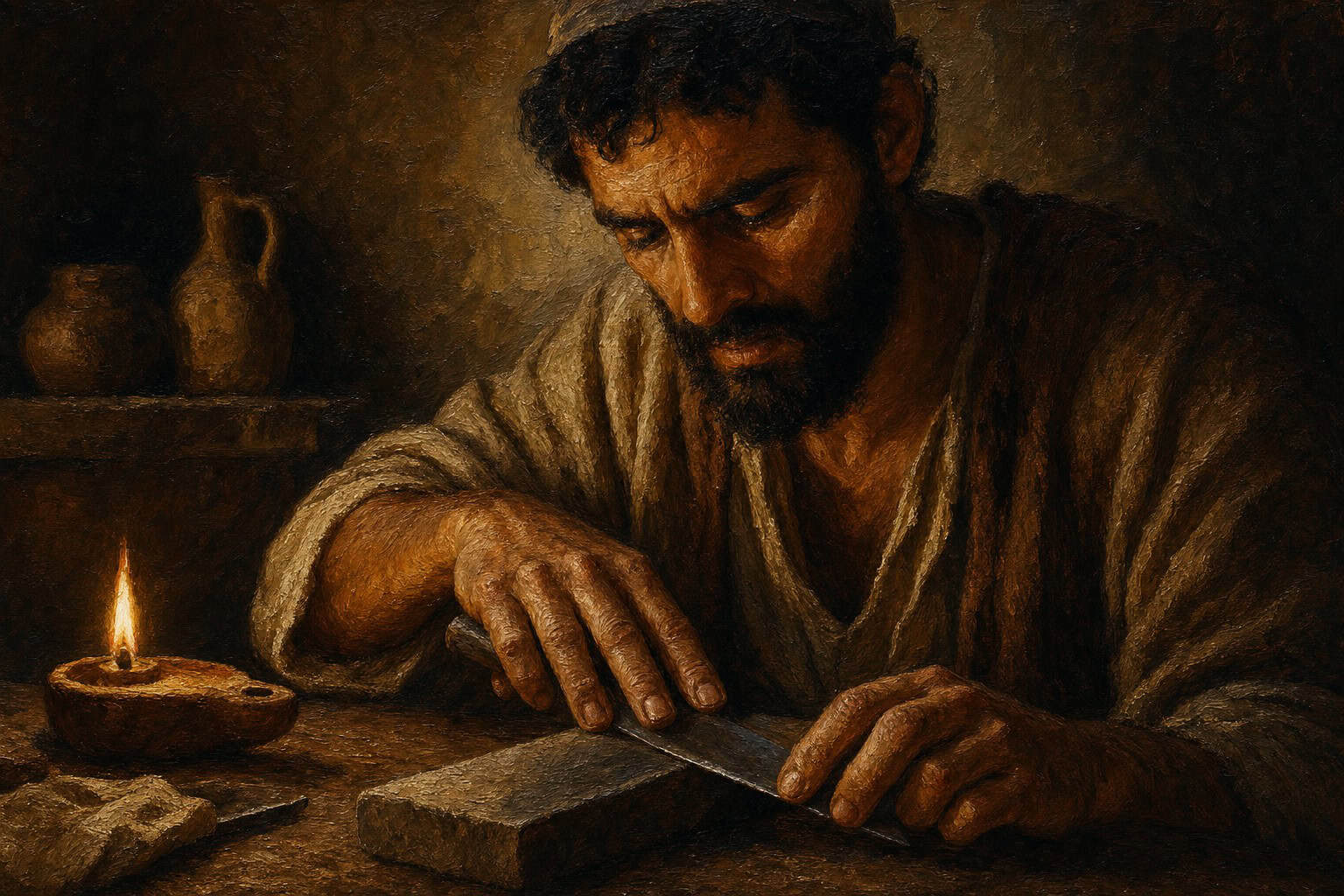
How do you keep going after you have failed at the one thing you were sure you were made for? I ask it now, older, with the scene behind me like a room I have walked out of but never fully left. There was a master and an apprentice, and there was a task that did not get finished. That is the plain fact of it, and I have learned not to soften plain facts. When I first sat with this passage from the sixth chapter, I thought it was about betrayal, about a student who walked away with what looked like ease. But the longer I stayed, the more I saw that the real subject was not the leaving. It was the blade itself, my own spirit, and the terrible discovery that it would not hold an edge. I had imagined healing as a single stroke. Something is wrong, you name it, you cut it out, you are whole. That is a boy’s idea of surgery. The truth I met here was slower and less merciful. There was a dullness in me, a limitation the writer names as a cancer without flinching, and it did not yield to one decision. I remember the physical feeling of it, the way a failure sits in the chest like something swallowed wrong, a hard cold shape that will not go down and will not come up. You cannot simply will it out. You grind. You take the edge along the stone and it lets out a thin metal complaint, and you do it again, and again, and the first hundred passes show you almost nothing. Your wrist aches. Grit gathers grey in the water. Nothing gleams. This is where the master’s doubt begins, and it is honest doubt, not the theatrical kind. If the one closest to him could turn and go, what was all the work for? I know that question in my own body. I have felt the futility of it in my hands and behind my eyes, the sense that everything circles and returns and leaves no mark, that the sea takes every river and is never filled. And yet the scene does not let me stay in that easy despair. It holds me at the stone. It keeps my hand there when my mind has already quit. It insists that the not-yet-sharp thing is still worth the hand’s return, that the dullness is not a verdict but an assignment. That is where I have to start, because it is where I actually was, kneeling over metal that would not shine, refusing to believe the work was still going on beneath my noticing.
Doubting the Eye That Chose Him
What frightened me most, reading it again, was not the failed task but what the failure did to the one who had chosen. The master begins to doubt the very perceptiveness that let him see promise in the first place. If I could not perceive that this would fall apart, was I ever as clear-eyed as I believed? That question has teeth. It does not attack the outcome; it attacks the faculty, the instrument, the self that judges and trusts and selects. When you fail at something that mattered, the wound does not stay in the thing done. It travels backward and poisons the choosing, the giving, the loving. It makes you suspect every moment you thought you saw truly. I recognize the man in this passage because I have been him, sitting in the dark going back over every early sign, asking whether I had ever read another soul correctly at all. I have looked at a relationship I gave myself to and thought: if I was wrong about this, I am wrong about everything, and my insights should die with me and stay unspoken. There is a cold logic in that despair, and I will not pretend it is stupid. It is precise, almost surgical. It says: your words failed to reach the one who sat beside you, who heard your voice, who knew your smallest gestures and the rhythm of how you breathed. So they will surely fail with strangers who know none of it. The reach becomes suspect. Every future offering feels like a coin dropped down a well so deep you never hear it strike water. And here the shortness of it all presses in. There is only so much time. A generation goes, a generation comes. You feel the sun rise and set over the same tired ground, the wind turning south and then north and then south again, going nowhere with great effort. I have stood at the edge of that weariness. I have wanted to forsake the world that turned its back, to keep my insights sealed in me like something too fragile and too costly to be spent on people who would drop it. But I notice, now, something I could not see then. The doubt about my own perceiving was itself a kind of blindness. I was so busy grieving the faculty that I could not see the faculty still working, still perceiving, still aching toward the person who had gone. The very pain that told me I had failed was proof I had loved with an open eye. A scalpel does not doubt itself for finding the cancer. It doubts itself only when it forgets that finding was the whole purpose of the cut. I forgot that for a long time. I am still learning, slowly, how to remember it.
The Cut That Loves While It Wounds
The turn came when I stopped asking how to avoid the pain and started asking what the pain was for. The passage names a spiritual scalpel and a whetstone in almost the same breath, and I used to read those as two separate tools for two separate jobs, one to hurt and one to help. Now I see they are one motion, one hand. The scalpel cuts what must go; the stone shapes what remains. Both take time. Both take a delicate hand that knows the difference between force and ruin. And here is the thing that undid my whole earlier despair: the hand that cuts is the same hand that heals. It is not two people, one who wounds you and one who mends you afterward. It is one presence, patient enough to hurt you slowly because a fast cut would take too much, would carry away good metal with the bad. I had wanted rescue. I had wanted to be lifted clean out of the failure the way you want to be hauled out of cold black water before your legs give. That is not what I was given. What I was given was company inside the failure, a hand that stayed on the stone with mine, pressing when I had no strength to press, grinding when I had already let go. This is the plainest truth I found in the whole chapter, and I will say it without ornament.
A soul is not saved by one clean cut but by the long patience of a hand that keeps returning to the wound.
I did not want that answer. It asks too much of a tired man. It refuses to let failure be either a verdict or an accident; it makes failure into material, the very metal that has to be worked. The apprentice’s leaving did not disprove the master’s vision. It exposed how much refining was still owed, how far from finished the blade had always been. And God, in this scene, is not the one who reverses the leaving or hands back a shining, completed blade to prove the point. He is the delicate hand. He is the quiet in the room where the metal shrieks against the stone. He walks with the man in the exact hour of the man’s uselessness, when no bold action is left, when all that remains is to hold the dull edge down and believe the sharpness is coming though nothing yet shows on the surface. That is not comfort in the soft sense. It is something harder and truer than comfort. It is a presence that does not require you to be finished before it will stay in the room with you.
A soul is not saved by one clean cut but by the long patience of a hand that keeps returning to the wound.
What the Grinding Leaves Behind
After the turn, the despair does not vanish, and I want to be honest about that, because the scene is honest about it. The weariness of the old preacher’s voice is still there in the chapter, still saying everything is futile, still counting the circling wind and the sea that never fills and the memory that fades from every generation. Grace did not delete those lines. It sat down beside them and let them keep speaking. What changed for me was not the amount of pain but what I understood the pain to be doing. Before, a failure felt like the end of a sentence, the period after which nothing follows. Now it feels like a comma, a hard pause in a work still underway. The falling action of my own life after this scene was not triumphant. There was no restored relationship, no vindication, no proof pressed into my hands that my words had reached anyone at all. There was only the daily return to the stone, the small refinements no one witnessed, the slow removal of the dullness that had cost me so much. I learned to distrust my hunger for a clean ending. I had wanted the failure to resolve into a tidy lesson I could frame and set on a shelf and stop feeling. But a soul under refinement does not resolve. It keeps being worked, hour after unremarkable hour. The apprentice who left became, in memory, less a betrayer and more a mirror held up too close to my face. What did he show me about myself that I did not want to see? That I had loved partly to be received, that my offering had a small hook buried in it, that some of my grief was wounded pride wearing the borrowed clothes of loss. Those are not comfortable admissions to make out loud. But the delicate hand does not spare us our real faults; it spares us only the lie that the faults are the whole of us. I began to see that the person who left had his own dullness too, his own limits I could not cut for him however much I wanted to bend over his soul and do it myself. That was its own kind of death, letting him go unrefined by my hand, watching the incomplete thing walk out the door. I had to bury the fantasy that I could ever finish another soul. And in burying it I found, strangely, that I could finally turn to my own. The failure freed me to it. That is the falling action I actually lived: not repair, not reunion, but a narrower and more honest labor, the only one still left in my hands to do.
The Hunger That Outlasts the Loss
Where it settles, at last, is in a longing I no longer try to satisfy too quickly. I used to think the ache after failure was a wound to be closed as fast as possible, stitched and forgotten. Now I think it is a compass, a needle swinging toward something real. The reach that outran its object, the love that gave far more than it ever got back, was not a mistake to be corrected. It was a rehearsal for something larger. I was reaching for a wholeness I could name but could not hold, and no apprentice, no reader, no single human face was ever going to fill the size of that reach. The shortness of my own life taught me this by pressing on me from every side at once. There is not enough time to finish everyone I love. There is not enough time to finish myself before the water runs out of the light. The sun sets whether the blade is sharp or not, and the wind keeps turning. And yet the whole of a life, I have come to believe, is a preparation for a journey that begins where the grinding finally ends. The old feel this most keenly, worn thin, ready to depart, tired of the circling wind but not bitter about it, only ground down to a strange and quiet readiness. I am closer to that readiness than I was when the apprentice left me at the stone. The failure I once thought would silence me forever is the reason I still write at all. If my words could not reach the one who knew me best, then they were never mine to guarantee in the first place. I offer them now and let them go, the way the delicate hand offers the cut and does not demand the wound be grateful for it. There is a bread the chapter keeps circling back toward, a food that promises to outlast death, and I understand now that all my hungers were pointing there the whole time, past every object they seized and could not keep. This is why Fractions of the Soul will not leave you where it found you. It refuses the tidy consolation and refuses the tidy despair with equal severity, and it holds you instead in the slow, faithful work of being made sharp again after loss has dulled you. It does not promise the leaving will be undone. It promises a hand on the stone beside yours. And it lets you feel, in your own chest, that the grinding you dreaded was the healing all along, arriving so slowly you mistook it for punishment. That mistake, I think, is the most human thing I have ever confessed.