You want peace, but the closeness keeps repeating and going flat. Here is why bodies alone exhaust themselves, and where quiet finally comes.
The Bed Grown Cold at Its Own Warmth
Why does the closeness keep going flat? You lie there afterward, the sheets still warm, another body breathing beside you, and something in your chest is already tired. You have done this before. Not with this person, maybe, but the shape is the same, the motions are the same, and some cold clerk inside you is keeping count. There is nothing new here, the clerk says, and he is not entirely wrong. The horizontal life has a horizon, and you have walked all the way to it and found a wall. What you wanted was to be less alone; what you got was a rehearsal of an old play with fresh actors and the same tired ending. The satisfaction the five senses can carry has a ceiling, and you keep knocking your head against it in the dark, softly, over and over, like a moth against glass. You reach for hair, for skin, for the warmth of an arm laid across you, and you get exactly that and no more, and the no more is the part that aches long after the warmth is gone. It is not that the flesh lied to you. The flesh kept every promise it ever made; the trouble is you asked it to keep a promise it never made at all. You wanted meaning and it gave you sensation, and sensation, however sweet, spends itself and leaves the room quiet again, the way a struck bell keeps ringing softer until you cannot tell the sound from the silence. So you get up, or you do not get up, and the ceiling is still there, and the tired clerk closes his ledger with a small dry sound. You are not wicked for feeling this. You are finite, and you have run into your own edge, and the edge is real and it is close. The body keeps a strange sum: pleasure repeated is pleasure worn thin, and repetition without ascent is a slow erosion, grain by grain, until the shore you stood on is somewhere out in the water. You can feel yourself thinning, spread wide across many closenesses and deep in none of them. Peace was supposed to arrive with being held. But being held, you have learned, is not the same as being known, and being known is not the same as being met somewhere higher than the mattress you are lying on. The warmth cooled while you were still inside it. And you begin to suspect, with a fear you cannot quite name, that the loneliness you were fleeing followed you into every bed, patient as a shadow along the wall, waiting for the heat to fade so it could sit up beside you again and rest its cold weight against your spine.
The Turtle That Learned to Live Indoors
So you built a room no one can enter, and you have lived in it a long time. Maybe you were the strange child once, the one whose thoughts ran too fast and too far for the noise of the playground, the one who stood at the edge and learned to read faces before he could trust words. Somewhere early you understood that your inner life was too odd for the room you were standing in, and you did the sensible thing: you moved inside. You built a world in there where the variables obeyed you, where the chaos of other people could not reach, where good things did not arrive only to be snatched back the moment you let yourself want them. You called it discipline. You called it clarity of thought, the exactness of a mind that will not be muddied. You told yourself that feelings were inconsistent, fleeting, always ending in the same pit, and you were not wrong to have seen people wrecked by their own undisciplined appetites, undone by wanting what they could not hold. But look closely at the walls you built. Run your hand along them. They are not made of strength. They are made of scar tissue. Each brick is a rejection you survived, a hand that let go of yours, a silence where you cried out as a child and expected an answer and got nothing back but the sound of your own breathing. You pulled your head inside the shell not because you were cold but because the world proved too cruel to a soul as tender as yours, and the shell was the only mercy anyone offered. Here is the thing you have hidden even from yourself, buried so deep you almost believe it is gone: the volcano. Under all that logic, under the neat control of a mind that would rather think an embrace than risk one, there sleeps a longing for tenderness so large it frightens you. That is exactly why the discipline has to be so rigid, so total, so tireless. You are not managing indifference. You are managing an abyss, and you know to the inch how much it wants, and you do not dare let it speak, because if it spoke once it might not stop. So you deal instead with a copy of the world, a version you drew yourself, smaller and safer and dead on the page. You would rather be misunderstood than exposed. But peace does not live in the copy. Peace needs a real thing to lean against, warm and unpredictable and out of your control, and you have spent your whole life making certain nothing real could get close enough to hold you. You are safe. You are also alone in a room of your own careful making, growing older by the hour, and the shell that once saved the child has begun, quietly, to close over the man like a lid.
The Straight Line Between Two That Runs Out of Country
Then comes the discovery you never wanted, and it arrives from the one place you thought was safe. You believed that if you could only find the right person, the closeness would finally hold, the ceiling would lift, the shadow would go home. So you poured everything into the straight line between the two of you, the exchange of bodies and words and needs, back and forth, back and forth, until the line itself wore smooth and then wore thin and then wore through. And still it exhausted itself, still the ceiling was there. Two people staring straight across at each other run out of country. There is only so much of you to give and only so much of another to take in, and when the whole exchange runs flat along the ground, the returns shrink no matter how hard or how honestly you love. This is the hard thing to swallow, and it is not a defeat of love but a truth buried inside it: closeness that has nowhere to climb turns slowly into a prison, and the bars are made of your own two faces, held too near, memorized past all surprise. You have looked at that beloved face until it stopped meaning anything, the way a word repeated aloud dissolves into mere sound. The way out is not another person and not some cleverer technique of intimacy. The way out is up. Two souls only stay close when they are both reaching past each other toward a third point higher than either one, when the line between them is not the whole map but one side of a triangle whose highest corner is beyond them both, up where neither can reach alone. Then the space between two people stops shrinking and begins, astonishingly, to widen again, fed from somewhere above the bed, somewhere the flat ground never touched. This is the labor you avoided your whole life, because it asks you to want what you cannot control, to submit to a height you cannot climb by discipline alone. And that is the terror in it, is it not, that the only exit from the prison of two faces requires you to loosen the very grip that kept you safe, to hand yourself over to a country you cannot survey in advance, to trust that the ground will hold when you cannot see the bottom of it. You have never once in your life let go of the rope like that. But the rope, you are beginning to see, is what keeps you dangling just short of the floor.
Two people staring straight across at each other run out of country; only when both look up does the ground between them grow wide again.
Grace That Sits in the Dark and Does Not Turn On the Light
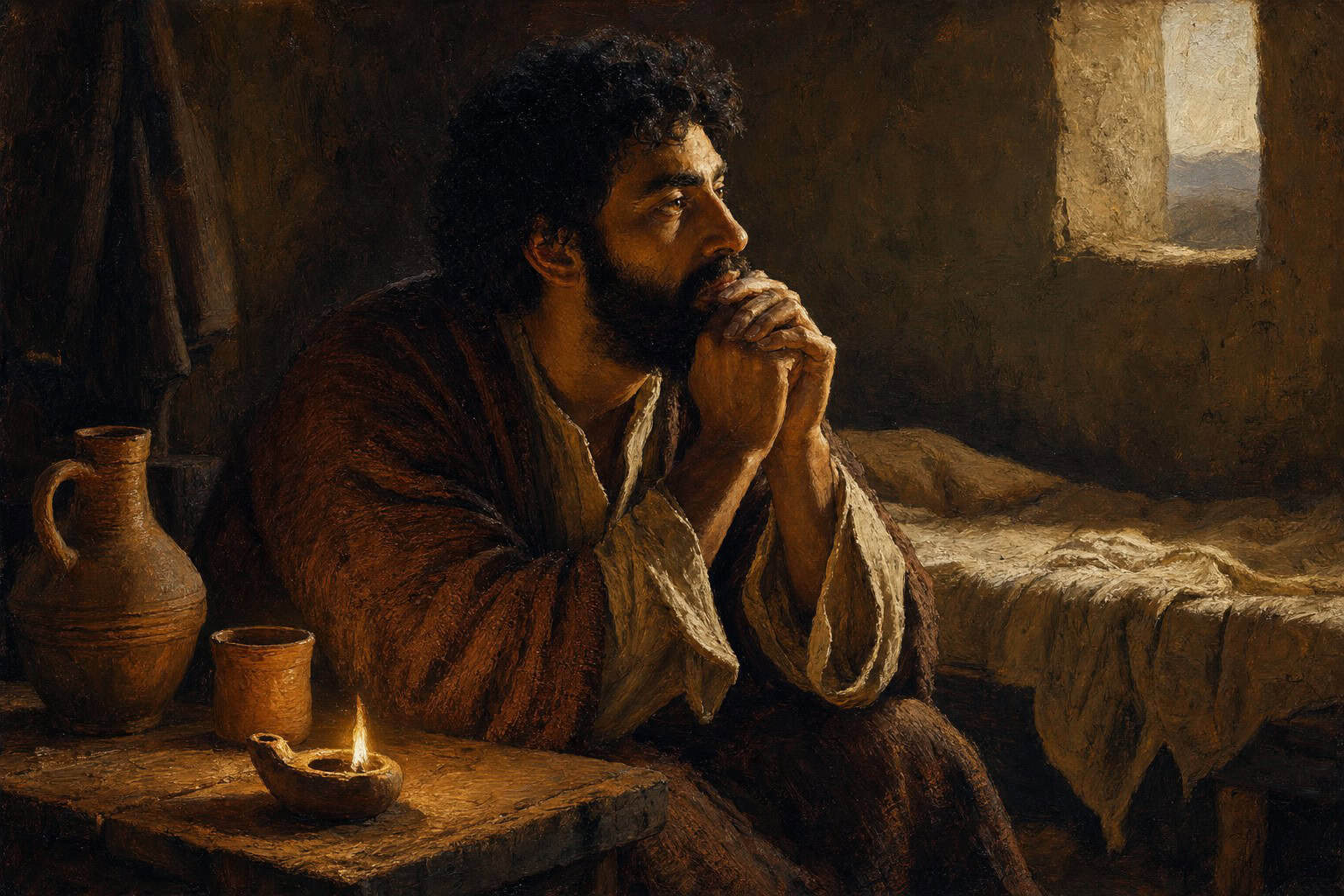
So the reaching begins, at last, and it does not feel like rescue. You go looking for the higher thing and find, at first, only a desert, the very solitude you spent your whole life fleeing. The noise falls away. The distractions you used to scatter yourself among go quiet, one by one, and you are left with the thing the shell was built to spare you: the silence of your own company, unbroken, unbought, with no body warm beside you to blur its edges. Here is where the easy promises break apart. No warm flood comes. No sudden certainty lifts the ache out of your chest and sets you down gently in green pastures. You sit in the dark, and the dark stays dark, and the clock on the wall keeps its small steady sound. But something shifts, and it is not the darkness. It is that you are no longer alone inside it. There is a nearness you cannot prove and cannot manufacture, a presence that does not switch on the light but sits down beside you in the unlit room, patient, unhurried, closer than the loneliness ever managed to get. This is not the miracle you demanded as a child, when your desperate plea met a deafening silence and something cracked in your chest and you learned, far too young, that crying out was pointless and dangerous both. That silence was real. You did not invent it, and no one should tell you that you did. But the silence, it turns out, was not the whole of the story; it was only the antechamber, the cold hall before the room. God, if you are honest, does not seem to speak in the clamor of the crowd or in the warm tangle of another body. He speaks, when He speaks at all, in the desert, quietly, to the soul that has finally stopped stuffing every empty hour with company. And even then He rarely takes the pain away. He walks inside it with you. He is present in the tears themselves, not in their drying. This is not the comfort you asked for. It is stranger and slower and, if you can bear it, far deeper: not a hand that hauls you up out of the pit, but a companion who climbs down into it and simply stays, breathing beside you in the dark that will not lift. The tenderness you buried, the one so large it frightened you into building walls, it turns out it was never too much after all. It was only aimed at the wrong horizon. It was built for the vertical and it kept dying on the flat ground because flat ground has no way to receive a longing that size. You were not too needy. You were made for more than any bed was ever built to hold.
The Shell Cracks Open From the Inside
Where does this leave you, then, at the end of the long repetition, tired of the horizontal, half-afraid of the desert you have finally walked into? It leaves you softer than you have let yourself be in years. The self you were taught to despise, the strange child who felt too much and hid it under logic, the one who mistook the shell for strength and wore it like armor, that self can finally be pitied now instead of scorned. You did what you had to do to survive. The walls were mercy before they became a lid. But you are not that endangered child anymore, and the fortress that once guarded a tender heart has become the very thing starving it, thinning it, keeping it hungry in the dark. Peace does not come from tearing the walls down in one heroic afternoon; that is just another feat of discipline, another thing you would do alone. It comes from letting a single crack open and refusing to seal it, from admitting out loud that you were never built to be self-sufficient, that the longing for a gentle hand smoothing your hair was not weakness but the truest thing in you, a homesickness for the higher country you were made to climb toward. And you are finite. You will not have endless time to learn this. The bodies age, the closeness fades, the ledger of repeated pleasures closes for good one day without asking, and somewhere ahead a last silence waits for everyone alive. That nearness of the end is not a threat here. It is a clarifier, a cold clean light. It burns off the lie that one more warm night could ever do what only the vertical can do. So you stop asking the flesh to be God. You let the buried tenderness turn its face upward at last. You sit in the dark that does not lift and discover you are accompanied there, and that accompaniment, not the erasing of the ache but the steady presence within it, is where a peace no repetition can wear thin quietly begins. This is the country Anthony Adoré walks through in Fractions of the Soul: not a tidy healing, but a man learning, late and without flinching, that the closeness he chased along the ground was always aimed at heaven, and that the loneliness he ran from was, in the end, the narrow way he had to walk through to be found at all. The peace you are looking for is real. It simply does not live where you keep looking for it.