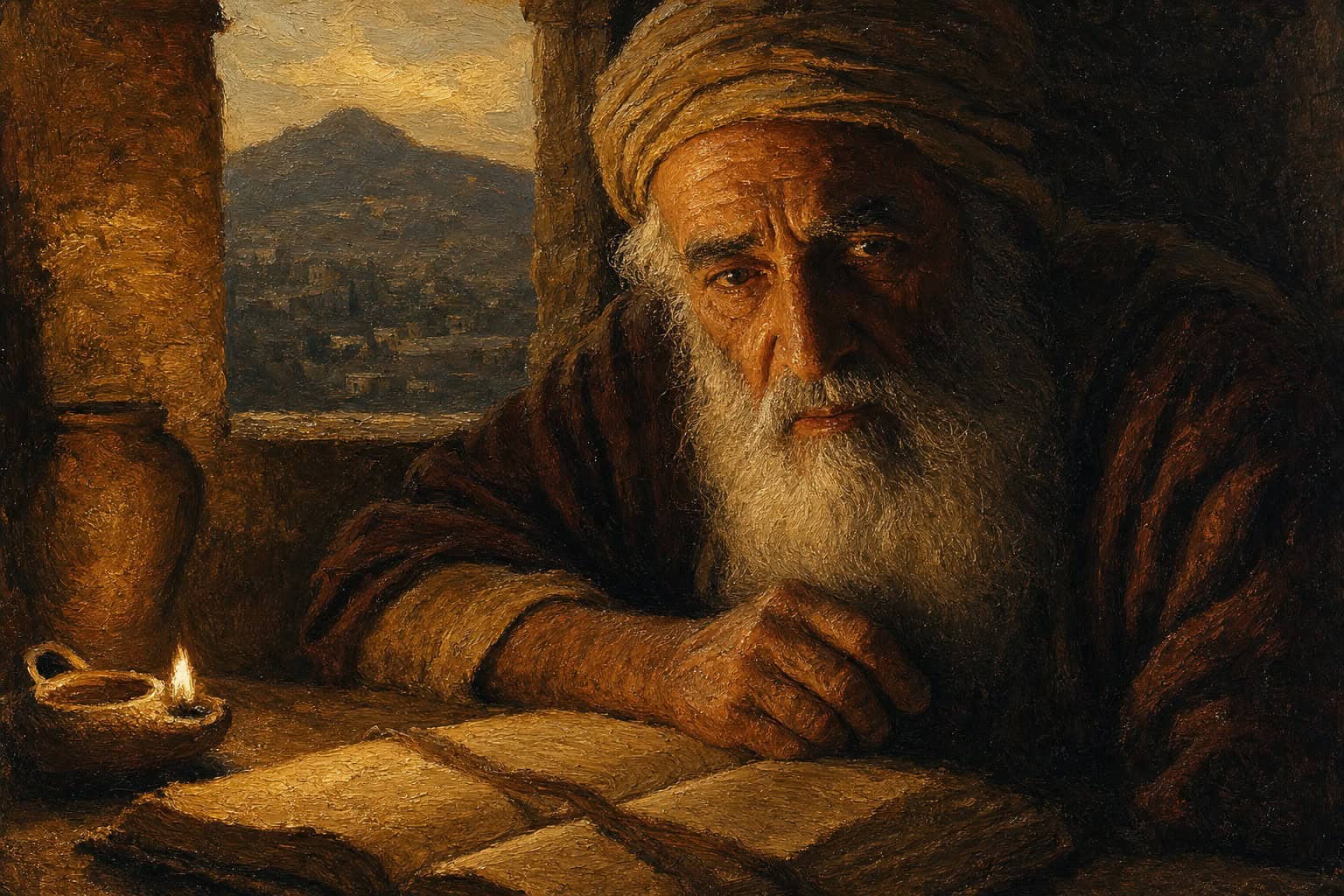
Living a double life psychology, read through desire: why we split love into flesh and spirit, and what the divided self is really hiding.
The Ledger He Kept Behind His Eyes
He was doing arithmetic on desire, and he knew it. In Fractions of the Soul the narrator lays out his ideal woman the way a careful man lays out a plan, one who feeds the body and one who feeds the mind, both at once, in equal measure. He speaks of anatomy first, the plain accidents of flesh, and grants that for the blunt reproductive mandate one woman is as good as the next. Then he pivots to the mind and the spirit, where he says the real loneliness lives. You can feel the cold precision in it, the way a man counts coins in the dark so no one hears the clink. This is the first face of the double life, the one that measures and sorts and prices. It presents itself as wisdom. It calls itself discipline. But underneath the ledger there is a man who cannot sit still with his own longing, so he turns it into a formula he can control. That is what a double life often is at its root, not two women or two beds, but two selves, one that feels and one that manages the feeling. The managing self writes the rules. The feeling self breaks them and pretends it did not. He knows this about himself, or he half knows it, which is worse. He confesses that if you seal emotion under a lid the pressure builds until the lid flies off and makes a mess. So he gives it a voice, he says, he disciplines it with reason, and even calls the writing of the book itself a way of draining the pressure off. But look at how much reason is doing here. Reason is the second face, the composed one, the one that meets the world in daylight with clean hands. And the raw hunger, the ache for a woman who could hold both his body and his soul at the same time, gets kept in the back room where the accounts are settled. He is not lying to anyone yet. He is only dividing himself, quietly, into the man who wants and the man who explains the wanting away. The dividing feels like safety. It feels like maturity, even like humility, the sober acceptance of what a man can and cannot have. But it is a wound learning to call itself a virtue. That division is where every double life begins, long before there is anything to hide, long before there is a second phone or a second address, in the ordinary quiet of a man deciding which half of himself he will let out of the house.
The Needle Against the Mountain
Watch what he does with feeling, because this is the engine of the whole split. He prefers reason, he tells us, over the frothy and slobbery force of raw emotion. He would rather think a thing than be flooded by it. Yet even as he says this, he admits emotion is a mountain and reason only a needle, and the needle must somehow pierce the mountain. That is a devastating confession dressed up as a preference. A man who truly trusted his reason would not need to picture it as a thin sliver of steel against a mass that dwarfs it. He builds the cold self precisely because the warm self terrifies him. This is the second movement of the double life, where the two selves stop merely coexisting and start defending against each other across a shared border. The reasoning man patrols the fence line. He decides what the feeling man is allowed to want out loud. He turns desire into categories, flesh in one column and spirit in another, so that he never has to face the whole undivided storm of wanting one person entirely, body and soul, without a plan. Here the tension sharpens, because his hunger is real and it will not be catalogued away. The skin knows before the mind names it. His body has already leaned toward a certain kind of touch, already decided whether it scans a woman for excitement or for shelter, long before his careful mind assigns her to a column and totals the sum. He craves the union of flesh and spirit not as a theory but as a felt absence, an emptiness that changes the way he moves through his own days, the way an empty house changes how you walk through its rooms. When touch is impossible the whole world tilts on its axis. That craving is not something he chose off a menu. It is something he suffers, the way you suffer weather, standing out in it whether you consent or not. So the double life here is not yet cynical. It is a wounded man trying to survive his own depth by cutting it clean in half. He keeps the ledger so the mountain cannot bury him. But the mountain is still there, and he knows it, and every neat category he builds is a small wall thrown up against a flood he cannot admit he fears. The pity of it is that he is bright enough to see the walls for what they are and not yet brave enough, in that hour, to let them fall and be drowned into something whole.
The Woman Who Was Never a Column
Then comes the turn, and it turns on the woman he is measuring. He wants one who excites both the evolutionary pull of the body and the lasting architecture of the mind, and he complains that most women build enough intellect to seduce or control a man but never enough to chase wisdom for its own sake, that they stay at his level or just below it and never draw him higher. It is a hard sentence, and honesty requires that we sit inside it rather than rush past it in a hurry to condemn. There is a real longing under the complaint, the longing to be met, to be sharpened by another soul rather than merely serviced or managed or endured. But there is also the whole rotten foundation of the double life exposed in a single line. He is asking a woman to do inside him what he refuses to do for himself. He wants her to reconcile the flesh and the spirit that he has split into separate rooms and locked. He wants her to be the bridge across a chasm he dug with his own hands. And no woman can be that, because she is not a column in his ledger or an answer to his math. She is another person, lived from the inside, with her own hungers, her own fear of being priced and found wanting, her own weather moving across her face while he tallies her worth. A woman’s love, he half senses, can be absorptive, wanting more of his attention, more of his thoughts, drawing him in until his careful borders blur and dissolve, and that very pull frightens the ledger-keeper more than any argument ever could. When he grades women by how well they feed both his appetites, he is not really seeing them at all. He is seeing his own division reflected back and calling the reflection their failure. This is the sharpest thing he almost admits and cannot quite say. The double life is not first a betrayal of another person. It is a betrayal of yourself, split so long you forget which face was ever the real one, until the woman across the table becomes a mirror you resent for showing you the crack running down the middle of your own soul.
We build two rooms inside ourselves and call it survival, but the man who lives in both is present in neither.
What the Grading Cost Him
After a turn like that, the room does not clear. He is left holding his own instruments, the scientific one in one hand and the spiritual one in the other, each showing a different territory of truth, neither able to make him whole. He says a man must choose a narrative, any narrative, to make sense of the world at all, that we are either spirits inside biology, or biology inside the divine, or bare chemistry building meaning on the long road to death. It sounds like philosophy delivered from a lectern. It is really a man standing at the edge of his own divided self, trying to decide which half he can bear to trust. And this is the fallout of every double life, the slow exhaustion of keeping two accounts that will never once balance. The flesh depreciates daily, he knows this, he can feel it in the mirror, and he is trying to trade its declining value for something that lasts, gambling his fading body against a woman’s promise of lasting worth, and the whole transaction leaves him poorer than when he sat down. What he wanted was communion. What he built was a marketplace with two exchange rates. The tragedy is not that he is wrong about flesh and spirit both mattering. He is right about that, painfully right. The tragedy is that he tried to solve inside another person the war he would not let God come near. He kept the divided self so long that even his longing came out sorted, catalogued, cooled to the temperature of a shopkeeper. Grace does not arrive here to sweep the mess away. That is the terrible mercy of this chapter. God does not swoop into the cold room and dissolve the split or set the perfect woman on the doorstep who reconciles all things at last. Instead there is only the quiet sense that God is present even in the counting, even in the arithmetic, walking beside a man who cannot yet weep and does not yet know he is being walked beside. That is the harder gift, presence without rescue, company kept inside the sin rather than deliverance handed down out of it. The narrator does not get comfort in this hour. He gets accompaniment, which is closer and stranger and far more relentless, and which refuses, no matter how he sorts and prices and totals, to leave him alone with his ledger.
The Undivided Thing He Cannot Buy
What settles at the end is not an answer but a hunger finally named for what it is. The double life promises safety, two rooms so that no single loss can level the whole house, and it delivers only a man present in neither one. You cannot love with half a self and expect the whole of another to come running. The narrator’s search for a mate who excites both flesh and spirit is really the buried ache to stop choosing between the two selves he has kept apart, to be one person again, whole enough to be met without flinching. And that wholeness, when it finally begins to dawn on him, is not something a woman can hand over like a key across a table. It is something the soul must let God reassemble, slowly, in the dark, with no guarantee the pain will lift on any timetable he would choose. The body still wants what it wants. The spirit still reaches past what it can hold. Death still pulls at both of them, and no clever narrative he selects makes that pull one ounce lighter. But there is a difference between a man managing his loneliness with tidy categories and a man who has begun to grieve his own division honestly, and that difference is the whole distance this book travels on foot. Fractions of the Soul does not offer the reader a formula for the ideal partner or a cure for the split self. It offers something rarer and more unsettling, a man dismantling his own defenses in slow motion, catching himself in the very act of pricing love and flinching hard at what he sees in his own hands. If you have ever lived divided, one self for the world and one kept for the dark, one that feels and one that explains the feeling away before it can spill, you will know the exhaustion in these pages and the strange relief of watching someone finally set the ledger face-down on the table. The wanting does not end when he does that. It only, at last, stops pretending to be arithmetic. And what waits on the far side of that honesty is not a woman who completes him and closes the account. It is a God who was already sitting in the cold room the whole time, patient, waiting for him to lift his head and notice he was never as alone as the two faces made him feel.