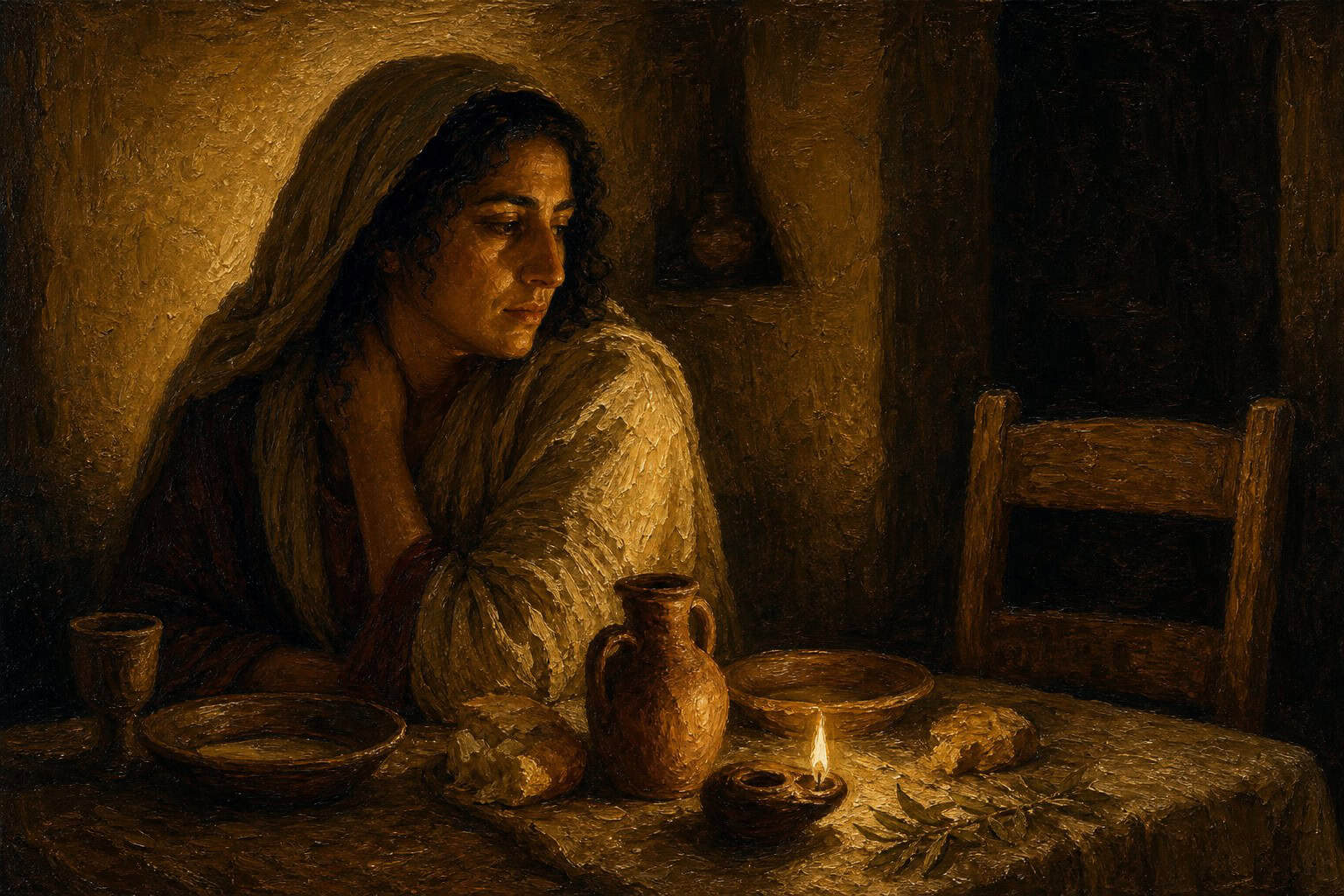
How to deal with a lying spouse when you feel like you’re funding a love you never receive. A reflection on betrayal, longing, and honesty.
The Banquet Set With Another Man’s Harvest
You feel it before you can name it. You bring home the money, the tenderness, the long patience, and you set it on the table of the marriage, and something is wrong with the meal. The food is there. The candle is lit. The plates are warm under your hands. But the flavor belongs to someone else. In the second chapter of Fractions of the Soul there is a portrait of a woman who takes the fruit grown in one man’s field and carries it to another man’s plate, and the man at that plate never planted a seed. He merely existed. He did nothing but be alive, and she prepared the feast of herself for him anyway. That is the ache you carry when you suspect a spouse is lying: not the plain fact of a lie, but the sense that your labor is being harvested and served at a table you will never sit at. You gave your body, your hours, your trust. You gave the small daily surrenders no one else saw. You lie awake counting what you spent, the numbers running behind your eyes like a bill you cannot pay. The bed still holds two people, but only one of them knows the true ledger. She fans a flame in one room and cools it in another with the same steady hand. She keeps a man close by calling him a friend, close enough to draw from, never close enough to let him see the whole shape of things. You are learning, slowly and against your will, that a marriage can be full of activity and empty of return. The gifts move outward. The affection you pour out does not come back in equal measure, and the imbalance does not announce itself. It hides inside ordinary evenings. And the terror is not only that she may have lied about where she was on some particular night. The terror is that the entire structure of your days may have been feeding a hunger that was never yours to satisfy. You start to reread every meal you ever cooked her. The kindness. The excuse that arrived a beat too smoothly, too rehearsed, too clean. What was real? What was staged for you and paid for by you? A thoughtful person does not want to think this way about the one they married. It feels like a sin against love itself to suspect the beloved of accounting. But the suspicion did not come from nowhere. It rose up from the body, which knew before the mind would let the words form. The flesh keeps a longer memory than the calendar, and it had been keeping score in the dark.
The Friend Who Is Kept but Never Chosen
There is a particular cruelty in the word friend when it becomes a leash. In the passage from that chapter, some men are paraded as a best friend, held near, made to work harder for affection, while others are quietly exempted from every rule she enforces. She defines the rules. She defines the exceptions to the rules. She decides who chases and who is chased, who obeys and who is forgiven before he even asks. This is where the lie stops being a single event on a single night and becomes a whole climate you breathe without noticing. A lying spouse is rarely lying about one thing one time. More often there is a hierarchy nobody drew on paper, a spectrum of access where each person is assigned a rank he cannot see and would not survive seeing. You may be the one paraded, shown off, called the beloved in daylight. You may be the one kept in the dark corner and told he is precious there, precious and hidden at once. Either way, you are inside an economy you never agreed to join, and the currency being spent is your own devotion. What makes the longing so severe is that the body wants union, real union, the kind where tenderness and desire meet in the same motion without greed in it. Desire that reaches for a whole person and not a harvested part, not an arm or a mouth alone but the living totality of another soul. When that union is withheld and only its performance is handed to you, the flesh senses the counterfeit even when the mind cannot prove it. You reach for your spouse in the dark and something in you registers a stranger, in the same bed, after years of the same body beside you. The older, reflecting voice in the memoir turns all of this back on itself and asks the harder question. Did I keep the arrangement going because part of me preferred the performance to the truth? Did I mistake being ranked above other men for being loved by her? A man wants desperately to be the one for whom the rules bend, and he can be flattered into a long silence by his own high placement. That is the trap closing. The hierarchy works on you precisely because it lets you feel chosen, singled out, spared. You do not want full disclosure, because full disclosure would fix your place on the spectrum, and your place might humiliate you in front of your own eyes. So you keep from asking. You look away from the small evidence. You collaborate in the fog because the fog is warm. This is the part of loving a liar that no one confesses easily: sometimes we ration our own questions because the answers would cost us the comfortable story we are still eating. The suspicion is real. So is the temptation to stay half-blind and keep the seat at the table a little longer.
When the Deceit Turns Out to Be a Wound
Here is the turn, and it does not comfort so much as it deepens the whole ache. The person who lies to you may not be lying out of simple appetite. The portrait in this chapter keeps the woman from ever arriving all at once, from showing up whole in a single room, and the reason is not only greed for more men and more resources. She fragments herself because being seen entirely, in one place, at one time, might undo her. With one man the promise of friendship is real. With another the draining, one-way pull is real. Alone, the raw terror underneath both is real. She lives each of these as its own small, temporary whole because arriving complete would let the annihilation in. The manipulation is real. The unseen hierarchy is real. The way she smuggles the harvest of one relationship to the table of another is real and it cost you. And beneath all of it may sit an old, primal fear of being left the instant she is fully known. This does not excuse the lie. It does not soften the harm done to the man who kept planting fields he never got to eat from. But it changes what you are actually fighting. You thought you were fighting a rival, or a bad habit, or a flaw in her character. You may be fighting a dread that predates you by decades, a dread she was handed long before your name. The one who takes, the memoir quietly suggests, was first someone from whom everything was taken. Two things become true in the same breath, and you have to hold both without dropping either. You are genuinely wronged. She is genuinely wounded. Collapse this into one truth and you lie to yourself as surely as she lied to you. Say only that she is hurt and you erase your own suffering, then call the erasure mercy and feel holy about it. Say only that she is cruel and you build a monster where a frightened person is standing, and you lose the last chance to actually see her. The reflecting narrator sits inside this tension and refuses to resolve it cheaply, refuses the relief of a verdict. He asks what he refused to see for so long. Did he love a real woman, or only the one warm compartment she let him into? Was the tenderness she gave him counterfeit all along, or was it the single true thing she could not keep alive once the other rooms began to press in on it? He does not get a clean answer to hand you. Neither will you. Loving someone who lies is partly the slow grief of never fully knowing which of the two of you was, in the end, the more afraid.
The cruelest deceit is not the other bed but the quiet accounting that spends your sacrifice on someone else’s table.
The Slow Sorting Done at Three in the Morning
After the turn comes the long fallout, and it is not dramatic. It is a quiet sorting done in the dark, hour after hour, while the house sleeps around you. You go back over the years and try to separate the real from the staged, the given from the performed. This is the hardest labor of all, because a lie folded into truth is worse than a pure lie. Some of the tenderness was real. Some of the desire was real, you are sure of it, you felt it in your own skin. The problem is you can no longer tell which nights were union and which were theater, and the not-knowing bleeds backward through every memory you have. Your own body becomes suspect to you now. You touched her and believed you were fully known in that touching. Now you wonder if you were ever perceived at all, or if you were a resource wearing the face of a beloved, a field she visited only to gather. This is the ache the memoir names without flinching: to fund someone’s romance while starving for return yourself, and to grasp it only after the harvest is long gone. What do you do with it. The book does not hand you a program, and this matters. There is no tidy list of steps out of this, and any writer who sells you one is lying to you the way she did. What the reflecting voice offers instead is plain honesty about the choices in front of you, each of them heavy. You can demand the full ledger, knowing the truth may break apart whatever is left standing. You can stay in the warm fog and keep your seat, and slowly become a stranger to your own face in the mirror. You can leave, and carry the wound out through the door with you, because the wound does not stay behind in the house you walk away from. It follows you in your own chest. None of these is painless. Each one asks something more of a body that has already given past emptying. And underneath the practical question sits a deeper one that will not leave you alone. A love that produces no love in return is a misfortune, a poured-out thing that never fills the vessel back up. Your soul was made to be received, not merely spent and spent. When it is only spent, something in you thins and grows quiet. You begin to give less, not from spite but from sheer depletion, and then you catch yourself and wonder if you have gone cold, and then you are afraid that you are the one who changed, the one who failed the marriage. This is how betrayal spreads its damage past the betrayer and into the betrayed: it makes him doubt his own goodness. That doubt is the last and quietest theft, and it steals in without a sound.
The Nearness You Did Not Expect in the Dark
There is a mercy in this that does not arrive as rescue, and its refusal to rescue is part of what makes it true. God does not, in these pages, sweep in to repair the marriage or unmask the liar in one clean, satisfying scene. That is not how He tends to move here. He is found instead down inside the mess, seated at the same three-in-the-morning table, walking beside the man in his very confusion, present in the tears that fall onto a meal set for someone else’s mouth. This is the strange gift the memoir keeps pressing on you. You are not accompanied only after you have sorted everything into its right pile. You are accompanied now, in the not-knowing, in the shame of having stayed too long, in the grief of having finally gone. The very fact that you exist at all, that you can still love even while bleeding, is itself a quiet sign that you were loved into being by One who did not need you and made you anyway, purely because He wished you to be. That is the reciprocity your marriage may have failed to give you, arriving from an unexpected direction. It does not repair the marriage. It reframes the man sitting at the table. You are not merely a resource, whatever she made you feel across those years. You were wanted into existence by a love that harvests nothing, takes nothing, keeps no ledger, and only gives. Hold that true thing up beside the counterfeit and you can slowly begin to tell them apart again by the light of it. And what of her. The book will not let you keep her as a villain, and it will not let you keep her as a victim only. She stays another consciousness, lived from the inside, frightened and hungry and hiding in her separate rooms, and you will never fully step into that inside no matter how long you circle it. You can forgive without pretending you understand her. You can grieve without deciding she meant every cruelty. The reflecting narrator ends nearer to an open wound than to any resolution, and that unflinching honesty is exactly why the chapter is worth entering. It does not teach you how to fix a lying spouse, because it does not believe you can. It tells you the truth about what it costs to love someone who cannot yet bear to be fully known, and about the quiet Presence who sits with you in the dim kitchen while you decide what to do next. If you are living inside this question tonight, the rest of that chapter will not give you an answer to swallow whole. It will give you company in the dark, which is the harder and the better thing, and it will show you a man slowly learning to be seen by the one Love that never once kept an accounting against him.