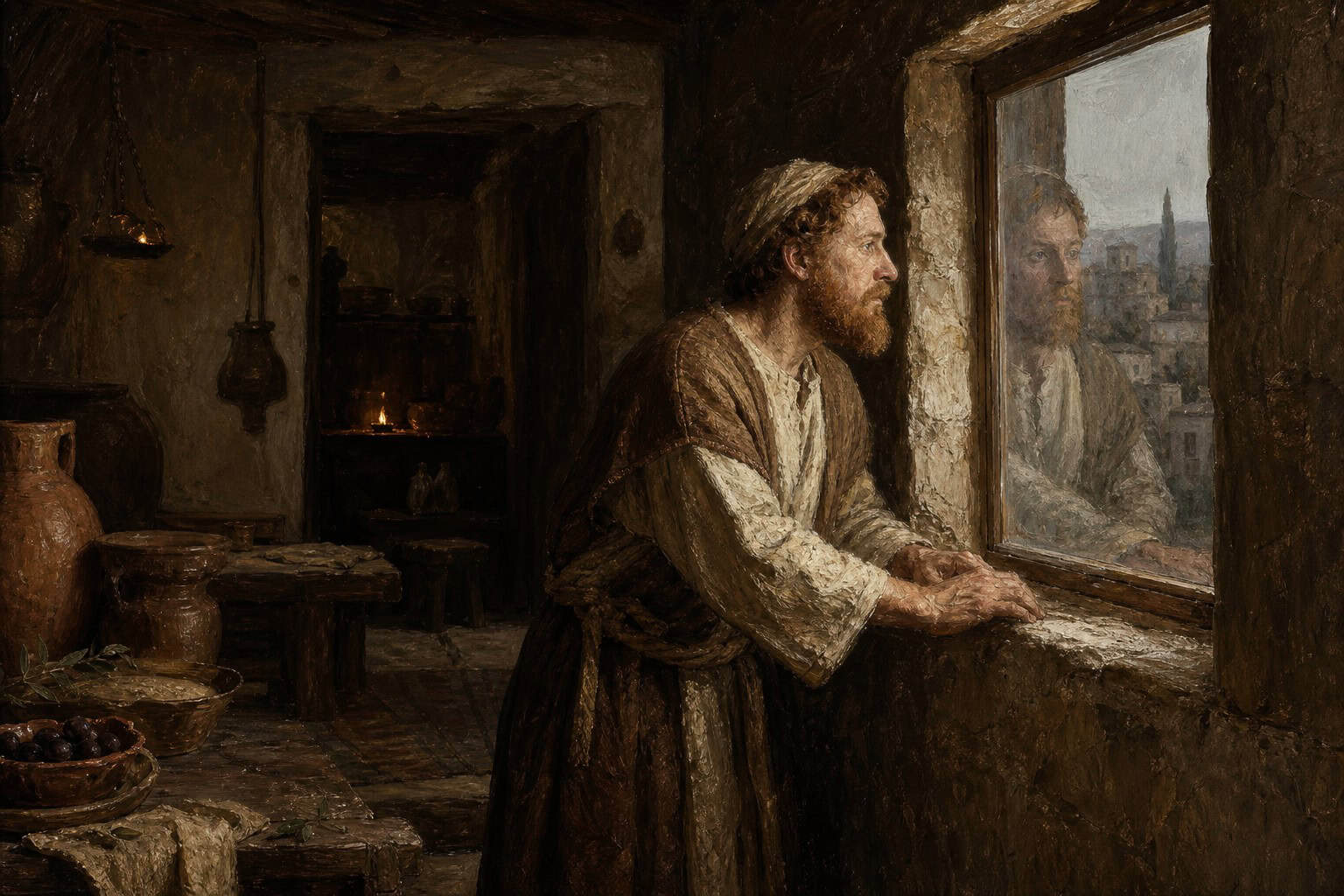
How to stop lying in a relationship: a raw, honest look at the split self, plausible deniability, and the slow work of becoming one person again.
The Small Lie You Told to Keep the Peace
You remember the first one because it was so small it barely felt like a lie. Someone asked you a plain question and you gave a smoother answer than the truth. Maybe it was where you had been. Maybe it was who had written to you, or how you really felt about the thing they were so proud of. You watched their face soften and you told yourself you had spared them. That is where it starts, at the kitchen counter with a coffee going cold in your hand, in the half-second when honesty would have cost a little discomfort and you decided you could not afford it. Nobody teaches you that this half-second is a fork in the road. You think you are managing a moment; you are actually choosing what kind of person you will be in the next thousand moments. The lie was not the danger. The danger was how good it felt to be believed for something that was not true. You learned that a well-placed word could make the room calm again, and calm felt like love, and you got hungry for it. So the next question came, and the next smoothing, and each one taught your hands a little more skill. You began to keep two ledgers without meaning to: the reasons you gave out loud, and the reasons you kept in the dark. At first the two columns sat close together. Over time they drifted, the way two boats drift when only one is tied to the dock. You did not notice the distance until you reached for something true and could not find where you had put it. There is a hunger in a small deception that nobody warns you about—the way the smooth answer buys you a little more time inside the version they already love. You start to protect that version like it is a rare thing, fragile, easily broken. Ask yourself honestly what you were protecting back then. Was it really them, their tender feelings, their peace? Or was it you, the self they thought they had married, the one you were terrified to lose? The tenderness you owe yourself begins right here, not with excuse but with plain sight. The child in you learned early that being fully known was dangerous, that some part must always be held in reserve to stay safe. You watched a face fall once and decided never again. That was a wound, not a strategy. And it is still running the kitchen, all these years later, deciding what your mouth is allowed to say and what it must swallow before the words even form.
The White Noise You Built Around Yourself
By now you have a whole architecture, and you did not draw the blueprints on purpose. It grew the way a hedge grows, one green season at a time, until it was a wall too thick to see over. There is the version of you that answers your partner’s questions across the dinner table. There is the version that lives in the phone warm in your pocket. There is the one that laughs a certain practiced way with certain people, and the quiet one that surfaces only when the house is empty and the front door has clicked shut behind them. Each has its own voice. Each has its own good reasons. You have gotten so skilled at the good reason that you can produce one before you even feel the real one stir underneath. Someone asks why you keep in touch with a person from your past and you have the answer ready, polished, harmless, mostly true. It is only an acquaintance, you say. It is nothing. And the word nothing does a strange thing in your mouth—it places a cold inch of distance between you and something that is not nothing at all. You have surrounded the one live wire with so much harmless static that no one, not even you, can find it anymore. You follow so many things, like so many things, keep so many casual threads running, that the single thread that matters vanishes into the tangle. This is the genius of the design and also its quiet horror. You built the noise to protect yourself from being seen, and it worked so well that you cannot see yourself either. Here is the tenderness the moment asks for: you did not do this because you are wicked. You did it because somewhere, long ago, you decided that the whole of you, arriving all at once, would be too much for anyone to bear, would get you left, would get you punished for the crime of being large. So you learned to arrive in pieces. Each piece could be defended. Each piece carried its own escape plan folded in its pocket. What you cannot see from inside the hedge is the cost you keep paying. A person made of defensible pieces cannot be loved, only managed, only handled, because there is no single self standing still long enough to be held. Your partner reaches for you across the bed in the dark and closes their hand on a version, a curated surface, a good reason with a heartbeat. They feel the coldness and cannot name it. And you feel it too, in the loneliest hour, when all your careful compartments are shut and locked and you sit down among them like a man in an empty house full of rooms he no longer has the keys to. The tiredness of it lives in your jaw. You clench it in your sleep.
The Body Present While the Soul Slips the Room
There is a betrayal deeper than the lie you speak aloud, and you know its exact shape because you have felt it from the inside. It happens in the moment that should be the most honest of all, when two bodies are close and every guard should have come down. And instead your mind slips out the back door. You are physically present, warm under the same blanket, doing all the right motions, and your soul is somewhere else entirely, walking with a different presence, tending a fantasy, escaping into a story you have never told and never will. The person beside you feels held. They do not know they are alone in the room with you. This is the quietest and cruelest of all the substitutions, because it happens in the very place built for total presence, and it hollows that place out from within, leaving a shell where a meeting should have been. You tell yourself the interior life is your own, that no one is harmed by what stays inside your head, that a private world is your inalienable right. And for a while the inner sanctuary feels like the one free room in a monitored house, the place where you are not performing for anyone. But the sanctuary has a way of turning into a cell. What began as the place where you kept what could not be lived openly becomes the place where the real you goes to hide, and stays, and stops coming out to answer the door. The presence you withhold does not gather somewhere safe for later spending. It simply dies, unused, unseen, like milk left out. And the terrible truth you have been circling for years is this: the lie was never mainly about the facts you concealed. The lie was the splitting itself, the decision to be more than one person so that no single person could ever be fully found and therefore fully lost.
You do not stop lying by confessing harder; you stop by refusing to be more than one person in a single skin.
What It Costs to Come Back Into the Room
So you decide, some grey morning with the light thin on the floor, to stop. And you discover that stopping is not a single act but a long unlearning, and it hurts in a way you did not expect. The first time you give the real reason instead of the good one, your throat closes. Your voice shakes on the vowels. You watch your partner’s face and every nerve in you screams to reach for the polished answer, the one that would keep the room calm and keep you safe inside the version they trust. You feel exposed in a way you have not felt since you were small, skinless, waiting to be left for the crime of being actually seen. Sometimes you fail. The old fluency is fast; the truth is slow and clumsy, and it arrives half a beat too late, after the smooth lie has already left your mouth and settled in the air between you. You will grieve those failures in the shower, replaying them. But something else happens too, something no one promised you. When you tell one true thing and survive it, a room inside you that had been shut for years fills suddenly with air. It is not relief exactly; it is closer to the ache of blood returning to an arm you had slept on wrong, painful precisely because it is coming back to life, prickling, alive. The compartments do not fall all at once. You take them down one at a time, and each one you open lets a little more of you back into the single house where a person actually lives and eats and sleeps. You begin to notice how tired you had been, holding all those versions upright, running all those good reasons at once, keeping the white noise humming so no one heard the one true sound. The tiredness had felt like your baseline, your ordinary weather. You did not know a life could weigh less. And here is where the tenderness toward your younger self does its quiet work: you stop hating the frightened one who first learned to split himself, and you begin to understand that he was only trying to stay in a world that felt certain to destroy him if it ever saw all of him at once. He was not evil. He was a child improvising survival with the only tools he had. You can thank him and tell him the danger is over now, that you will carry the risk from here, that he can lay down the two ledgers and come home to the warm kitchen. It will not be tidy. Some damage does not undo, and you will limp where you were broken. But the future that had been pressing down on you like a handed-down sentence begins to feel, faintly, like a road you can walk down as one person, in daylight, unhidden.
One Face in the Morning Light
What settles, in the end, is not triumph but a strange and quiet integrity, hard-won and unglamorous, the kind nobody applauds. You will still feel the pull of the old fluency; the good reason will still surface faster than the real one, the way a reflex outruns thought. But you will know it now for what it is, and knowing changes what you do with your hands and your mouth. Truth-telling in love turns out to be less a single heroic disclosure and more a daily posture, the plain discipline of arriving whole to small moments, of letting one thing be known before you have decided whether it is safe to be known. You learn that the goal was never to scrub yourself of every hidden thought, as if the mind could be made sterile as a clean counter. The goal was to stop building the house of many rooms in the first place, to become a single self who can be reached, who can be refused, who can be genuinely loved precisely because he is genuinely there when they turn toward him. This is costlier than any lie and cheaper by far than the exhaustion of a lifetime spent managing the static. You wake one ordinary morning, the kettle ticking, and your partner asks you something small, and you answer plainly, and the plainness does not cost you your throat this time, and you realize with something like wonder that you have not rehearsed an escape plan in weeks. You had forgotten what it felt like to have nothing to guard. The self you were taught to despise—the one too much, too needy, too visible, too loud in its wanting—turns out to have been the only self ever worth carrying into a room where someone waits for you. And the God who never once required the edited version is nearer to you in this uncomfortable honesty than He ever was in the smooth years of the double ledger, closer in the shaking voice than in the polished one. If you want to sit longer inside this reckoning, inside the anatomy of the split self and the slow mercy of becoming one person again, Fractions of the Soul is the well this was drawn from. It does not offer you a clean escape from the darkness. It offers you a companion who has walked those locked rooms himself, and the stubborn news that the light was in there with you the whole time, standing in the cold you left behind, waiting only for you to stop hiding and turn your face around.